#Product Trends
Aluminium on the Rise: How Lightweight Design, Sustainability and New Aircraft Concepts Are Changing Manufacturing
Longer flight ranges, higher efficiency requirements and sustainable production demand new solutions for automated chip handling.
Aluminium on the Rise: How Lightweight Design, Sustainability and New Aircraft Concepts Are Changing Manufacturing
Longer flight ranges, higher efficiency requirements and sustainable production demand new solutions for automated chip handling.
The aerospace industry is going through a major technological transformation. Modern aircraft must fly longer distances, use less energy and meet stricter sustainability requirements at the same time.
One of the most important factors is lightweight design. Every kilogram of weight that can be saved improves the aircraft's efficiency, increases its possible flight range and reduces energy consumption throughout its entire life cycle.
A good example of this development is the new generation of ultra-long-range aircraft. These aircraft can operate routes that previously required one or more stopovers. The Airbus A350-1000ULR was specially developed for very long-distance flights and demonstrates the importance of advanced materials, optimized designs and highly precise manufacturing processes for the future of aviation.
However, these developments do not only create new challenges for aircraft design. They also place new demands on industrial manufacturing.
To achieve maximum efficiency, components must be lighter, stronger and more cost-effective to produce.
One material continues to play a key role: aluminium.
Aluminium Remains a Key Material for Modern Lightweight Aircraft Design
Thanks to its excellent strength-to-weight ratio, corrosion resistance and very good machinability, aluminium has been one of the most important materials in aircraft manufacturing for decades.
Today, advanced high-strength aluminium alloys and aluminium-lithium alloys are becoming even more important. They make it possible to produce high-performance structural components with improved mechanical properties and help reduce the weight of modern aircraft even further.
Alongside composite materials, aluminium remains an essential part of modern aircraft structures, especially for components where high strength, precision and cost-effective manufacturing are critical.
These requirements are also changing manufacturing processes. Today, larger and more complex components are increasingly machined from solid aluminium blocks.
Machined Aluminium Components from Solid Blocks Open New Possibilities in Aircraft Manufacturing
Modern manufacturing technologies make it possible to produce highly complex components from solid aluminium blocks.
Large structural parts, frames, connecting elements and other safety-critical components are increasingly machined on advanced 5-axis machining centres.
These components offer significant advantages in terms of lower weight, higher strength and better functional integration.
Precise machining creates components that are perfectly adapted to their mechanical loads while reducing overall weight. Another advantage is the ability to produce complex geometries and integrate multiple functions directly into a single component.
However, this manufacturing process also has one important consequence: large amounts of material must be removed during machining.
A highly optimized lightweight component is produced from a solid aluminium block, while the removed material becomes aluminium chips.
These chips are not waste. They are a valuable raw material that should be collected efficiently and returned to the recycling process.
Aluminium Chips Are Becoming a Strategic Production Factor
Machining large aluminium components produces significant amounts of chips. Depending on the size of the component, modern aerospace production lines can generate several hundred tonnes of aluminium chips every year.
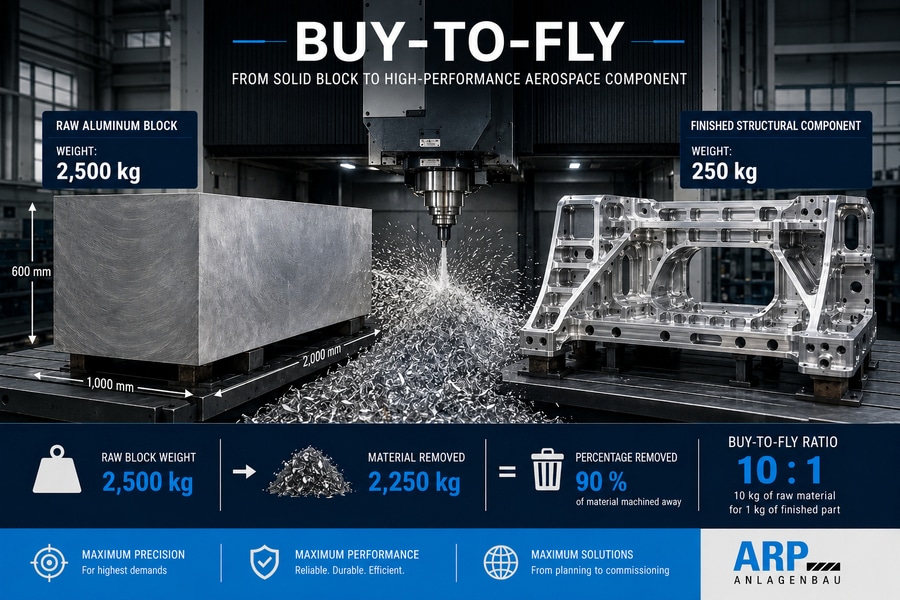
A key performance indicator in this process is the buy-to-fly ratio. It describes the relationship between the weight of the raw material purchased and the weight of the finished component. It is an important measure of material efficiency in aircraft manufacturing.
In many cases, the buy-to-fly ratio is between 10:1 and 20:1. This means that up to 90% or more of the expensive raw material is removed during machining and becomes aluminium chips.
As efficiency and sustainability become more important, reliable automated chip handling is becoming increasingly critical.
Today, the requirements go far beyond simply removing chips from the machine tool. Modern chip handling systems must provide:
• Continuous chip removal during highly automated production
• Reduced manual handling
• Prevention of machine downtime
• Reliable transport of chips to downstream recycling processes
• Separate collection of different aluminium alloys
The separation of different aluminium alloys is becoming especially important. Each alloy has its own material properties and can only be recycled efficiently if it is collected separately.
Mixed aluminium chips reduce the quality of the recycled material and make it more difficult to return valuable raw materials to the production cycle.
Sustainability Through Closed-Loop Aluminium Recycling
In the aerospace industry, sustainability is no longer defined only by more efficient aircraft. Today, it also includes the entire manufacturing process.
Aluminium offers major advantages in this area. Recycling aluminium requires much less energy than producing primary aluminium. However, high-quality recycled material is essential.
For this reason, closed-loop material recycling is becoming increasingly important. Production scrap is collected, separated and returned to high-value recycling processes.
As a result, chip handling is no longer just a secondary production process. It has become an important part of modern resource efficiency.
An intelligent chip handling system helps manufacturers keep valuable raw materials in the production cycle while making production more efficient, more economical and more sustainable.
Automation Beyond the Machine Tool
As machine tools, robots and manufacturing systems become more automated, the supporting processes are becoming just as important.
In highly automated production, overall productivity depends on more than just the performance of the machine tool. Material flow, chip handling and recycling must also be reliable, transparent and fully integrated.
For this reason, modern manufacturing increasingly relies on connected systems that monitor operating conditions, optimize processes and improve overall equipment availability.
These systems include, for example:
• Automated chip conveyors and central collection systems
• Monitoring of fill levels and operating conditions
• Optimized separation of different aluminium alloys
• Full traceability of recyclable material flows
• Early detection of maintenance requirements
The industry is moving away from isolated machines toward fully integrated production systems, where supporting processes also play a key role in efficiency and sustainability.
ARP – Automated Chip Handling for the Manufacturing of Tomorrow
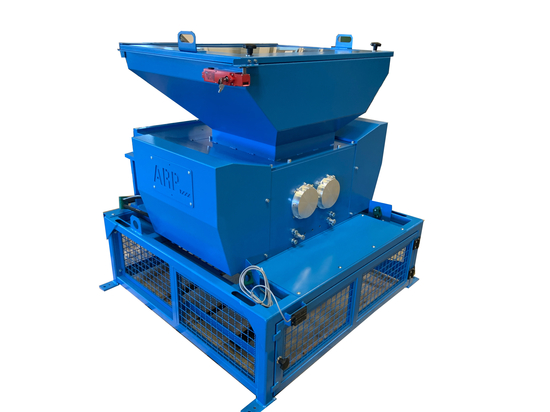
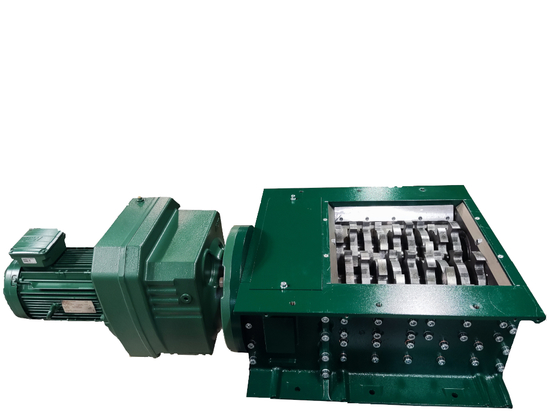
This is where ARP comes in. As a specialist in automated chip handling systems, ARP develops customized solutions for demanding industrial manufacturing processes.
Today, ARP systems are already in operation in highly automated production facilities of leading aerospace manufacturers. These projects clearly demonstrate that modern chip handling is far more than a simple waste disposal process.
It is an essential part of efficient, reliable and sustainable manufacturing.
Continuous automated chip removal increases machine uptime, reduces manual intervention and makes production processes more reliable. At the same time, the separate collection of different aluminium alloys improves recycling quality and supports sustainable closed-loop material recycling.
ARP helps manufacturers put this vision of the future into practice today.
ARP Expertise
Automated Chip Handling for the Highest Requirements
✓ Experience in highly automated manufacturing environments
ARP system solutions are already in use at leading companies in the aerospace industry.
✓ Automated handling of large volumes of aluminium chips
Reliable solutions for continuous production processes with high material throughput.
✓ Separate collection of different aluminium alloys
Targeted collection of individual alloys to improve recycling efficiency and increase material value.
✓ Higher productivity through reduced manual intervention
Minimizing machine downtime and reducing the workload on employees through automated processes.
✓ Customized system solutions from a single source
From planning and integration to commissioning – tailored to the requirements of modern manufacturing.