#Industry News
Automating the Filling and Packaging Process for Food Products in Buckets
Bucket line
Automating the Filling and Packaging Process for Food Products in Buckets
From automatic bucket handling to filling, lid application, capping and labelling: a complete automation solution developed by CM3 Engineering for flexible food packaging operations.**
Automation in the food packaging industry requires solutions capable of combining filling accuracy, flexibility and production continuity, particularly when several container sizes and different products have to be handled on the same line.
This was the starting point for a recent project developed by **CM3 Engineering, which designed and manufactured a complete automatic line for filling and packaging food products such as creams and chocolate-based products in buckets ranging from **3 to 25 kg.
A line designed around the customer's production requirements
The project was developed around the specific requirements of the customer's production process, with particular attention to layout optimisation, format flexibility and the integration of the new equipment with the existing product preparation system.
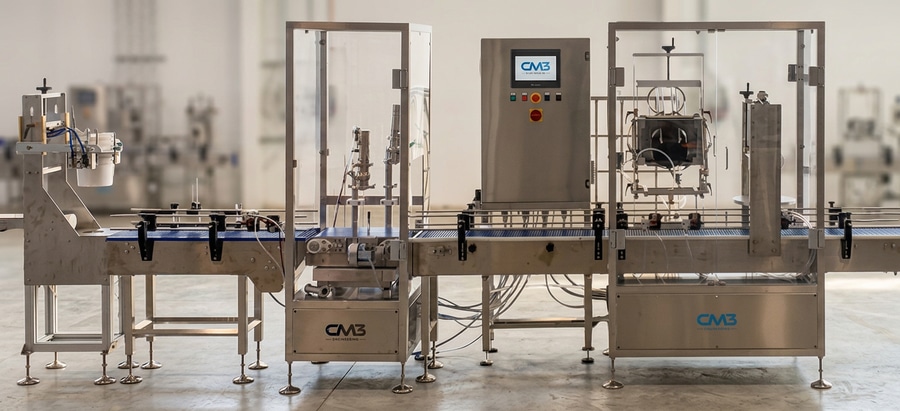
CM3 Engineering developed the complete 3D layout of the line, defining the positioning of the different stations and their integration within the available production area.
A key aspect of the project was the design of the filling system to allow the product to be supplied directly from the customer's preparation tank.
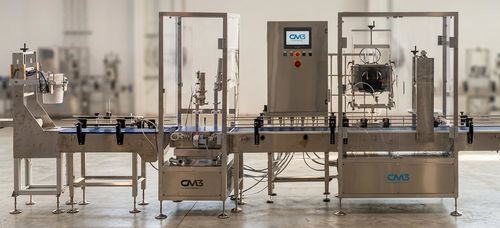
The final solution integrates **four main automatic stations**, managed by a central electrical control cabinet equipped with a touch-screen operator panel.
1. Automatic bucket denesting
The first station automatically feeds the empty buckets into the production line.
A dedicated denesting system separates the buckets and places them onto the conveyor, eliminating manual loading and ensuring a continuous supply to the following processing stages.
The system has been designed to handle **five different bucket formats**, with diameters ranging from 150 to 280 mm.
2. Automatic filling from 3 to 25 kg
The filling system represents the core of the line.
The machine uses **two self-priming, reversible pumps**, connected to filling nozzles equipped with drip-prevention valves.
The product is dosed directly into the bucket, which is positioned on an integrated weighing system.
This configuration allows the line to handle filling quantities from **3 to 25 kg**, adapting the process to different products and container formats.
The filling system was specifically engineered to handle food products with different viscosities while maintaining controlled and repeatable dosing.
3. Automatic lid application and pressure capping
After filling, the buckets are transferred to the next station.
The system includes a **lid denesting unit with a vacuum cup transfer system**, which automatically picks up each lid and positions it onto the corresponding bucket.
The bucket then passes through the **automatic pressure capping station**, completing the closure without requiring manual intervention.
By integrating lid handling and capping into the automatic process, the system maintains a continuous product flow from filling through to final closure.
4. Front and rear labelling and product coding
The final stage of the line is dedicated to product identification and labelling.
The automatic labelling system applies labels to the **front and rear of the buckets**, while accommodating the different container diameters handled by the line.
The station also integrates **batch and expiry-date coding**, completing the packaging process and preparing the finished products for subsequent logistics and distribution operations.
Flexibility for five bucket formats and different products
One of the main objectives of the project was to allow the customer to use the same production line for different products and container sizes.
The CM3 solution was therefore designed to handle **five different bucket formats**, from Ø150 to Ø280 mm, and products including food creams and chocolate-based preparations.
Format changeovers have been taken into account during the engineering phase, allowing the different machine stations to be adjusted according to the characteristics of the container being processed.
One integrated system for the complete packaging process
The result is a complete automatic line combining the main operations of the packaging process:
denesting → filling → lid application → capping → labelling → coding.
By automating these operations, the system reduces manual handling, improves process consistency and coordinates the different stages through a single control system.
The complete line was delivered approximately **six months after order**, achieving a production rate of up to around **600 buckets per hour**, depending on the product and container format.
A project developed around the customer's requirements
This installation is an example of CM3 Engineering's approach to the design of automatic packaging systems for the food industry: rather than offering a standard machine, the company develops each solution around the **product characteristics, container formats, available production space and required output**.
From layout engineering and mechanical design to machine manufacturing, automation, integration and final testing, **CM3 Engineering develops complete automatic solutions for filling, capping and labelling food products**.
The result is a packaging system designed to combine **automation, flexibility and production continuity**, providing a solution tailored to the customer's actual industrial requirements.
PROJECT DATA
- Industry:Food & Beverage
- Products:Food creams and chocolate-based products
- Container:Buckets from 3 to 25 kg
- Formats:5 bucket formats, Ø150–280 mm
- Main stations:4
- Operations:Denesting, filling, lid application, capping, labelling and coding
- Production rate:** Up to approximately 600 buckets/hour
- Lead time:** Approximately 6 months