#Product Trends
Anechoic Chamber Explained: Types, Design Standards, and How to Test Without One
A practical guide to anechoic chambers, key standards, design factors, and alternative acoustic testing methods.
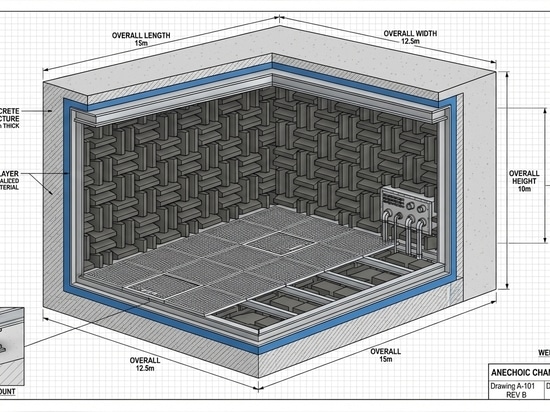
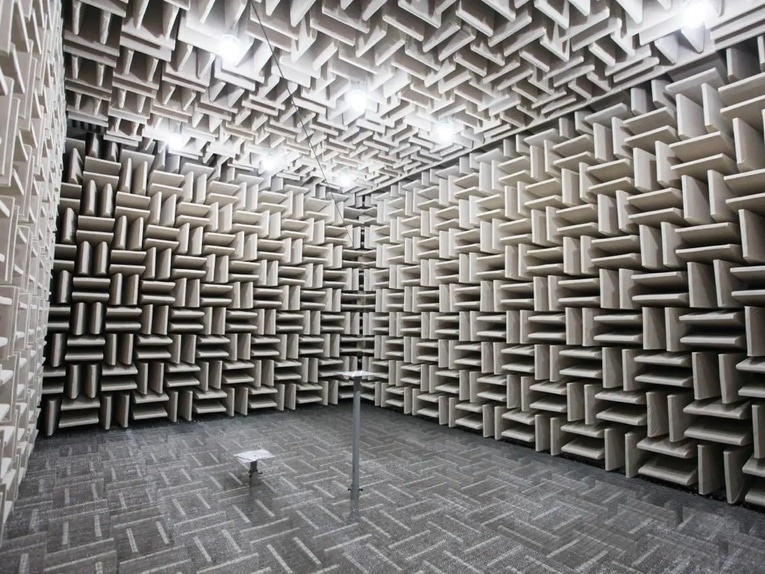
An anechoic chamber is a room designed to absorb sound reflections and create a controlled acoustic environment. Its walls, ceiling, and, in a full anechoic chamber, the floor are covered with wedge-shaped absorbers that stop sound waves from bouncing back into the room.
This creates free-field conditions, similar to measuring a sound source in open air with no nearby reflective surfaces. For acoustic measurements such as sound power, directivity, and frequency response, this type of controlled environment helps produce repeatable and standards-compliant results. Without it, room reflections can affect the measurement and make results depend more on the room than on the product being tested.
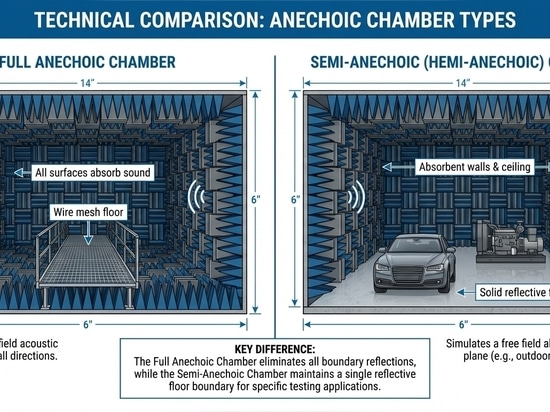
Full Anechoic vs Semi-Anechoic Chambers
Absorbing surfaces: Full anechoic chamber: all 6 surfaces are absorbing, including walls, ceiling, and floor. Semi-anechoic chamber: 5 surfaces are absorbing, including walls and ceiling, while the floor remains reflective.
Floor: Full anechoic chamber: wire mesh or perforated metal grid suspended above absorbers. Semi-anechoic chamber: solid, load-bearing concrete or steel floor.
Acoustic condition: Full anechoic chamber: free-field conditions with no reflections from any direction. Semi-anechoic chamber: free-field conditions over a reflecting plane.
Load capacity: Full anechoic chamber: limited load capacity because heavy equipment cannot be placed directly on the suspended floor. Semi-anechoic chamber: suitable for vehicles, machinery, and industrial equipment.
Primary standards: Full anechoic chamber: commonly used for ISO 3745 precision sound power measurement. Semi-anechoic chamber: commonly used for ISO 3744 engineering sound power measurement and, in some cases, ISO 3745.
Typical applications: Full anechoic chamber: microphone calibration, loudspeaker characterization, and hearing research. Semi-anechoic chamber: automotive NVH, product noise testing, and industrial machinery testing.
Cost: Full anechoic chamber: higher cost because floor treatment adds complexity. Semi-anechoic chamber: lower cost because the floor does not need absorber treatment.
In industrial acoustic testing, semi-anechoic chambers are more common because many test objects, such as cars, appliances, compressors, and power tools, are too heavy for a suspended wire-mesh floor.
Standards That May Require an Anechoic Chamber
ISO 3745: Precision sound power measurement. This is a key standard for sound power determination. It requires a full anechoic or hemi-anechoic chamber that meets strict free-field deviation limits across the required frequency range. The chamber must show that the inverse-square law is maintained within the specified tolerance at the measurement positions.
Typical cut-off frequency: The usable low-frequency limit is often around 80 to 200 Hz, depending on chamber size and wedge depth. Below the cut-off frequency, the chamber no longer behaves as a proper free field.
ISO 3744: Engineering sound power measurement. This standard is less stringent than ISO 3745 but still requires a suitable hemi-anechoic environment. It allows environmental corrections when the room is not perfectly anechoic, which makes it practical for production-floor test cells and other spaces that approximate free-field conditions.
ISO 26101: Qualification of free-field environments. This standard defines how to verify whether a room meets free-field requirements. It is used to qualify an anechoic or hemi-anechoic chamber and confirm that its acoustic performance matches the stated performance.
Other related standards: ECMA-74 for IT equipment noise measurement; ANSI S12.55 and ANSI S12.56 as North American equivalents of ISO 3744 and ISO 3745; and ISO 11201 to ISO 11205 for sound pressure level determination methods, some of which require free-field conditions.
Key Design Considerations
Chamber size and usable volume: The physical size of the chamber affects the lowest usable frequency. As a general rule, the chamber should be large enough so that the distance between the sound source and each measurement microphone is at least one wavelength at the lowest frequency of interest.
Example: For a 100 Hz cut-off frequency, the source-to-microphone distance is approximately 3.4 metres. This means the internal dimensions of a hemi-anechoic chamber, excluding wedges, may need to be around 7 to 8 metres per side.
Wedge absorbers: The depth of the absorbing wedges determines low-frequency performance. Deeper wedges absorb lower frequencies.
Wedge depth: 200 mm corresponds to an approximate low-frequency cut-off of 500 Hz. 500 mm corresponds to around 200 Hz. 1000 mm corresponds to around 80 to 100 Hz.
Wedge materials: Common materials include melamine foam and fibreglass. Melamine foam is lightweight and fire-retardant, while fibreglass can provide stronger low-frequency absorption but is heavier.
Background noise: An anechoic chamber must also be isolated from external noise. The ambient noise level inside the chamber should be at least 6 dB, and preferably 15 dB, below the sound pressure level generated by the test object at the measurement positions.
Noise isolation construction: This usually requires multiple layers of heavy construction materials, such as concrete and steel, plus vibration-isolated mounting to reduce structure-borne noise transmission.
Vibration isolation: For NVH testing, especially automotive applications, the floor may need vibration-isolated foundations or air-spring mounting systems. This prevents road-simulator or dynamometer vibration from affecting the acoustic measurement environment.
Testing Without a Full Anechoic Chamber
A purpose-built anechoic facility can require a major investment, so not every organization can justify a full chamber. Depending on the product and measurement goal, several practical alternatives may be used.
Sound intensity method: Sound intensity testing, described in ISO 9614, is less sensitive to room reflections because intensity is a vector quantity. It can distinguish outgoing sound from the source and incoming reflected sound from surrounding surfaces. This makes sound power testing possible in ordinary rooms without full anechoic treatment. The trade-off is that it requires specialized intensity probes and more complex procedures.
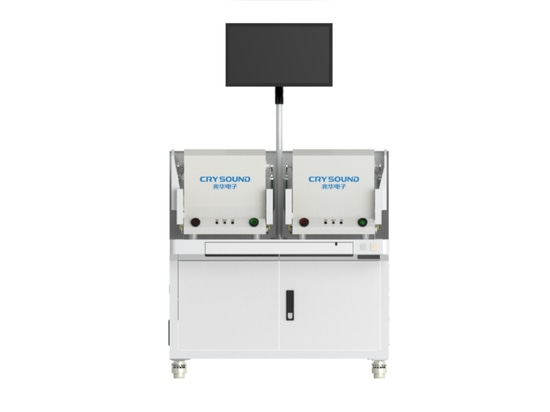
Acoustic test boxes: For small products such as electronics, components, and transducers, a desktop-sized acoustic test box can provide a controlled, low-noise environment within a defined frequency range. It is much more compact and cost-effective than a full chamber and can be used directly on a production line.
CRYSOUND acoustic test chamber options: CRY723 Pneumatic Acoustic Test Chamber is a compact shell-type test box suitable for smartphones and wireless wearables. CRY725 Pneumatic Acoustic Test Chamber is designed for larger wireless devices such as laptops and walkie-talkies. CRY7865 Pneumatic Acoustic Test Chamber provides both acoustic isolation and RF shielding for production-line audio and noise testing of wireless electronic devices. CRY7412 Ultra-Quiet Chamber uses a double-shell design for testing very quiet sounds in noisy environments.
Production-line advantage: These acoustic test chambers support pneumatic operation, allowing fast and repeatable loading of devices under test. They are practical alternatives when a full anechoic chamber is not necessary for the application.
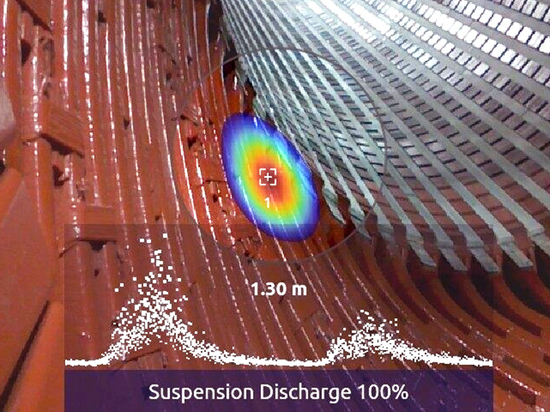
Portable acoustic arrays: Acoustic imaging cameras can identify and locate noise sources in factories, production lines, and field environments without anechoic treatment. They are not replacements for standards-compliant sound power measurement, but they are valuable for fast noise source diagnosis.
CRY8500 Series SonoCam Pi Acoustic Camera: This portable acoustic imaging camera provides real-time sound source visualization and is suitable for R&D engineers working on automotive NVH, industrial equipment, and consumer electronics noise source identification.
In-situ sound power measurement: ISO 3744 allows environmental correction factors to account for room reflections. If the correction is small, often less than about 2 dB, sound power measurement may be performed in a reasonably quiet industrial space without a dedicated chamber.
SonoDAQ Pro and OpenTest: The SonoDAQ Pro data acquisition system, combined with OpenTest software, supports automated sound power calculations with environmental corrections, helping users perform standards-based measurements without a dedicated anechoic chamber.
Frequently Asked Questions
How much does an anechoic chamber cost? Cost depends on chamber size, performance requirements, and cut-off frequency. A small hemi-anechoic room for component testing may start around USD 100,000 to 300,000, while a large automotive-grade chamber can exceed USD 2 million. For smaller products, acoustic test boxes can provide useful isolation at a much lower cost.
What is the difference between an anechoic chamber and a soundproof room? A soundproof room blocks external noise from entering, but it does not necessarily absorb internal reflections. An anechoic chamber both blocks outside noise and absorbs internal reflections, creating a free-field environment for precision acoustic measurement.
Can acoustic testing be done without an anechoic chamber? Yes. Depending on the application, alternatives include acoustic test boxes for small products, sound intensity methods under ISO 9614, portable acoustic imaging cameras such as the CRY8500 SonoCam Pi, and in-situ measurements with environmental corrections using systems such as SonoDAQ Pro.
What frequency range does an anechoic chamber cover? The usable range depends on wedge depth and chamber dimensions. Many chambers are effective from their cut-off frequency, often 80 to 200 Hz, up to 20 kHz or higher. Below the cut-off frequency, absorption performance is no longer sufficient.
How is an anechoic chamber qualified? Chamber qualification follows ISO 26101. This verifies that sound pressure decreases according to the inverse-square law, typically 6 dB for each doubling of distance, within the required tolerance at the measurement positions.
Conclusion
Anechoic chambers remain one of the most reliable solutions for precision acoustic measurement, but they are not the only option. The right solution depends on the product, the test standard, the required accuracy, and the available facility conditions.
For some applications, a full anechoic chamber or semi-anechoic chamber is necessary. For others, a compact acoustic test chamber, portable acoustic imaging system, sound intensity method, or in-situ sound power approach can provide a practical and cost-effective path.
CRYSOUND provides solutions ranging from purpose-built anechoic chambers to portable acoustic test boxes, acoustic imaging cameras, data acquisition systems, and measurement software, helping users obtain accurate acoustic results under different testing constraints.