#Industry News
Cubic NDIR-Based Gas Analysis Solutions for Real-Time and Accurate CO2RR Process Monitoring
How Gasboard-3100P Addresses Real-Time and Multi-Component Gas Analysis Requirements for CO2RR Application
CO2RR: An Emerging Pathway in Carbon Utilization
Carbon utilization is emerging as the next frontier of decarbonization. Rather than treating carbon dioxide solely as an emission to be reduced, industries are increasingly exploring ways to transform captured CO2 into valuable fuels and chemicals. Supported by advances in renewable electricity, catalysis, and carbon capture technologies, carbon utilization is evolving from a research focus into a practical pathway that simultaneously addresses greenhouse gas emissions and generates industrially useful feedstocks for building a circular carbon economy.
Within this landscape, electrochemical CO2 reduction (CO2RR) represents one of the more actively pursued pathways. The process uses electrical energy to drive the reduction of CO2 at a catalyst surface, converting it into valuable chemicals and fuels (including carbon monoxide, methane, ethylene, formate, and methanol) that serve as feedstocks for industrial production or as clean energy carriers. Several industrial and startup initiatives are now operating CO2RR systems at pilot scale, with commercial deployment anticipated within the coming years. As that transition accelerates, demand is growing for analytical technologies capable of accurately monitoring reactants, products, and process efficiency throughout the reaction.
Gas Analysis in CO2RR: A Challenging but Essential Requirement
One of the most critical requirements of electrochemical CO2 reduction is accurate and timely gas analysis. Throughout electrolysis, CO2 is continuously consumed while multiple gaseous products are generated simultaneously. The composition of the gas stream can change rapidly with catalyst activity, operating conditions, and reaction time, making reliable gas analysis essential for evaluating catalyst performance, optimizing reaction conditions, and supporting process scale-up.
However, obtaining comprehensive and real-time gas composition data throughout the CO2RR process remains technically challenging. Conventional analytical methods, such as gas chromatography (GC), provide accurate compositional analysis but typically rely on periodic sampling and offline measurement. The resulting delay between reaction and analysis makes it difficult to capture dynamic changes and accelerate catalyst optimization.
These challenges exist throughout the CO2RR workflow, from maintaining stable reactant conditions to analyzing reaction products and monitoring dynamic process changes:
• Ensuring consistent CO2 feed conditions: Reliable CO2RR evaluation requires stable and consistent CO2 feed conditions. Continuous monitoring of inlet CO2 concentration helps verify feed conditions, improve experimental consistency, and provide reliable gas composition data for CO2 conversion evaluation and carbon balance analysis. Even small variations in feed conditions may affect catalyst performance assessment and the comparability of experimental results.
• Comprehensive outlet gas analysis: The CO2RR outlet gas stream may contain multiple gaseous components, including CO, H2, CH4, C2H4, and residual CO2, depending on catalyst materials and operating conditions. Simultaneous measurement of multiple components is essential for accurately evaluating catalyst performance, product distribution, and reaction efficiency.
• Real-time monitoring of reaction performance: During catalyst screening and process optimization, gas composition may change throughout electrolysis as catalyst behavior and operating conditions evolve. Periodic sampling provides only limited snapshots of reaction behavior and may overlook transient changes in product distribution. Real-time gas composition monitoring enables researchers to track reaction trends, compare operating conditions, and optimize reaction parameters more efficiently.
A gas analyzer deployed in CO2RR must therefore be capable of measuring multiple components simultaneously, with sufficient accuracy and response speed to support both process control and catalyst evaluation.
Portable Infrared Syngas Analyzer Gasboard-3100P: An Advanced Solution for Real-Time Multi-Component CO2RR Gas Analysis
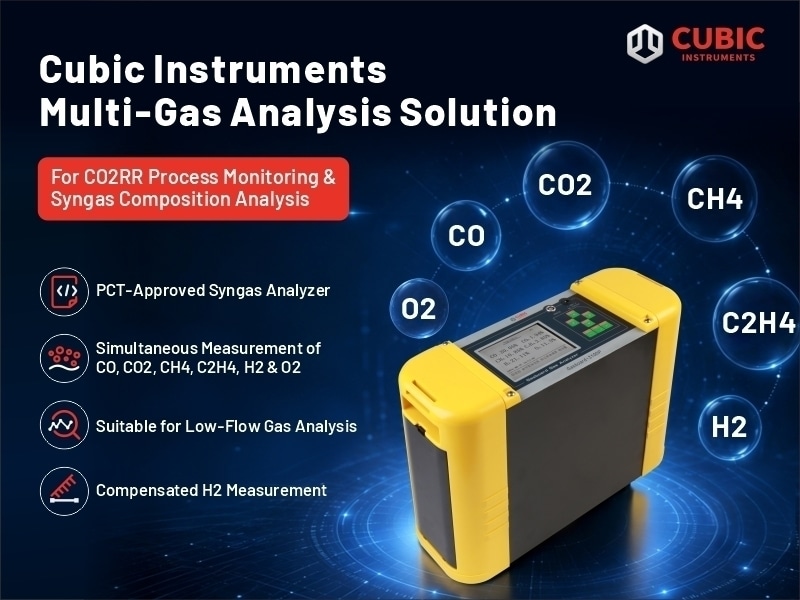
To address the need for precise, real-time multi-component gas analysis in CO2RR application, Cubic Instruments, a leading manufacturer of gas sensors and gas analyzers, provides Gasboard-3100P, a PCT-approved portable infrared syngas analyzer based on patented non-dispersive Infrared (NDIR) and thermal conductivity detection (TCD) technologies, combined with electrochemical detection (ECD) technology for comprehensive gas analysis.
Specifically, Gasboard-3100P utilizes NDIR technology to measure CO, CO2, CH4, and C2H4, leveraging the distinct infrared absorption characteristics of each gas to achieve selective and accurate measurement even in complex multi-component gas streams. For accurate H2 detection, TCD technology is employed with intelligent cross-sensitivity correction to compensate for interference from CO, CO2, and CH4. In addition, O2 is measured based on ECD technology, enabling detection of oxygen impurities that could otherwise interfere with the reduction reaction. By integrating these complementary sensing technologies, Gasboard-3100P provides simultaneous multi-component gas measurement capability to support CO2RR performance evaluation and process optimization.
Accurate quantification of gas-phase products is essential for evaluating catalyst selectivity and conversion efficiency in CO2RR. Gasboard-3100P delivers an accuracy of ±1% F.S. across NDIR channels and ±2% F.S. for H2 and O2, providing the measurement precision required to meet the precision requirement.
Fast response is also critical for CO2RR research, where gas composition may change during electrolysis due to variations in catalyst activity and operating conditions. With a response time of less than 10 seconds, Gasboard-3100P enables researchers to capture gas composition changes with minimal delay, providing faster feedback during catalyst screening and reaction optimization. The fast response capability of Gasboard-3100P helps reduce iteration time, improve experimental efficiency, and accelerate reaction condition optimization.
Designed for convenient deployment in CO2RR testing environments, Gasboard-3100P integrates a built-in sample pump, flow meter, filters, and rechargeable battery alongside the gas analysis modules, providing a self-contained solution for experimental setups. Compared with conventional offline analysis approaches, the integrated design simplifies the measurement workflow by reducing manual sampling requirements and the need for complex sample handling or additional analytical steps. Internal data storage and standard digital communication interfaces further support efficient data transfer and integration with existing experimental systems.
By combining multi-component gas analysis, accurate measurement, rapid response, and flexible deployment capabilities, Gasboard-3100P supports researchers in obtaining reliable insights into CO2RR reaction behavior and optimizing experimental conditions more efficiently.
Why Cubic Instruments
Cubic Instruments has built a broad and deep foundation in gas sensing technologies, with core competencies spanning non-dispersive infrared (NDIR), Laser Raman scattering, UV-DOAS, TDLAS, electrochemical detection (ECD), and ultrasonic technologies. The multi-platform technical capability enables Cubic Instruments to develop purpose-built solutions for a wide range of gas monitoring and analysis applications.
Gasboard-3100P is built on established technology platforms that have demonstrated reliable performance under continuous operating conditions. Backed by rigorous product quality control, responsive technical support, and a commitment to long-term customer partnership, Cubic Instruments provides CO2RR researchers and process engineers with instrumentation solutions they can depend on, from initial deployment through the full duration of their research and development programs.
As electrochemical CO2 reduction continues to advance toward pilot-scale and commercial deployment, Cubic Instruments remains committed to delivering precision gas monitoring solutions that meet the evolving analytical requirements of this application.