#Product Trends
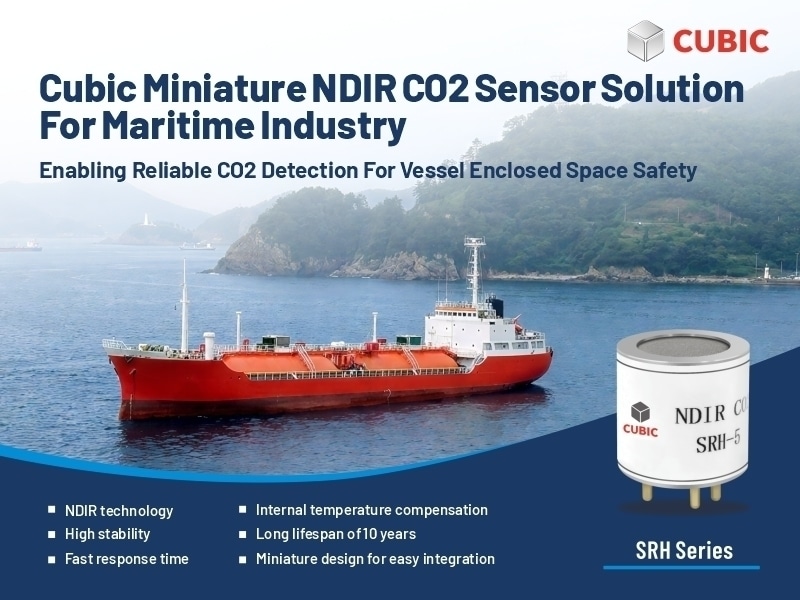
Cubic Miniature NDIR CO2 Sensor Solution For Maritime Industry
Enabling Reliable CO2 Detection For Vessel Enclosed Space Safety
With the rapid growth of the global shipping industry, safe vessel operation related to enclosed space entry has remained an important concern in the maritime sector. Areas such as cargo holds, fuel tanks, ballast tanks, pump rooms, double-bottom tanks, and equipment compartments are often poorly ventilated due to prolonged closure, creating potential risks including oxygen deficiency, toxic gas accumulation, and hazardous atmosphere formation. Without proper atmospheric testing before entry, personnel may be exposed to serious hazards, including poisoning, suffocation, and life-threatening accidents.
Strengthened Requirement to Ensure Safer Operation in Maritime Enclosed Spaces
To address these risks, the International Maritime Organization (IMO) has continuously strengthened safety management requirements for enclosed space operations. The IMO Maritime Safety Committee (MSC) recently adopted MSC.581(110) “Revised Recommendations for Entering Enclosed Spaces Aboard Ships”, further enhancing requirements for risk assessment, atmospheric testing, entry procedures, and crew training before entering enclosed spaces. Entry to an enclosed place is permitted only when all monitored parameters meet the applicable safety criteria. During operations, personnel must adopt personal gas detectors for continuous monitoring. If abnormal readings are detected or atmospheric conditions change, work must be stopped immediately, personnel evacuated, and the space re-ventilated and retested before re-entry.
The enhanced requirements of comprehensive atmosphere testing before personnel enter enclosed spaces make reliable gas detection an essential part of ship safety management. Among the target gases, CO2 monitoring plays a critical role in identifying potential asphyxiation risks. The elevated CO2 concentrations can displace oxygen and create a dangerous breathing environment.
Based on the IMO enclosed space safety recommendations, CO2 concentration levels can be assessed as follows:
• CO2 < 0.5% (5,000 ppm): Generally considered an acceptable level for safe entry conditions.
• CO2 0.5%–1% (5,000–10,000 ppm): Requires attention, with improved ventilation and continuous monitoring recommended.
• CO2 1%–3% (10,000–30,000 ppm): May cause discomfort, increased respiration, fatigue, and other health effects; prolonged exposure should be avoided.
• CO2 >3% (30,000 ppm): Indicates a hazardous atmosphere requiring ventilation and additional safety measures before entry.
• CO2 >10% (100,000 ppm): Extremely dangerous and may result in unconsciousness or fatal consequences; entry is strictly prohibited.
Cubic Industrial Miniature NDIR CO2 Sensor Solution
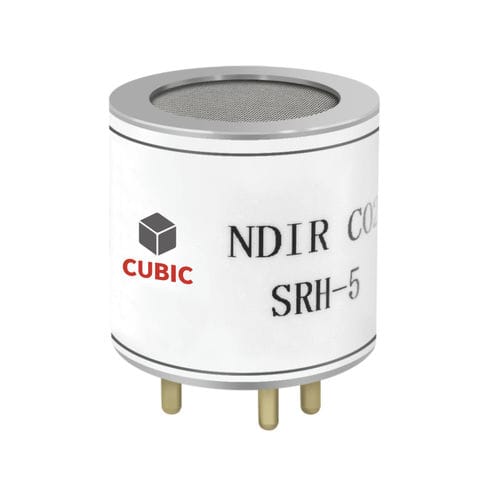
To meet these safety requirements, accurate CO2 measurement is essential to evaluate atmospheric conditions and ensure safe access for crew members. Cubic, as a leading manufacturer of gas sensors and gas analyzers, has leveraged its mature NDIR technology to develop the SRH Series, a miniature industrial-grade NDIR CO2 sensor designed for integration into fixed marine gas detection systems and portable safety alarm devices.
SRH Series can provide sensitive detection of CO2 concentration changes in enclosed spaces and support early identification of potentially hazardous atmospheres. It supports multiple CO2 measurement ranges, even down to 100 ppm, enabling flexible configuration for different enclosed space monitoring requirements. The sensor features a fast response time for timely feedback of changing CO2 levels and has a long lifespan of up to 10 years, providing reliable long-term operation for marine gas detection equipment.
In the high-humidity, high-salt-spray, and high-vibration environment unique to ships, Cubic SRH Series delivers excellent industrial reliability. A built-in heated infrared source keeps the internal temperature of the sensor higher than the ambient temperature, helping prevent condensation and reduce the influence of high humidity on measurement performance. In addition, the PCB is specially treated for corrosion protection, while the integrated temperature compensation algorithm helps maintain stable and accurate measurements across an operating temperature range of -40°C to +70°C and 0–95% RH under non-condensing conditions.
Moreover, its compact structure and diffusion sampling design make the SRH Series easy to integrate into various types of portable and fixed marine gas detectors. Even where the internal space of the detection equipment is highly limited, the miniature form factor allows flexible deployment. The sensor supports both UART-TTL and analog voltage outputs, facilitating communication with the data processing module of gas detection equipment and enabling real-time CO2 monitoring, data feedback, and alarm linkage.
In addition, the mature and stable product design of the SRH Series provides highly reliable core component support for system integrators and gas detector manufacturers. By integrating accurate CO2 sensing into multi-gas detection systems, the SRH Series can help support enclosed space atmosphere assessment and safety management in accordance with evolving international maritime safety requirements, including the IMO MSC.581(110) recommendations.
Key product features highlight:
• Advanced NDIR technology
• Measurement range down to 100 ppm
• Fast response time
• Built-in heated infrared source to reduce condensation and humidity effects
• Internal temperature compensation
• Long lifespan of 10 years
• Miniature design for easy integration
With these advantages, Cubic SRH Series miniature industrial-grade NDIR CO2 sensors can be widely integrated into marine CO2 detectors and enclosed space monitoring systems, supporting applications such as cargo holds, machinery spaces, CO2 fire suppression system areas, and other confined spaces where CO2 accumulation may present a safety risk. Looking ahead, Cubic will continue to advance gas sensing technologies and provide more accurate, reliable, and intelligent sensing solutions to support safer and smarter maritime transportation.
For more detailed information, please visit https://en.gassensor.com.cn/CO2Sensor/info_itemid_95.html or contact us via [email protected]