#Product Trends
Beyond Rest: A Clearer View of Exercise Physiology with Cubic CPET
Cubic One-Stop OEM/ODM CPET Solution for Integrated Exercise Testing and Physiological Analysis
When shortness of breath appears only during activity, resting measurements may tell only part of the story. Exercise challenges the entire cardiopulmonary system, revealing limitations that may remain hidden under resting conditions. Cardiopulmonary exercise testing (CPET) turns exercise into a controlled physiological challenge, allowing clinicians to observe how the lungs, heart, circulation, and working muscles respond together as demand increases.
By synchronizing oxygen uptake (V̇O₂), carbon dioxide output (V̇CO₂), minute ventilation (V̇E), heart rate, oxygen saturation, workload, and symptoms, CPET goes beyond showing how much exercise a person can perform. It provides a clearer view of why exercise capacity may be limited. [1–2,4–5]
That insight depends on the quality of the measurement chain. During exercise, tidal volume, breathing frequency, ventilation, and respiratory-gas concentrations can change within seconds. Flow, O₂, and CO₂ signals must respond quickly and remain closely synchronized. Even small timing or measurement errors can carry through to the calculated gas-exchange variables. [2,12–13]
A complete CPET system must therefore bring together a controlled and repeatable exercise load, synchronized breath-by-breath measurement of respiratory flow and gas concentrations, and software that aligns these measurements with supporting physiological data. [1–3,12–13]
How CPET Works—and What It Can Reveal
A standardized CPET protocol commonly progresses through four phases: a resting baseline, unloaded exercise, an individualized incremental work phase, and recovery. Rather than producing only a final peak value, this sequence records how ventilation, circulation, metabolism, and symptoms change as workload rises, as well as how these responses resolve after exercise. [1–2]
During CPET, a cycle ergometer provides a controlled external workload while breath-by-breath respiratory flow, inspired and expired O₂ and CO₂ concentrations, heart rhythm, blood pressure, oxygen saturation, and symptoms are continuously monitored. These synchronized measurements allow calculation of key variables including V̇O₂, V̇CO₂, V̇E, respiratory exchange ratio, ventilatory efficiency, and other physiological indicators. [1–3]
Peak V̇O₂ remains an important indicator of integrated aerobic capacity, but exercise limitation cannot be explained by a single value alone. Comprehensive interpretation considers the combined pattern of responses, including the V̇O₂–work-rate relationship, V̇E/V̇CO₂ slope, oxygen pulse, breathing reserve, heart-rate response, end-tidal gases, oxygen saturation, workload, and symptoms. [3-5]
Reliable interpretation depends on maintaining consistency throughout the measurement chain. Respiratory flow, gas concentrations, workload, and physiological signals must remain accurately synchronized from rest through incremental exercise and recovery. Therefore, responsive flow measurement, stable O₂ and CO₂ analysis, accurate workload integration, calibration, environmental compensation, and quality control are essential for repeatable and clinically meaningful CPET results. [1–2,12–13]
By integrating respiratory, cardiovascular, and metabolic responses during exercise, CPET provides a comprehensive assessment of exercise capacity and helps identify the predominant mechanism of limitation, including ventilatory impairment, circulatory dysfunction, abnormal gas exchange, metabolic limitation, or deconditioning. This integrated approach supports clinical evaluation in chronic respiratory and cardiovascular disease, pulmonary vascular disease, unexplained exertional dyspnea, rehabilitation, perioperative assessment, and cardiorespiratory research. [4–11]
Cubic’s One-Stop CPET Solution
A reliable CPET workflow depends on more than a single analyzer or exercise device. Workload, respiratory flow, O₂ and CO₂ concentrations, ECG, SpO₂, and software processing must remain connected on the same timeline. [1–3,12–13]
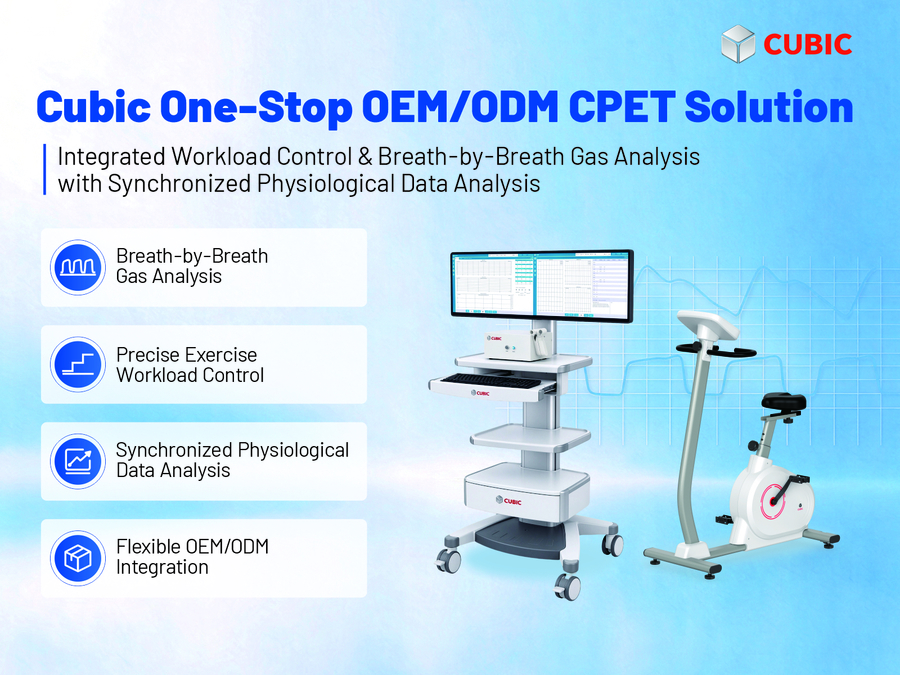
Cubic brings these elements together in a one-stop OEM/ODM CPET solution covering controlled exercise loading, breath-by-breath gas analysis, physiological-signal synchronization, intelligent data processing, and system integration.
Breath-by-Breath Measurement and Analysis at the Core
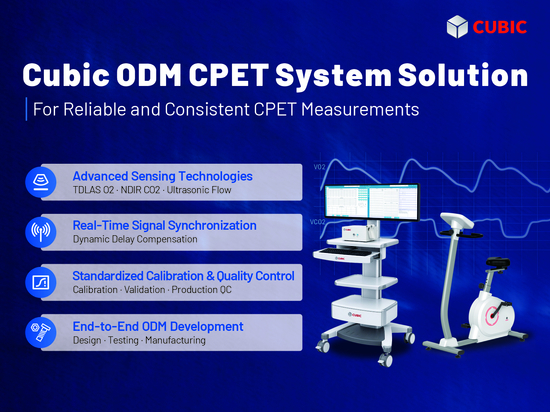
MEC8660 is an OEM/ODM CPET system developed for comprehensive assessment of cardiopulmonary and metabolic performance. It integrates Cubic’s ultrasonic flow measurement, Tunable Diode Laser Absorption Spectroscopy (TDLAS) O₂ analysis, and Non-Dispersive Infrared (NDIR) CO₂ analysis technologies. Together, these sensing platforms capture respiratory flow and changing O₂ and CO₂ concentrations throughout exercise.
Using synchronized flow and gas-concentration data, MEC8660 performs real-time breath-by-breath analysis to calculate V̇O₂, V̇CO₂, V̇E, respiratory exchange ratio, ventilatory-efficiency variables, and related physiological parameters. MEC8660 can be configured to receive ECG, heart-rate, and SpO₂ data from compatible external devices, allowing these signals to be displayed and analyzed alongside respiratory and gas-exchange measurements.
Intelligent algorithms process and organize these signals in real time, turning continuously changing physiological responses into clear, reviewable results for clinical assessment, rehabilitation, research, and performance evaluation. Its modular architecture and flexible configuration allow the system to fit into different clinical, research, and sports-medicine workflows while supporting further integration and customization.
Controlled Workload Completes the Measurement Loop
Gas-exchange analysis requires a known, stable, and repeatable exercise stimulus. When MEC8660 is paired with the Cubic MEC5060 CPET Ergometer, each programmed workload change can be connected with the corresponding respiratory, metabolic, and cardiovascular response.
MEC5060 uses an electronically controlled electromagnetic braking system to provide fast and smooth resistance changes. Its frictionless braking design reduces mechanical wear, supports quiet operation, and helps maintain stable and repeatable loading during repeated or continuous use. Constant-power, linear-ramp, and constant-torque modes allow the ergometer to support step, ramp, and interval exercise protocols across clinical assessment, rehabilitation, and sports-science applications.
Through standardized digital communication, real-time workload data from MEC5060 can be synchronized with respiratory flow, O₂, CO₂, ECG, and SpO₂ data from MEC8660. Clinicians and researchers can then observe how ventilation, gas exchange, heart rate, and oxygen saturation respond to each change in exercise demand.
From the resting baseline and unloaded phase to incremental exercise and recovery, the Cubic solution connects the exercise stimulus, breath-by-breath measurement, and physiological analysis in one continuous workflow.
Flexible Integration for OEM/ODM Co-Development
A one-stop solution does not have to mean a fixed system configuration. Cubic’s modular architecture allows gas analysis, flow measurement, workload control, communication interfaces, software functions, and operating workflows to be adapted to specific clinical, research, or sports-medicine requirements.
With Cubic, OEM/ODM partners can work with one supplier from core sensing technology to a market-ready CPET system. Cubic can provide integrated gas-analysis and flow-measurement solutions, while also supporting customized hardware, communication interfaces, data acquisition, and application software development. We can further support system integration, validation, production transfer, and manufacturing, giving a clear path from requirements definition and prototype development to scalable delivery. Whether you need an integrated analyzer, a customized subsystem, or a complete CPET platform, Cubic helps reduce multi-vendor coordination, shorten development cycles, and move your product toward commercialization faster.
From Exercise Load to Actionable Physiological Insight
Exercise places the body’s systems in motion, and that is often where functional limitation becomes visible. By combining controlled and repeatable workload delivery with breath-by-breath gas analysis, ECG, SpO₂, and synchronized software processing, Cubic connects the key elements of CPET in one coordinated solution.
With MEC8660 as the central measurement and analysis platform and MEC5060 providing controlled exercise loading, the system records how cardiopulmonary and metabolic responses develop throughout the complete exercise sequence.
For clinical teams and researchers, this creates a clear data foundation for assessment, rehabilitation, research, and performance evaluation. For OEM/ODM partners, Cubic’s modular design provides the flexibility to integrate, customize, and extend CPET systems around real application needs.
References
1. American Thoracic Society; American College of Chest Physicians. ATS/ACCP Statement on Cardiopulmonary Exercise Testing. Am J Respir Crit Care Med. 2003;167(2):211–277. doi:10.1164/rccm.167.2.211.
2. Radtke T, Crook S, Kaltsakas G, et al. ERS statement on standardisation of cardiopulmonary exercise testing in chronic lung diseases. Eur Respir Rev. 2019;28(154):180101. doi:10.1183/16000617.0101-2018.
3. Balady GJ, Arena R, Sietsema K, et al. Clinician’s guide to cardiopulmonary exercise testing in adults: a scientific statement from the American Heart Association. Circulation. 2010;122(2):191–225. doi:10.1161/CIR.0b013e3181e52e69.
4. Staes M, Gyselinck I, Goetschalckx K, Troosters T, Janssens W. Identifying limitations to exercise with incremental cardiopulmonary exercise testing: a scoping review. Eur Respir Rev. 2024;33(173):240010. doi:10.1183/16000617.0010-2024.
5. Neder JA, Phillips DB, Marillier M, Bernard AC, Berton DC, O’Donnell DE. Clinical interpretation of cardiopulmonary exercise testing: current pitfalls and limitations. Front Physiol. 2021;12:552000. doi:10.3389/fphys.2021.552000.
6. Behnia M, Sietsema KE. Utility of cardiopulmonary exercise testing in chronic obstructive pulmonary disease: a review. Int J Chron Obstruct Pulmon Dis. 2023;18:2895–2910. doi:10.2147/COPD.S432841.
7. Buber J, Robertson HT. Cardiopulmonary exercise testing for heart failure: pathophysiology and predictive markers. Heart. 2023;109(4):256–263. doi:10.1136/heartjnl-2021-319617.
8. Forbes LM, Bull TM, Lahm T, Make BJ, Cornwell WK III. Exercise testing in the risk assessment of pulmonary hypertension. Chest. 2023;164(3):736–746. doi:10.1016/j.chest.2023.04.013.
9. Behrooz L, Barillas-Lara M, Fattouh M, Loubeau B, Ibrahim M. The role of invasive cardiopulmonary exercise testing in patients with unexplained dyspnea: a systematic review. Acta Cardiol. 2023;78(7):754–760. doi:10.1080/00015385.2022.2141434.
10. Stubbs DJ, Grimes LA, Ercole A. Performance of cardiopulmonary exercise testing for the prediction of post-operative complications in non-cardiopulmonary surgery: a systematic review. PLoS One. 2020;15(2):e0226480. doi:10.1371/journal.pone.0226480.
11. Ezzatvar Y, Izquierdo M, Núñez J, et al. Cardiorespiratory fitness measured with cardiopulmonary exercise testing and mortality in patients with cardiovascular disease: a systematic review and meta-analysis. J Sport Health Sci. 2021;10(6):609–619. doi:10.1016/j.jshs.2021.06.004.
12. Hesse A, White M, Lundstrom C. The prevalence of gas exchange data processing methods: a semi-automated scoping review. Int J Sports Med. 2025;46(4):227–236. doi:10.1055/a-2495-5364.
13. Beijst C, Schep G, van Breda E, Wijn PFF, van Pul C. Accuracy and precision of CPET equipment: a comparison of breath-by-breath and mixing chamber systems. J Med Eng Technol. 2013;37(1):35–42. doi:10.3109/03091902.2012.733057.