#Product Trends
Generation Change in AC Transmitters
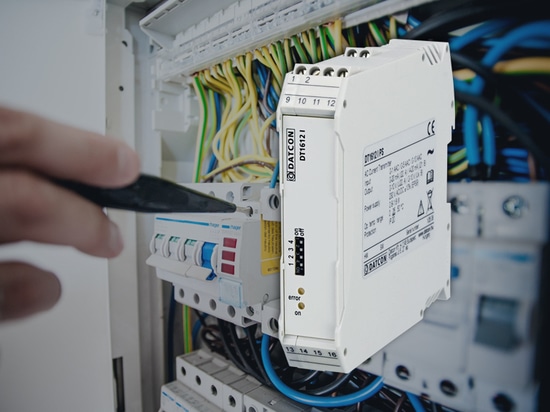
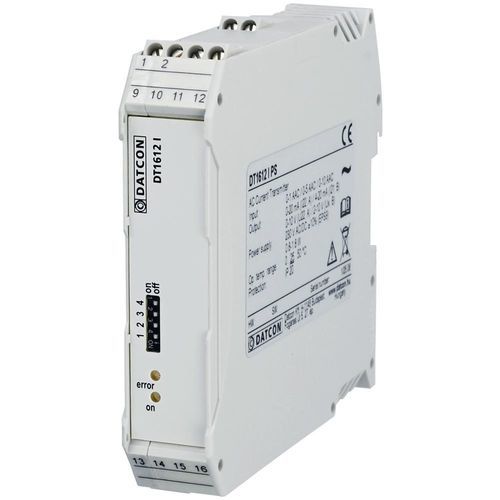
The newly developed DT1612 I AC transmitter replaces the DT1600 I product family
During the design of the new device, our developers utilized the manufacturing experiences of the previous model, as well as user feedback.
One of the goals was to reduce the number of the previous 12 model variants. This has been achieved, as the two variants of the new DT1612 I fully replace the earlier ones.
Another goal was to increase the directly connectable input current. In the new device, this is 10 AAC, which eliminates the need for an external current transformer in many applications.
Even with the 10 AAC input measurement range, the device fully complies with the requirements of the relevant EN 60688 standard. Here, the requirement is to withstand a continuous 2 × Iin (20 A) overcurrent and a short-term 20 × Iin (1 s, 200 A) overcurrent, which presented a serious challenge during the design of the input stage.
The applied measuring transformer ensures a measurement error of <0.2% in the 40–400 Hz frequency range, with minimal additional frequency error.
As a result of the high-speed A/D converter and fast digital signal processing (DSP), the settling time has been successfully reduced to almost one-tenth (120 ms).
The device features three-way isolation: the input, the output, and the power supply are galvanically independent of each other.
In the output stage, the dual (current, voltage) output (0–20 mA / 4–20 mA / 0–10 V / 2–10 V)—well-proven in Datcon isolators—has been implemented. These can be selected using the front-panel switches.
The input measurement range can also be selected via the front-panel switches: 0–1 AAC, 0–5 AAC, 0–10 AAC.
The two model variants of the new DT1612 I AC transmitter are:
• DT1612 I (24 V DC power supply)
• DT1612 I PS (230 V AC/DC power supply)
These two models replace the previous twelve. The remaining input and output parameters can be selected using the front-panel switches—even out in the field.
This not only simplifies manufacturing but also makes it easier for designers and users during the appropriate model selection process.
The calibration and testing of the transmitters are fully automated, similarly to other Datcon products.