#Industry News
Preventing recalls
Acoustic sensors detect glass breakage
If glass breakage is not detected immediately, the affected products can enter the market and, in the worst case, reach the end customer. At that point, extensive and costly recalls of entire batches become necessary. To prevent this problem from arising in the first place, the Schwerin-based company ds automation develops acoustic sensors that reliably detect glass breakage events based on signal level and frequency characteristics.
Whenever food or beverages are filled into glass containers such as bottles or jars, breakage can occur. The resulting shards can contaminate other units nearby. “In the portal produktwarnung.eu, there were already twelve entries in the first seven months of 2022 in the DACH region with the keywords ‘glass shards’ or ‘glass breakage’,” reports Dipl.-Ing. Christian Schröder, developer at ds automation gmbh. “For the affected manufacturers, this not only entails enormous costs, but also permanently damages the trust that their clients and end customers place in them.”
Additionally, the entire batch must be recalled, which inevitably leads to perfectly good products being discarded. In the worst case, if the recall does not reach some consumers in time, their health may be at risk.
“Such incidents and their far-reaching consequences occur in the first place because there is no standardized solution for glass breakage detection in food and beverage filling lines,” explains Schröder. Some companies rely on optical detection systems, which, however, involve relatively complex and costly measurement technology. Others depend on time-consuming manual inspections. In contrast, ds automation has developed a proven and efficient method for reliably detecting glass breakage, specifically tailored to the needs of the food and beverage industry, using its dsound airborne sound sensors.
Quality assurance via airborne sound
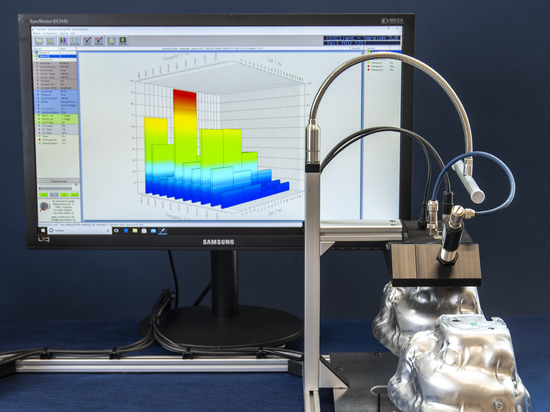
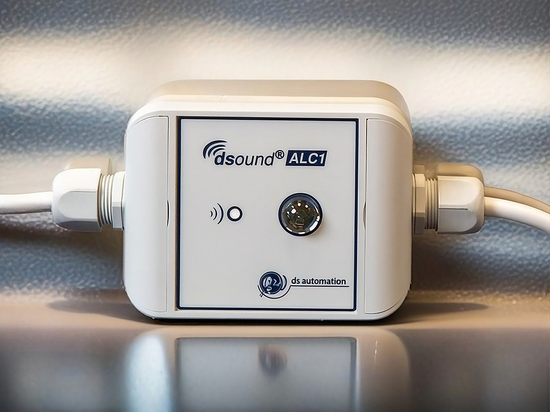
“The sensors for glass breakage detection are special microphones that continuously monitor their surroundings,” explains Schröder. “They detect any deviation from a noise situation defined as the normal state.” For this purpose, specific trigger thresholds are set in advance, representing the usual soundscape of the production line. The sound generated by glass breakage can be characterized as a very broadband ‘crack’ with a relatively high signal amplitude. This exceeds the preset threshold and can therefore be identified as an anomaly by the sensor.
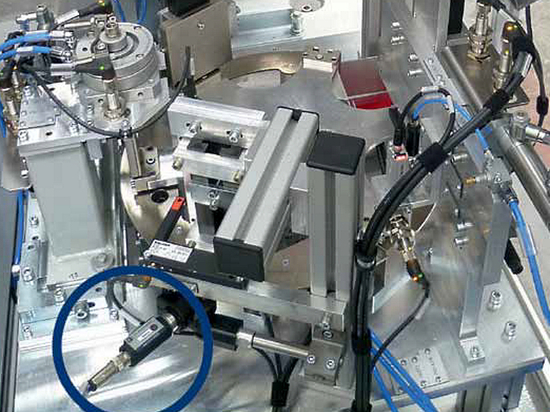
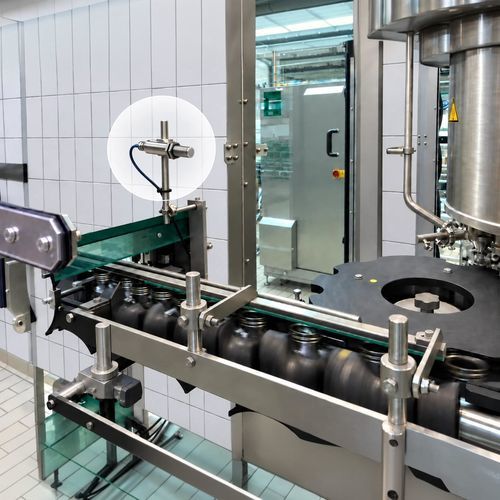
A major challenge in detecting glass breakage events using air sound lies in the damping effect of air itself and the background noise of the production line. However, air damping—and thus the likelihood of detection errors—is lower the closer the sensors are placed to the sound event. “In most production lines, there are specific points where units typically break—for example, during separation processes or the filling process,” Schröder explains. Breakage can occur there if individual bottles or jars are pre-damaged, misaligned, or filled incorrectly. “We take advantage of this knowledge by installing the sound sensors close to the specific problem areas and eliminating interfering factors,” Schröder continues.
Furthermore, the risk of false alarms increases due to the usually relatively loud ambient noise in production lines, which often requires employees to wear hearing protection. The measurement technology specialists at ds automation overcome this problem by not only measuring sound level but also applying band-pass filtering. This allows the measurement signal to be focused, for example, on the frequency spectrum between 16 and 32 kilohertz, which is barely or not perceptible to the human ear. In this way, the sound event caused by breaking glass can be reliably identified, and appropriate follow-up actions can be initiated.