#White Papers
Aerospace: Development of a Carrier Board for a COM-HPC Mini Module
A provider of aerospace applications required a customer-specific carrier board for a COM-HPC Mini module based on an Intel® Core™ Ultra Series 3 processor to enable a compact, rugged computing platform.
What issue did the customer face?
The key challenge was to combine high processing performance with extreme robustness within a very constrained installation space. The system needed to provide four 1000BASE-T Ethernet ports, two configurable serial interfaces (switchable between RS232, RS422, and RS485), an additional RS232 terminal interface, as well as proprietary interfaces for commissioning and debugging. In addition, the platform had to operate reliably under harsh environmental conditions, including temperatures from −55 to +55 °C, altitudes up to 10,000 m, and vibration levels in accordance with MIL-STD-810G and AECTP-400. A critical requirement was reliable startup and operation at very low temperatures.
No off-the-shelf solution on the market was able to meet this combination of COM-HPC Mini integration, high interface density, and stringent environmental requirements.
What does the solution look like?
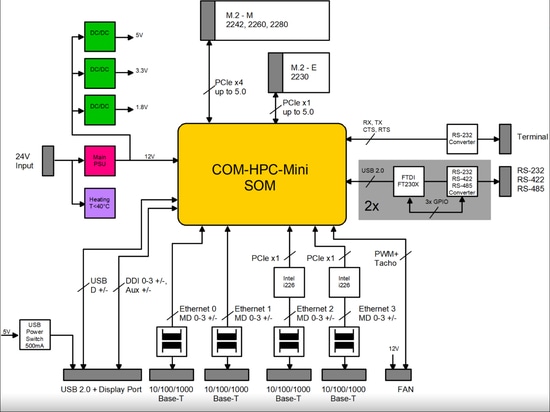
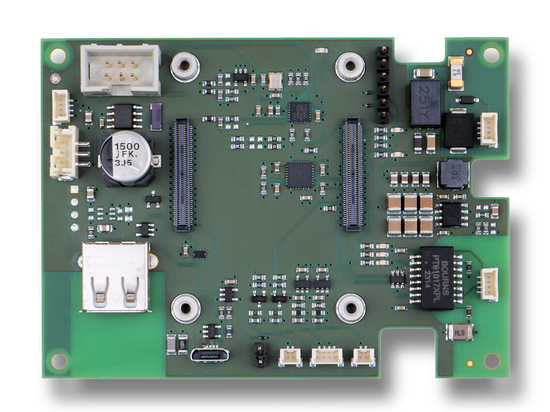
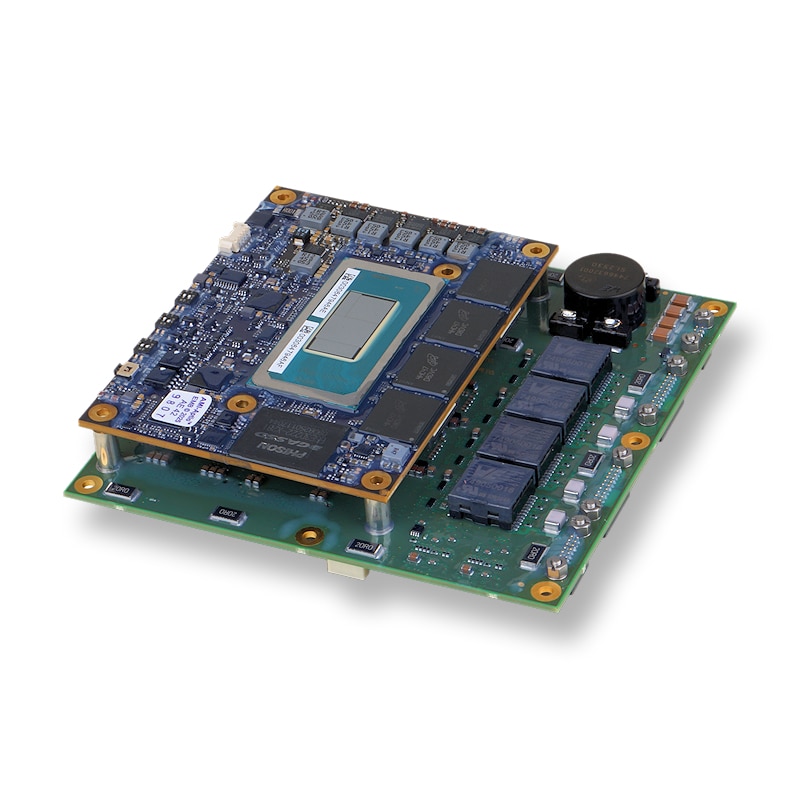
esd electronics first supported the customer in selecting and designing the appropriate platform and subsequently developed, manufactured, and delivered a custom carrier board for the COM-HPC Mini module in use. The carrier board supplies power to the CPU module and supports the integrated onboard functions. It features a COM-HPC Mini slot with a 10 mm mating height, an M.2 M-Key slot for SSDs in 2242, 2260, and 2280 formats, as well as an additional M.2 E-Key slot, for example for WLAN modules. Furthermore, the design includes four 1000BASE-T Ethernet ports, two configurable serial interfaces supporting RS232, RS422, and RS485, an RS232 terminal interface, and proprietary DisplayPort and USB 2.0 interfaces for commissioning and debugging purposes.
To ensure reliable operation at ambient temperatures below −40 °C, an intelligent heating system was integrated. esd electronics also supplied simple software tools enabling configuration of the serial interface modes and heater control. For deployment in harsh environments, the carrier board was provided with a protective conformal coating. In addition, esd electronics coated the CPU modules supplied by the customer for prototype use and assembled the required cabling for both internal connections and external interfaces via the circular connectors used.
"esd electronics provided close support throughout the entire process, from platform design through to implementation of the carrier board. Their technical consulting and integration expertise enabled us to efficiently translate our system requirements into a fully functional solution." Project manager of the system provider
How does this solution benefit the customer?
The customer was provided with a hardware platform tailored to its specific application, including consulting, development, protective coating, cable assembly, configuration tools, and prototype manufacturing.
This enabled key integration tasks – such as power supply, interface implementation, service access, internal and external cabling, and low-temperature performance – to be addressed early within a coherent and feasible system design. As a result, overall integration effort was reduced, technical risks (for example related to cold start behavior, mechanical integration, and interface connectivity) were minimized, and the need to coordinate multiple partners was eliminated. This approach gave the customer a reliable foundation for further system integration, testing, and qualification of the rugged computing system.