


#Industry News
Italian Engineering Meets Australian Standards: Euromecc’s Solutions for the Precast Industry
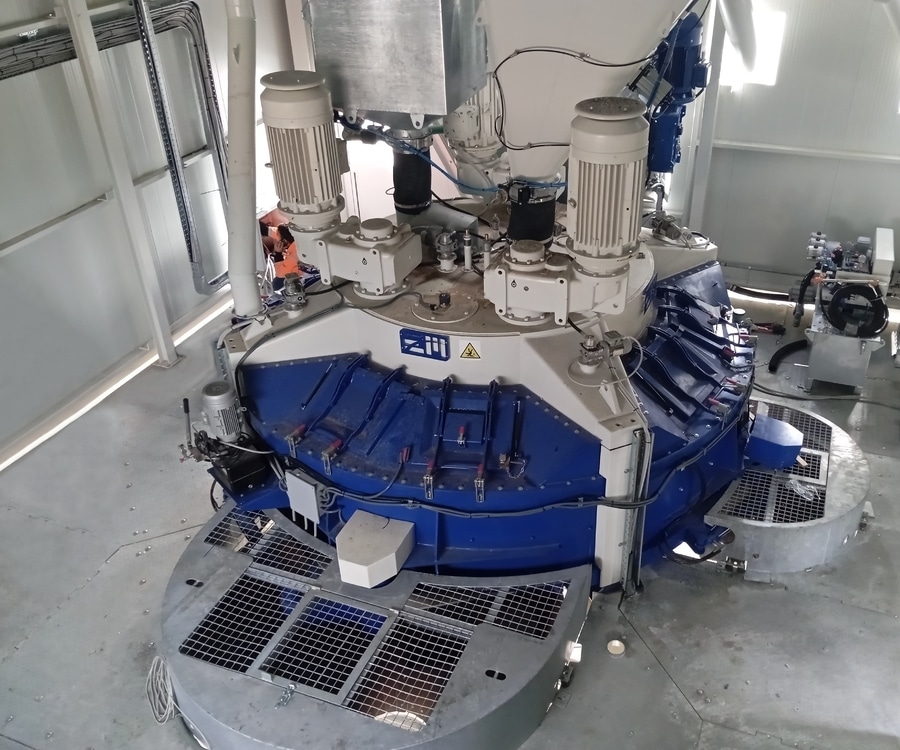
Inside Euromecc’s customised precast batching plant in New South Wales, Australia.
Introduction
The global precast concrete industry is evolving rapidly, driven by the demand for shorter construction times, greater durability and consistent quality. This trend is particularly evident in Australia, where major infrastructure investments, from tunnelling and highway projects to water management systems, continue to support demand for high-quality precast concrete elements.
At the same time, the Australian market presents demanding technical and regulatory challenges. Engineering standards, workplace health and safety (WHS) requirements and electrical compliance are fundamental considerations in the design and delivery of industrial equipment.
For international equipment manufacturers, succeeding in this market involves more than exporting standard machinery. It requires designs adapted to local requirements, a sound understanding of the applicable regulatory framework and close collaboration with local specialists. Euromecc, an Italian manufacturer of concrete batching plants and bulk material handling systems, has approached the Australian precast market by combining its engineering experience with the expertise of a dedicated local team.
This approach was demonstrated in the design, manufacture, installation, commissioning and compliance process for a concrete batching plant in New South Wales (NSW). Developed for a leading manufacturer of precast concrete pipes and civil infrastructure products, the project illustrates Euromecc’s ability to provide a customised solution for a technically demanding production environment.
The Australian Context: Engineering and Safety Standards
Delivering a heavy industrial plant in Australia requires careful consideration of the relevant Australian Standards (AS) and the regulatory requirements applicable to the project. For a concrete batching plant, these requirements can affect material dosing, structural design, safe access, machine guarding and electrical installations.
AS 1379 (Specification and Supply of Concrete) provides an important reference for concrete production and quality control, including requirements relevant to accurate weighing and batching. Consistency is particularly important when manufacturing concrete pipes and other elements intended for civil infrastructure applications.
Structural design must also address local environmental conditions. AS/NZS 1170 (Structural Design Actions) provides the framework for assessing actions such as wind and, where applicable, seismic loads. Steel structures, supporting elements
and foundations therefore require appropriate engineering verification in accordance with the project requirements and relevant local approval processes.
Workplace safety is another key consideration. Australian WHS legislation establishes obligations for safe plant design and operation. AS 1657 (Fixed Platforms, Walkways, Stairways and Ladders) informs the design of access systems, while the AS 4024 series (Safety of Machinery) addresses machinery risk reduction and safeguarding. Electrical design and installation must also take account of applicable requirements, including AS/NZS 3000 (Australian/New Zealand Wiring Rules).
Project Spotlight: A Precast Facility in New South Wales
When a leading concrete pipe manufacturer sought to upgrade its production capabilities in NSW, it needed a batching plant suited to a specialised manufacturing process. The facility was designed to produce high-strength, zero-slump, semi-dry concrete for the spun and vibrated casting of heavy-duty concrete pipes.
Producing semi-dry concrete for pipe manufacture requires particular attention to the mixing process. Its low moisture content demands efficient, intensive mixing to achieve a homogeneous distribution of cementitious materials and aggregates within short production cycles.
Detail of the mixing arms and wear-resistant liners inside a planetary mixer
Euromecc developed a customised indoor/outdoor batching facility to accommodate the client's site layout and operating requirements. Heavy-duty planetary mixers form the core of the plant. Their mixing action is particularly suited to low-moisture concrete, helping distribute materials uniformly and reduce agglomerations. The mixers incorporate wear-resistant liners and blades made from specialised high-chromium alloys, selected to withstand the abrasion associated with semi-dry concrete production and support maintenance efficiency.
Precision Engineering for Precast Operations
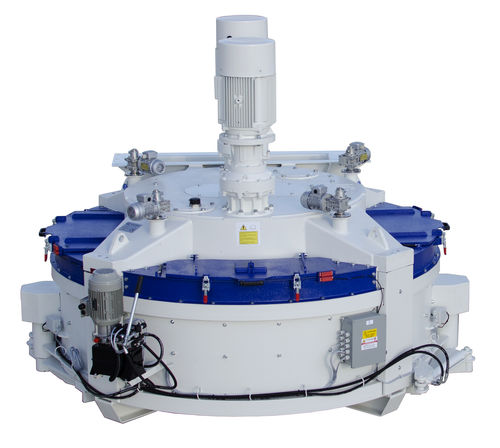
Euromecc MEP planetary mixer for intensive mixing of low-moisture concrete
In addition to the mixers, the material handling system was designed to support accurate and repeatable dosing. Aggregate storage is arranged in a low-profile, high-capacity inline bin configuration, adapted to the site's logistics. High-frequency extraction belts for fine dosing form part of the batching arrangement, supporting the control of material quantities and the production consistency required for precast operations.
Moisture control is a particularly important factor in producing zero-slump concrete. Variations in the moisture content of sand can affect the consistency of the mix and the behaviour of freshly demoulded pipes. The plant incorporates microwave moisture probes in the aggregate bins and mixer floor, connected to Euromecc’s PLC-based control system. The system uses moisture measurements to calculate compensation water and adjust dosing during production, helping maintain the required mix consistency.
Efficient transfer of the mixed concrete to the pipe-making equipment is another important part of the process. Euromecc designed an automated flying-bucket distribution system suspended from an overhead monorail. Integrated with the batching plant controls, the buckets receive the concrete and deliver it to the hoppers of the pipe-making machines, supporting a coordinated production flow and reducing delays in material transfer.
Addressing Local Compliance Requirements
Alongside the mechanical process, the project required close attention to the safety and compliance requirements applicable to the installation and operation of an industrial facility in NSW.
From the early design stages, Euromecc’s engineering department in Italy developed a detailed 3D model in collaboration with the Australian team and the client's safety personnel. This approach supported early hazard and operability reviews (HAZOP) and allowed potential design and access issues to be considered before fabrication.
Access platforms, stairs and maintenance walkways were developed with reference to AS 1657 and the client's site-specific safety requirements. Design adaptations included wider walkways, revised stair inclinations and additional fall-protection measures where required.
Machine safeguarding was addressed with reference to the AS 4024 series. The design includes protective barriers around identified hazardous areas, such as conveyor pulleys and other moving components. A trapped-key interlocking system was also incorporated to help ensure that access to designated maintenance areas takes place only after the relevant equipment has been isolated and the prescribed safety procedures have been followed.
The electrical system was adapted for the Australian market through cooperation with local electrical engineers. Motor Control Centres (MCCs) and main switchboards were designed with regard to the applicable Australian requirements, including AS/NZS 3000, and the use of locally approved, readily available components. This approach helped facilitate the compliance process and supports future serviceability and spare-parts availability.
Italian Engineering and Local Australian Expertise
An important element of the NSW project was Euromecc’s combination of Italian design and manufacturing expertise with local Australian knowledge. For a project of this scale, effective coordination between the equipment manufacturer, the client and local specialists is essential throughout design, installation and commissioning.
While fabrication and pre-assembly activities were carried out at Euromecc's manufacturing facilities in Italy, its Australian team was involved from the outset. The team worked closely with the Italian design office to translate local technical, regulatory and operational requirements into practical project specifications.
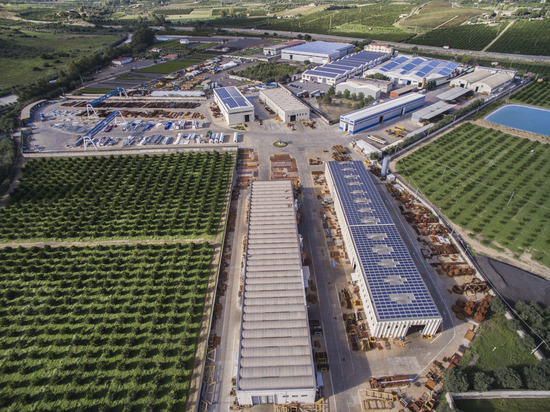
Engineering and assembly activities at Euromecc manufacturing facilities in Italy.
Following shipment to New South Wales, mechanical and electrical installation was undertaken by a specialised local team selected by the client. The work was supported by joint supervision from Euromecc’s Italian and Australian engineering teams, providing guidance on mechanical, structural and electrical aspects and helping ensure consistency with the agreed design and installation requirements.
Supporting Production Efficiency and Reliability
The completed facility was designed to improve the client's production capacity, support consistent semi-dry concrete quality and reduce waste associated with batching variability. Accurate material dosing and controlled mixing are intended to contribute to reliable pipe production, including consistent surface quality and mechanical performance.
The combination of plant automation and electrical components selected for local availability also aims to simplify operation and maintenance, limit unnecessary manual intervention and support long-term reliability. These features provide a foundation for efficient and safe precast pipe manufacturing.
Conclusion: An Approach for Future Projects
The New South Wales precast pipe facility demonstrates the value of combining specialised concrete production technology with a project-specific approach to engineering, safety and local compliance. It also highlights the importance of cooperation between an international equipment manufacturer and local project partners.
As Australia's infrastructure sector continues to require reliable precast concrete products, producers need equipment tailored to their manufacturing processes, site constraints and regulatory environment. Through this NSW project, Euromecc illustrates how customised engineering, attention to safety and coordinated local support can contribute to the successful delivery of concrete batching solutions for the Australian precast industry.

 鄂公网安备42018502009509号