
#Product Trends
Challenges of Micro Airflow Measurement and Reverse Flow Risk in Positive and Negative Pressure Control Environments
Challenges of Micro Airflow Measurement and Reverse Flow Risk in Positive and Negative Pressure Control Environments
In critical spaces such as positive pressure (e.g., clean production areas in pharmaceutical factories) and negative pressure (e.g., isolation wards, bioreactor rooms), maintaining stable and unidirectional airflow is the core protective mechanism to prevent contamination spread and block cross-infection. The industry currently relies on differential pressure transmitters as the primary monitoring method, if air will flow steadily along the pressure gradient, which is then used to control air dampers, access control, or alarm systems. However, this design has a key blind spot: the existence of differential pressure does not guarantee actual airflow, nor can it determine whether the airflow is being directed correctly.
Why Differential Pressure Sensors Cannot Fulfill the Task of Unidirectional Airflow Monitoring?
1. Differential Pressure ≠ Airflow Kinetic Energy
2. Differential Pressure Cannot Identify Airflow Direction
3. System Delays and Obstruction Risks
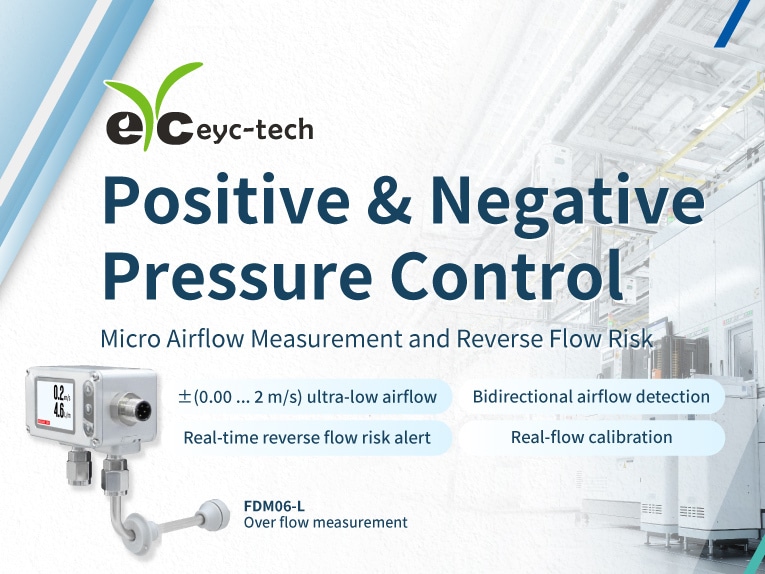
FDM06-L Bi-directional Low Air Flow Thermal Mass Transmitter (Overflow type) for Positive and Negative Pressure Measurement
Positive and negative pressure are important measurements in cleanroom design for maintaining airflow direction. They are often installed between two adjacent zones to drive air from high cleanliness areas toward low cleanliness areas using pressure gradients to prevent backflow of suspended particles or contaminants. This airflow is typically lateral, low-speed, and stable unidirectional flow, with air velocity typically between 0.2 to 0.4 m/s, which imposes strict requirements on flow direction consistency and continuity.