#Industry News
LU-S
Industrial tanks: when standard dimensions are not enough
Industrial tanks: when standard dimensions are not enough
Distances, liquids and control points vary from one system to another. Level indicators must therefore adapt to the specific requirements of each application
Industrial tanks do not have a single configuration suitable for every application. Their dimensions, the liquid they contain, the distance between connections and the points at which the level must be monitored can all vary.
The choice of a level indicator cannot therefore depend solely on the dimensions available in a catalogue. It must begin with the tank structure, the operating conditions and the information required while the system is running.
In some cases, a clear visual indication of the liquid level is sufficient. In others, visual reading must be combined with electrical monitoring at one or more predetermined points. These positions also vary according to the application and cannot be defined in the same way for every system.
From visual indication to electrical monitoring
Combining both functions in a single instrument makes it possible to check the liquid level directly while simultaneously monitoring the points considered relevant through electrical contacts.
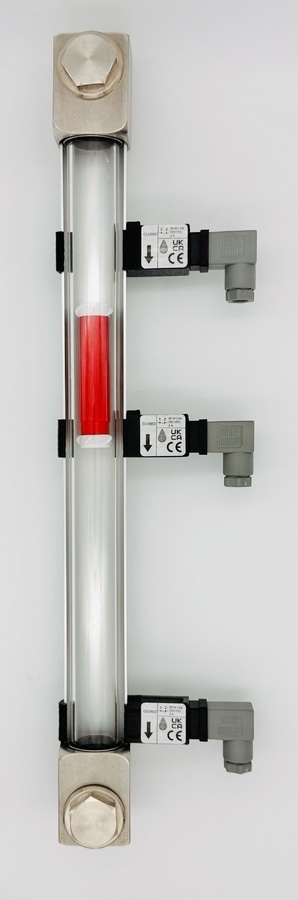
This is the requirement addressed by LU-S, the solution developed by F.lli Giacomello for the visual and electrical monitoring of liquids in tanks.
The product is available with centre distances from 150 to 4,000 mm and 3/8” and 1/2” Gas connections. The centre distance indicates the distance between the indicator’s connection points and does not necessarily correspond to the tank’s overall height.
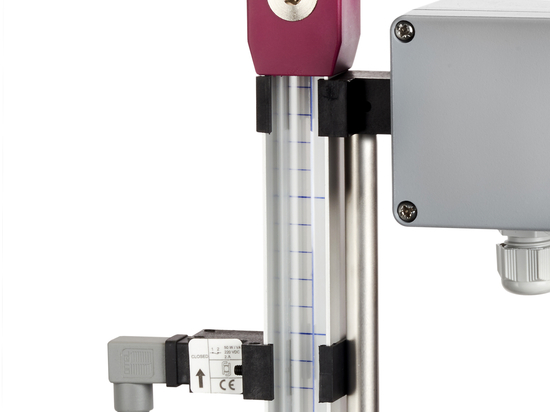
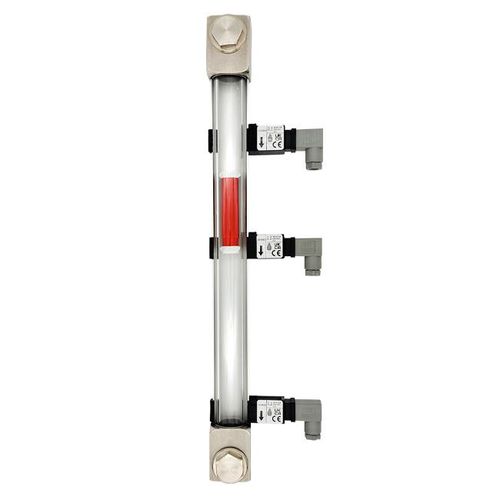
One or more bistable Reed sensors can be positioned along the axis of the instrument according to the points that must be monitored in the specific application.
As the float moves through the tube, it changes the state of the sensor placed in the predetermined position. The contact returns to its previous state only when the float travels in the opposite direction.
The LU-S configuration is therefore not restricted to a single centre distance or to predefined control points; it can be adapted to the actual characteristics of the tank.
The communicating-vessels principle applied to industrial monitoring
The visual indication is based on the communicating-vessels principle. The liquid passes through the instrument by means of hollow screws, showing the operator the level inside the tank.
At the same time, the float moving through the tube activates the bistable Reed sensors positioned along the indicator’s axis.
LU-S therefore combines:
· visual level indication;
· electrical monitoring through one or more sensors;
· centre distances from 150 to 4,000 mm;
· variable-position sensors;
· 3/8” and 1/2” Gas connections;
· components that can be configured according to specific operating conditions.
Customisation therefore concerns not only the length of the indicator, but also the number and position of the points to be monitored.
Different applications require different configurations
LU-S is suitable for installation on hydraulic power units and tanks containing water, diesel fuel, oils with a viscosity of up to 220 cSt, and other compatible liquids, excluding flammable liquids.
The variety of possible applications makes the choice of configuration particularly important. The distance between connections, the position of the sensors and the components must be defined by considering the tank’s characteristics and the conditions in which the instrument will operate.
Thanks to the modular range of available components, LU-S can be customised to meet specific operating requirements while retaining both visual indication and electrical monitoring in a single instrument.
The application defines the indicator
When standard dimensions are not sufficient, the tank should not have to adapt to a predefined configuration. The indicator must instead be designed around the system.
With centre distances of up to 4,000 mm, variable-position sensors and a modular structure, LU-S is a practical example of this approach: level monitoring is configured according to the actual distances and the points that need to be monitored.
This design choice transforms customisation from a simple dimensional variation into an integral part of the instrument’s operation.