
#Product Trends
How Plate Geometry Reduces Fouling in Wastewater Heat Exchangers
Why plate design matters more than you think
Heat recovery has become a key strategy for improving the energy efficiency of wastewater treatment plants, biogas facilities and industrial processes. Recovering thermal energy from wastewater can significantly reduce operating costs while supporting sustainability goals. However, these applications also present one of the greatest challenges for plate heat exchangers: fouling.
Wastewater, sludge and other process fluids often contain suspended solids, fibres, grease and biological contaminants that gradually accumulate inside the heat exchanger. As deposits build up, thermal performance decreases, pressure losses increase and maintenance intervals become more frequent.
Although operating conditions influence fouling, one of the most decisive factors is often overlooked: plate geometry.
Why conventional plate heat exchangers struggle
Traditional plate heat exchangers are designed to maximize heat transfer by creating highly turbulent flow through narrow channels. This approach delivers excellent thermal efficiency when handling clean liquids.
In wastewater applications, however, the same narrow passages can become a disadvantage.
Fibres, organic particles and suspended solids are more likely to become trapped inside the channels. Over time this leads to:
reduced heat transfer efficiency
increasing pressure drop
higher pumping energy
more frequent cleaning
unplanned production downtime
The result is a higher total cost of ownership, even when the initial investment is relatively low.
The importance of plate geometry
Selecting the right plate geometry is often more important than simply increasing the heat transfer surface.
For contaminated or particle-laden fluids, wider flow channels allow solids to pass more freely through the exchanger while maintaining efficient heat transfer. Properly designed plate patterns also help distribute flow evenly across the plate surface, minimizing dead zones where deposits typically begin to accumulate.
This combination significantly reduces the risk of blockage without compromising process reliability.
Engineered for demanding wastewater applications
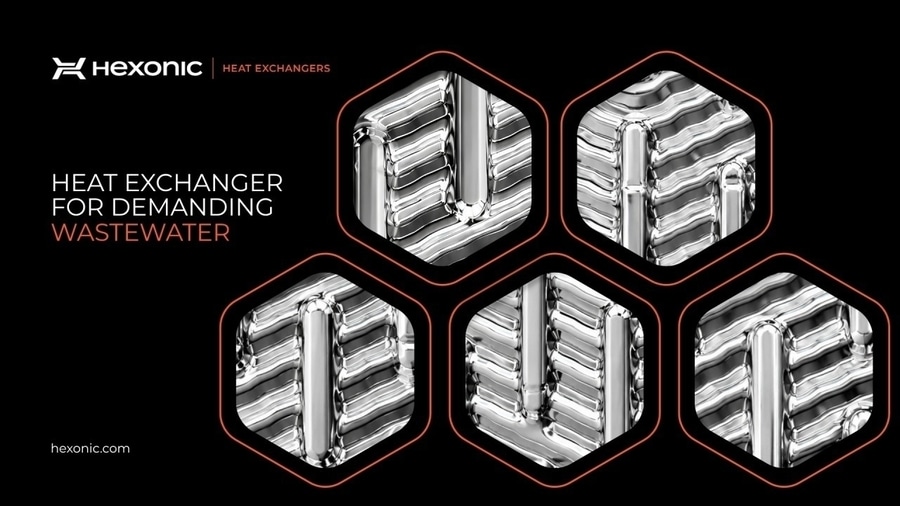
To address these challenges, Hexonic developed the REEFLOW plate technology, available in selected gasketed plate heat exchangers.
Unlike conventional plate designs, REEFLOW features optimized wide-flow channels specifically intended for difficult industrial media, including:
municipal wastewater
industrial wastewater
sludge
digestate
biogas processes
fibre-containing liquids
viscous process fluids
The optimized channel geometry enables particles to pass through more easily, reducing the tendency for fouling while maintaining stable thermal performance.
Rather than maximizing turbulence alone, the design focuses on balancing heat transfer efficiency with long-term operational reliability.
Operational benefits
Choosing the correct plate geometry can provide measurable operational advantages:
reduced fouling tendency
longer operating intervals between cleaning
lower maintenance requirements
more stable thermal performance
reduced pressure losses
improved equipment availability
lower lifecycle costs
For many wastewater facilities, these benefits outweigh small differences in peak thermal efficiency that may be achieved using narrower plate designs.
Typical applications
Wide-channel plate technology is particularly suitable for:
municipal wastewater treatment plants
industrial wastewater recovery
anaerobic digestion systems
biogas production
pulp and paper industry
food processing
beverage production
chemical processes containing suspended solids
In these environments, operational reliability is often more valuable than achieving the absolute maximum heat transfer coefficient.
Selecting the right heat exchanger
There is no universal plate geometry suitable for every application.
Clean fluids generally benefit from conventional high-efficiency plate designs, whereas contaminated media require a different engineering approach.
When selecting a heat exchanger for wastewater applications, engineers should evaluate:
solid particle concentration
fibre content
fluid viscosity
fouling potential
cleaning frequency
allowable pressure drop
maintenance accessibility
Considering these factors during the design stage helps ensure reliable long-term operation while minimizing maintenance costs.
Looking beyond thermal performance
Heat exchanger selection should never be based solely on heat transfer calculations.
For demanding wastewater applications, operational reliability, ease of maintenance and resistance to fouling are equally important design criteria.
Optimized plate geometry, such as Hexonic's REEFLOW technology, demonstrates how thoughtful engineering can significantly improve system availability while reducing operating costs throughout the equipment's service life.
About Hexonic
Hexonic designs and manufactures advanced heat exchangers for HVAC, industrial processing, energy, refrigeration and wastewater applications. Its portfolio includes gasketed, brazed, shell-and-tube and shell-and-plate heat exchangers engineered to deliver high efficiency, reliability and long service life in demanding operating conditions.