#Product Trends
When Rotation Stays Connected: Fiber Optic + Electrical Slip Ring Combinations Are Packing Gas, Power, Fluid, and optic into the Same Rotating Shaft
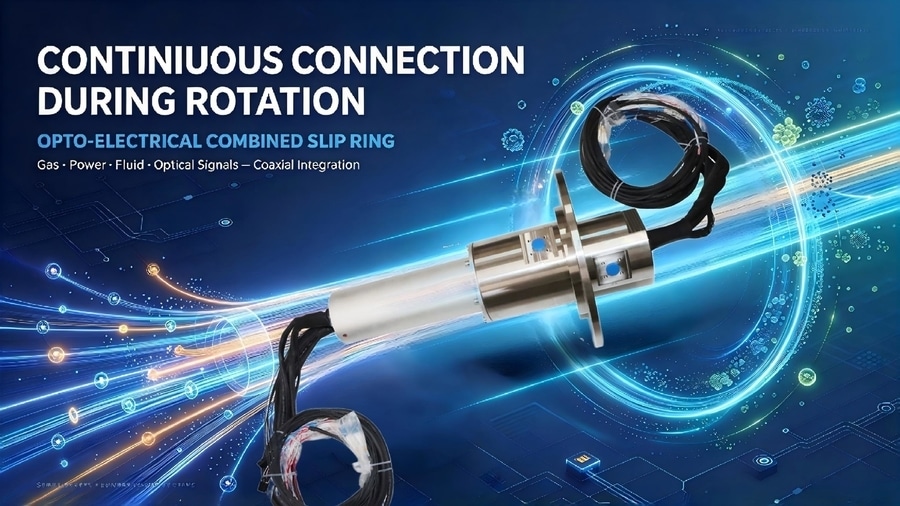
Continuous Connection During Rotation | Combined Fiber-Optic & Electrical Slip Ring, Coaxial Integration of Gas, Power, Fluid and Optical Signals
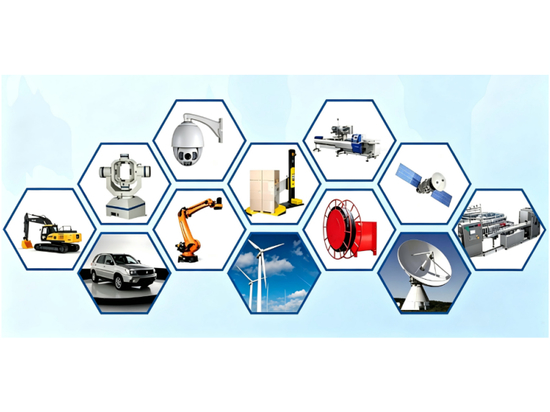
News Brief:In radar turntables, ROV thrusters, medical CT scanners, and construction machinery slewing platforms, there is an inconspicuous component that determines whether the entire machine can “transmit while rotating” — the slip ring. In the past, it only handled power conduction; later, encoders and Ethernet were added; now, fiber optics are becoming one of the core channels in highend electrooptical hybrid slip rings. In this issue, we take a closer look: exactly how many types of electrical signals can a fiber optic slip ring “team up” with, and to what extent can the “gas + electricity + liquid +optic” allinone integration go today?
I. Why Fiber Optic Slip Rings Are in the Spotlight
Traditional electrical slip rings rely on metal brushes sliding over copper rings to transmit current and signals, but they struggle with three things:
•High-speed data: Gigabit Ethernet, highdefinition video, radar echoes, Camera Link;
•Long distances: Backhaul over tens to thousands of meters, where electrical signal attenuation becomes unbearable;
•Strong electromagnetic interference: Near variablefrequency drives, motors, and welding equipment, copper wires act like antennas.
Fiber optic rotary joints (FORJ) use light instead of electricity to transmit data. They inherently offer high bandwidth, low loss, EMI resistance, and support singlemode/multimode switching. Therefore, a common approach in highend equipment is to “let the electrical slip ring supply power and lowspeed signals, while the fiber optic slip ring handles highspeed data,” with both systems stacked on the same rotating shaft.
II. What “Electrical Signals” Can Fiber Optics Combine With? A Quick List
1. Power Electricity (The Most Basic Partner)
•2A / 5A / 10A / 20A signal and power rings
•High-voltage, highcurrent up to 3300V / 720A (thruster grade)
•Low-voltage 24V / 220V / 480V control and servo power supply
Typical combo:N channels of fiber + several channels of power, allowing a turntable to supply power to a pod while rotating.
2. Industrial Ethernet & Data
•100M Ethernet (100BaseT)
•Gigabit Ethernet (1000BaseT)
•Industrial Ethernet: PROFINET, EtherNet/IP, EtherCAT, Modbus/TCP
•USB 2.0 / USB 3.0
Fiber carries the “highspeed backbone,” while electrical rings supplement the “control command loop.”
3. Fieldbus & Serial Ports
•RS232 / RS422 / RS485
•CAN / CANopen / CANbus
•ProfibusDP
•DeviceNet / ControlNet / CCLink
•InterBus, Modbus RTU
Commonly used for servo drives, PLC remote I/O, and encoder feedback.
4. Servo / Encoder / Sensor Signals
•Servo encoder cables (compatible with Yaskawa / Panasonic / Siemens servo systems)
•Resolver signals, excitation signals
•Thermocouples, RTDs (PT100)
•4–20mA / 0–10V analog
•Temperature, pressure, load cell sensors
•SSI, BISS, TTL, SPI, I²C, UART, 1553B, 1394B
Electrooptical slip rings are often configured as “1–36 channels fiber + dozens of weaksignal electrical channels.”
5. Video / Audio / High Frequency
•CVBS / AHD / CVI / TVI analog high definition
•HD-SDI / 3GSDI
•HDMI (19pin), VGA (9pin)
•Coaxial RF, microwave, RF rotary joints (can be embedded separately)
Common in electrooptical pods, turntable surveillance, and broadcast vans.
6. Special Options
•Singlemode / multimode available (FC / SC / ST / LC / APC)
•Wavelength division, multichannel fiber (products with up to 120 channels have been seen)
•Goldtogold contacts, IP65–IP68, stainless steel housing, explosionproof housing
III. “Gas + Electricity + Liquid + Optic” All-in-One: The Ultimate Legolike Form of Slip Rings
Doing “optical + electrical” alone is no longer novel; the real challenge is stacking “gas and liquid paths” as well, without crosscontamination of media.
Integratable Media List
Medium Type Common Content Remarks
Electric Power + signal + Ethernet + bus High/low voltage modules isolated
Optical Single-mode/multimode fiber, RF fiber Expandable from 1 to 120 channels
Gas Compressed air, nitrogen, vacuum, water vapor Vacuum lines count as one channel
Liquid Hydraulic oil, coolant, water, lubricating oil, hot oil, cleaning fluid Pressure limit depends on sealing grade
High Frequency RF, microwave, SDI rotary joints Often chosen between fiber or used together
Typical All-in-One Structures
•Stacked type: Electrical slip ring + fiber optic ring + pneumatic/hydraulic rotor stacked in sections for easy modular maintenance
•Coaxial nested: Central throughbore for shaft, pneumatic/hydraulic ports distributed on the periphery
•Separate type: Fiber optic rotary joint (FORJ) physically separated but coaxial with the electrical slip ring
•Largeaperture throughbore: Inner diameter 500–1000 mm, convenient for cable and pipe routing (top drives, winches)
IV. Typical Application Scenarios
•Ocean engineering / ROV / thrusters: 3300V + 720A power + 6channel fiber + 100M Ethernet + 10channel gas/liquid, IP68 + 316L housing
•Military radar / electrooptical pod: Gigabit Ethernet + HDSDI + servo encoder + singlemode fiber, GJB150A environmental testing
•Medical CT / surgical arm: Low speed, high channel count, electrical + optical + encoder, lownoise precious metal contacts
•Construction machinery slewing: Power 20A×N + control valve signals + compressed air for dust blowing + fiber video
•Packaging / printing / semiconductor turntable: Ethernet + bus + servo + vacuum suction nozzle gas path
•Oil top drive / coiled tubing: High current + hydraulics + fiber + high frequency, vibration and saltspray resistant
V. Summary: Slip Rings Are Evolving from “Components” to “Rotary End Systems”
Early slip rings = conductive rings;
Later = conductive + encoders;
Today’s highend form = optical (FORJ) + electrical (power/bus/Gigabit) + gas + liquid + high frequency, stacked and integrated according to turntable operating conditions.
For equipment manufacturers, the significance goes beyond “using fewer cables”; it means:
•Centralized and controllable failure sources at the shaft end
•Higher overall protection rating
•Reduced wiring costs for large systems
•In scenarios like deep sea, military, and medical electronics, domestic alternatives are now competitive