#Product Trends
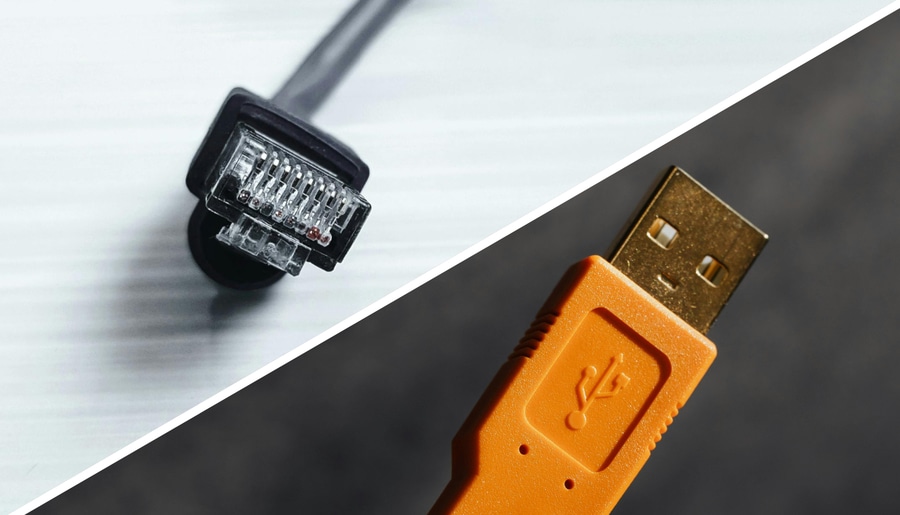
USB vs Ethernet: Which protocol should you choose for a CNC?
The USB protocol was originally designed for office peripherals. Its integration into a manufacturing workshop has structural limitations.
In industrial automation and CNC machine control, reliable data transmission is a critical factor in productivity. While USB interfaces remain common on equipment, Ethernet is becoming the standard for demanding production environments.
The USB protocol was originally designed for office peripherals. Its integration into a manufacturing workshop has structural limitations.
- Electromagnetic Interference (EMI): USB is extremely sensitive to noise generated by variable frequency drives (VFDs), servo motors, and plasma cutting systems. A spike in interference can cause a break in the command queue, resulting in immediate shutdown of machining and potential loss of the part.
- Distance Constraints: The USB standard limits signal integrity to a maximum distance of 5 meters. Beyond that, active repeaters are required, adding an additional point of failure.
- Connection Integrity: USB connectors do not have mechanical locking (except for specific industrial versions), making them susceptible to mechanical vibrations from the machine.
Ethernet is designed for communication in harsh environments. For an integrator or production manager, its advantages are decisive.
- Galvanic Isolation: Ethernet ports use coupling transformers that electrically isolate the CNC controller from the control PC. This architecture eliminates ground loops and protects the electronics from electrostatic discharge.
- Throughput and Real Time: Unlike USB, which operates in “packets” managed by the PC processor, Ethernet allows for more deterministic communication. The flow of coordinates is smoother, resulting in a better surface finish during complex 3- or 5-axis machining.
- Scalability and Distance: With a range of 100 meters without degradation on CAT6 cable, Ethernet allows control units to be located in air-conditioned cabinets or control rooms isolated from dust and splashes.
For light engraving or occasional prototyping applications, USB offers quick implementation at a lower cost. However, for any mass production, high-speed machining (HSM), or environments with strong electromagnetic constraints (plasma, fiber laser, metal milling) applications, Ethernet is the only solution that guarantees optimal machine availability.