#Industry News
Laser Degating vs. Mechanical Cutting of Sprues Compared
Laser degating or mechanical cutting of sprues: a comparison of edge quality, residue, wear, and repeatability on injection-molded parts
Anyone who injection-molds plastic components knows the final step of the cycle well: separating the part from the sprue, that is, the solidified feed channel that carries the molten resin into the cavity. It seems like a trivial operation, but that is where the appearance of the break point, the cleanliness of the surface and, often, the amount of scrap that fails visual inspection are all decided.
Separation can be done in two very different ways. Mechanical cutting — shearing, clipping, nippers — is the traditional method and remains valid for many production runs. Laser degating separates the sprue without contact, using a beam that works the material right at the break point. This article compares the two approaches on what really matters to anyone managing production: edge quality, residue, wear, repeatability and in-line integration — while also pointing out when mechanical cutting remains the more sensible choice.
Sprue separation is a critical point in the cycle
The sprue is not a cosmetic detail. The point where it was attached (the gate) is a transition zone between the functional geometry of the part and the scrap material, and the way separation occurs leaves a permanent mark. On a visible component — a frame, a light guide, an automotive interior panel — that point must be flat and clean; on a functional component it must be free of cracks or deformations that would weaken the area. In both cases the separation method goes directly into the part’s quality specification.
Mechanical cutting: where it works and what it leaves on the part
Mechanical cutting is fast, direct and perfectly adequate when the gate is thick, the geometry of the break point is accessible and the cosmetic tolerance is wide. A well-sharpened blade or nippers on a resin that cuts well produces an acceptable separation in fractions of a second, and it is hard to beat this simplicity on high volumes of non-visible technical parts.
The limits arise when the part is visible or the material is sensitive. Tool contact applies stress to the break zone: on filled, fiber-reinforced or brittle resins, this can generate microfractures, whitening (stress whitening) or an edge that frays. Then there are burrs and flash left to finish, and dust and small chips are produced that settle on the part or in the work environment. Finally, blades wear out: an edge that loses its sharpness progressively worsens the edge quality, and the moment it needs replacing does not always coincide with a controlled quality threshold.
Laser degating: separating the sprue without contact
Laser degating addresses the same problem thermally rather than mechanically. The beam is directed to the break point and removes material along a software-defined path, separating the sprue from the part without anything physically touching the surface. The absence of contact eliminates mechanical stress on the break zone at its root: there is no blade pressing down, so there is no load to generate whitening or microfractures on delicate resins.
The cutting path is a geometric value in the program, not the physical position of a tool. This makes the process controllable: the break point is always the same, cycle after cycle, and the edge profile depends on the set parameters, not on the sharpness of a blade. Laser sprue removal was developed precisely for cases where mechanical cutting cannot guarantee a repeatable, clean break point.
Edge and residue: the comparison that counts on the finished part
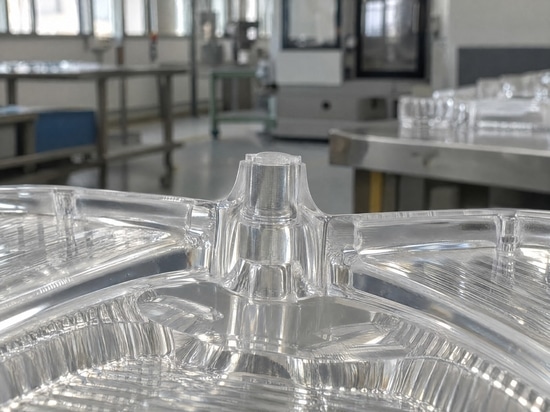
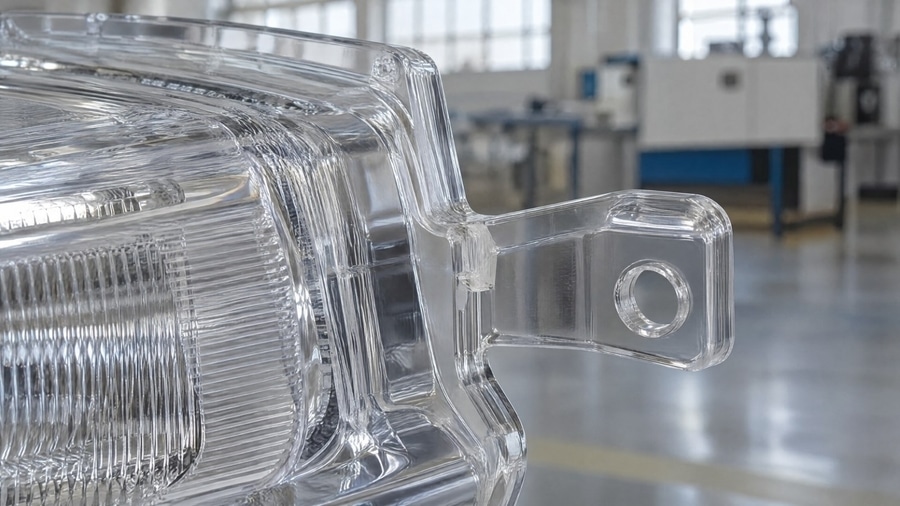
On the edge the difference is noticeable to the eye and to the touch. Contactless separation tends to leave a crisp point, without the burrs and fraying typical of a blade that loses its edge, and without the whitened zone that sometimes accompanies shearing on rigid materials. On optical lighting components this aspect has a specific, well-known implication: the residue and micro-particles left by an imprecise separation can migrate and condense on internal surfaces, a phenomenon we explored when discussing the foggy effect in laser degating. A clean edge and a process that manages smoke with localized extraction reduce the source of the problem instead of having to chase it downstream.
Repeatability and wear: what changes on high volumes
On a single part the two technologies can give similar results; it is over the life of the run that the paths diverge. In mechanical cutting, edge quality is tied to a part that wears out: as the blade loses its edge, flash grows and stress on the part increases, until replacement. This introduces variability across the lot that must be managed with inspections and scheduled maintenance.
Laser degating has no cutting edge that wears down: the result depends on stable parameters and the programmed path, so the edge of the first part and that of the last in the run are governed by the same logic. For production that measures quality in repeatability — and that has to justify it in process control — this stability is often the real argument, more than the peak quality achievable on a single sample.
In-line integration and flexibility on part changeover
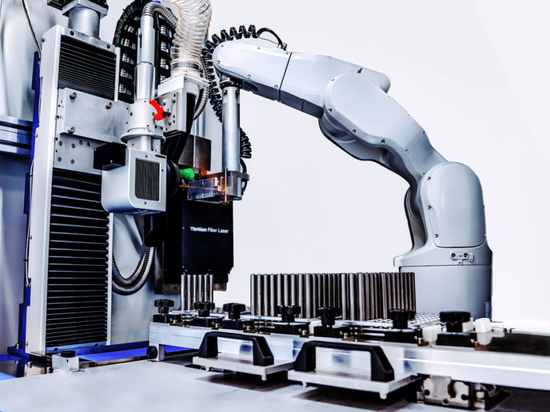
Because laser degating is software-driven, switching components means recalling another path, not setting up new blades or dedicated fixtures. On production with many variants or small lots, this flexibility affects setup time more than any single speed figure. The laser cell can also operate as an integrated node in the line, in sync with the press and the handling, and it can combine separation with traceability marking on the same part at the same station. Mechanical cutting remains quicker to integrate when the geometry is fixed and the format almost never changes.
When mechanical cutting remains the right choice
Laser degating does not replace mechanical cutting in every situation. On very thick, massive gates, on large-section sprues or on resins that cut cleanly and are not visible, shearing remains the simplest, fastest and most economical approach to set up: adding a laser source where a tool solves the problem well makes no technical sense. The laser is justified when the break point is critical for appearance or function, when the material is sensitive to mechanical stress, when residue is a downstream quality problem, or when edge variability across the run is not acceptable. In practice, it is in visible components, in delicate or filled resins and in multi-variant production that contactless separation shows its value; elsewhere, the nippers still do their job just fine.