
#Industry News
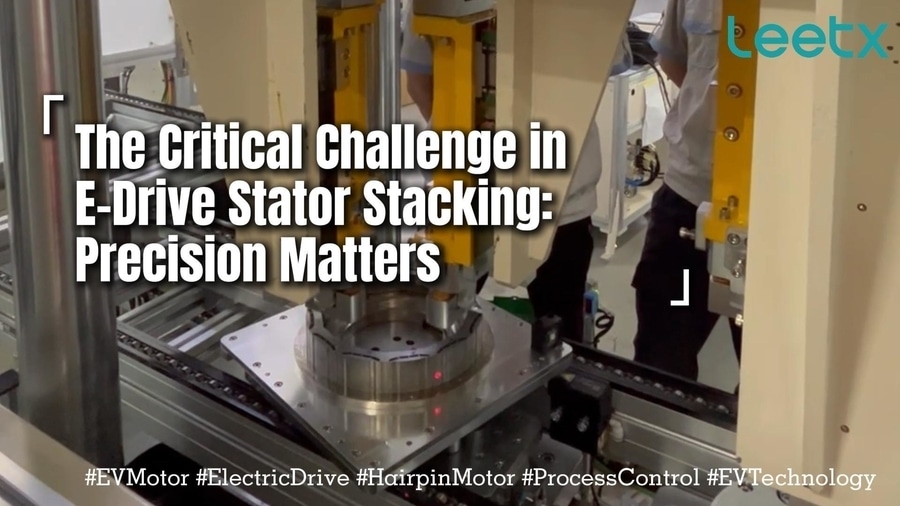
The Critical Challenge in E-Drive Stator Stacking: Precision Matters
Stator Stacking: Small Gaps, Big Problems
In the manufacturing of new energy vehicle e-drive stators, the lamination process for silicon steel sheets hinges on two make-or-break factors: pressure-displacement accuracy and stack alignment.
Pressure Precision: Avoiding Gaps & Deformation
Excessive or inconsistent pressure can cause over-compression, leading to micro-gaps and deformation between laminations. Even slight misalignment in the stack can result in a distorted stator core - making winding or pin insertion impossible, and ultimately failing assembly specs.
Stack Alignment: Ensuring Hole Consistency for Hairpin Motors
The alignment of interlocking tabs is equally critical. These small contact areas are prone to misalignment during pressing, which can cause layer-to-layer shift. In hairpin motor stators, misaligned laminations lead to misaligned pin holes - causing copper wires to scrape, bend, or fail insertion entirely. This directly impacts motor performance, power output, and assembly yield.
Why It Matters
A deviation of just fractions of a millimeter in pressure or alignment can compromise the entire stator - affecting efficiency, NVH, durability, and manufacturability. In precision e-drive production, there's no room for guesswork.
The Solution Lies In
1. Closed-loop force and position control
2. Real-time monitoring of pressure and displacement curves
3. Vision-guided or mechanical alignment systems
4. Data-traceable pressing processes
Precision lamination isn't just a step in the process - it's the foundation of a high-performance e-drive.