#Industry News
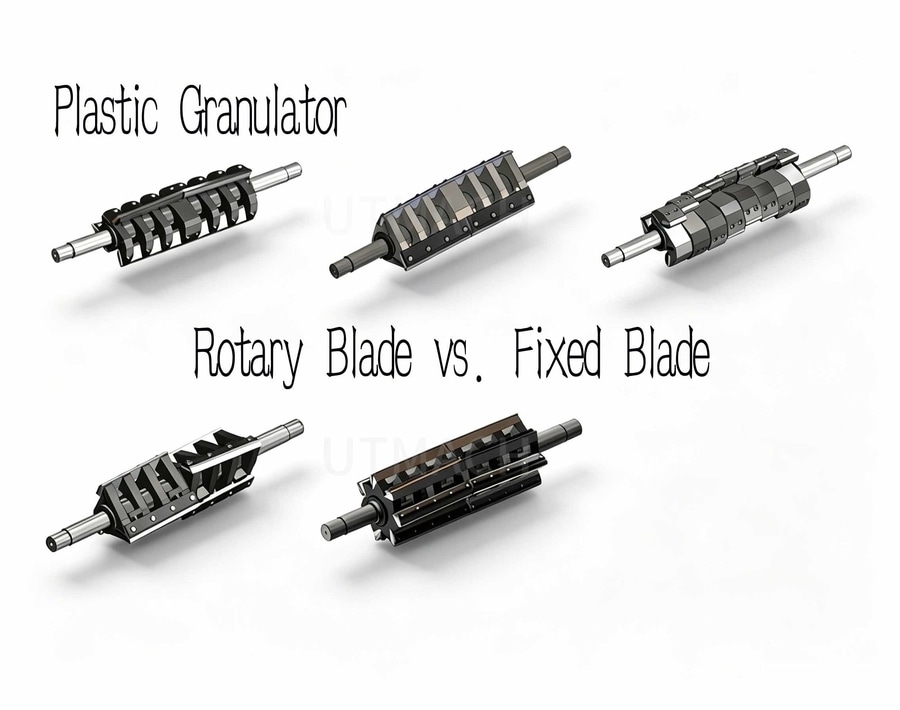
Plastic Granulator Rotary Blade vs. Fixed Blade:
How Do They Work?
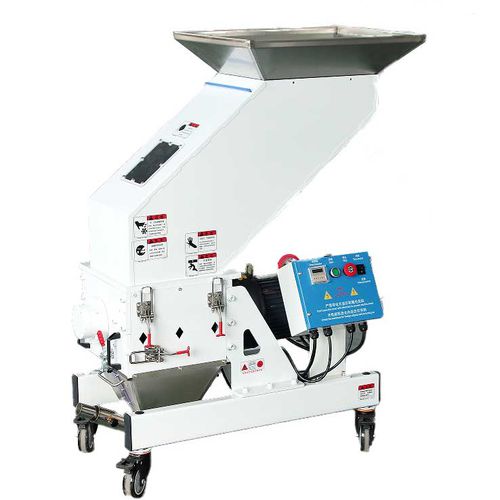
The rotary blade and fixed blade in a plastic granulator form a high-speed shearing system.
Simply put:
The rotary blade moves, while the fixed blade stays in position. Together, they create a shearing action that cuts plastic into smaller and more uniform pieces.
Understanding the function of each blade is important when selecting, operating and maintaining a plastic granulator.
1. What Is a Rotary Blade?
The rotary blade, also called a rotor knife, is installed on the rotating rotor of the plastic granulator.
As the rotor rotates at high speed, the rotary blades:
Grab and pull plastic into the cutting area
Cut the material together with the fixed blades;
Continuously move material through the cutting chamber
Work with the screen to control cutting efficiency and output size
In simple terms, you can think of the rotary blade as the moving part of a pair of scissors.
2. What Is a Fixed Blade?
The fixed blade, also called a bed knife, is mounted on the machine frame or knife holder and does not rotate.
Its main functions are to:
Provide a fixed cutting surface
Form a cutting gap with the rotary blade
Help achieve stable and efficient cutting
Reduce excessive tearing and squeezing of the plastic
In simple terms, the fixed blade acts as the stationary partner of the rotary blade.
3. How Do Rotary and Fixed Blades Work Together?
When a rotary blade passes the fixed blade, a small cutting clearance is created between them.
The cutting process can be simplified as:
Plastic → Rotary blade grabs material → Rotary + fixed blades shear → Small pieces → Screen → Finished output
Therefore, cutting is not completed by the rotary blade alone.
The actual cutting performance depends on:
Rotary Blade + Fixed Blade + Proper Cutting Clearance
Together, they form the core shearing system of the plastic granulator.
4. When Should Rotary and Fixed Blades Be Replaced?
Rotary Blade Wear
When rotary blades become worn or blunt, you may notice:
Reduced cutting efficiency
Lower production capacity
Higher motor current or energy consumption
Less consistent particle size
Fixed Blade Wear
When fixed blades wear, the cutting clearance becomes larger, which may cause:
Blunt cutting
More tearing instead of clean cutting
Lower production efficiency
Increased energy consumption
For some plastic granulators, worn blades can be resharpened and reused, helping extend blade service life.
How Can We Liantai Machinery Help?
The correct blade design, material and cutting clearance should be selected according to the plastic type, material size, required output and machine configuration.
Contact Liantai Machinery for more information about plastic granulator blades and cutting systems.
Tel: +86-18653354363
Email: [email protected]