#Product Trends
Solving Debris Problems in Ball Transfer Units
Don’t Trap It — Discharge It
Dust, debris, and water entering a ball transfer unit can accumulate inside and interfere with smooth rotation. In conventional ball transfer units, these contaminants can collect around the support-ball receiving area, potentially causing rotation problems.
Planeveyor uses an original spherical structure (PAT.P) that distributes the load across numerous support balls positioned around the circumference beneath the main ball, rather than relying on the support balls directly beneath it. Compared with the conventional design, approximately six times as many support balls share the load, distributing the load more evenly.
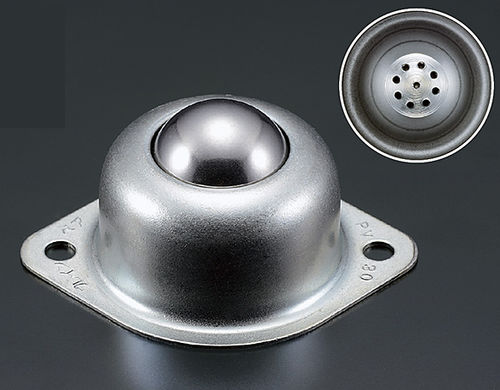
This structure also provides an important advantage for debris discharge. Because Planeveyor does not rely on the support balls directly beneath the main ball to support the load, debris-discharge holes can be provided at the lowest point of the unit without compromising its load capacity.
The dust-discharge version of Planeveyor allows debris and water that enter the unit to be discharged during operation, significantly reducing poor rotation caused by debris buildup. For downward-facing applications, dedicated debris-discharge slits are used instead of holes.
For applications where debris or water is causing ball transfer rotation problems, this dust-discharge design can provide an effective solution.