#Industry News
Case Study: Designing Low-Latency Wireless Machine Connectivity for BYD Electronics’ 1.7 Million m² Smart Factory
How a 1.7-million-square-meter smart factory built a repeatable wireless path from PLCs to plant systems
Introduction
A large EV and electronics manufacturing campus needed to connect production-machine PLCs to plant-level control, manufacturing, and monitoring systems without creating a different integration method for every machine. The resulting edge architecture combined industrial Wi-Fi with local Modbus conversion and compact installation at the machine level.
The Huizhou BYD Electronics campus is a major production base for electronics, batteries, and automotive components. Its scale and mix of automated equipment create a dense operational technology environment in which machine controllers must exchange data with supervisory control, manufacturing, and monitoring platforms.
The connection path spans machine PLCs, wireless access points, the industrial Ethernet backbone, and the plant's upper-layer systems. Equipment is installed close to machinery, where cabinet space, temperature variation, and electromagnetic interference all affect communication design.
Machine-side data included Modbus RTU and other serial traffic, while plant applications required Ethernet and Modbus TCP connectivity. Without a consistent conversion layer, each machine connection could become a separate protocol and cabling project.
The factory also required wireless access for equipment distributed across production areas. A commercial wireless bridge would not adequately address deterministic command transport, industrial EMI, temperature range, or compact machine-side mounting.
Requirements
The design had to preserve existing machine interfaces while establishing a repeatable path into the factory network. At campus scale, reducing per-machine engineering effort was as important as selecting a technically compatible device.
1. Support Modbus RTU/TCP conversion for integration with upper-layer systems.
2. Use a command-transmission acceptance target of 50 ms or less.
3. Maintain stable wireless communication in an EMI-intensive industrial environment.
4. Operate across -40°C to 75°C with industrial protection characteristics.
5. Fit limited machine-side space through DIN-rail or wall mounting.
Solution
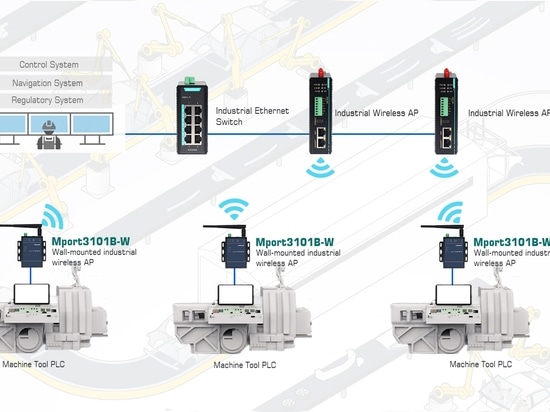
The architecture keeps the plant backbone wired while moving protocol conversion and wireless access to the machine edge. Industrial access points provide wireless cells across production areas, and an Mport3101-W at each machine connects the PLC or serial endpoint to the wireless network.
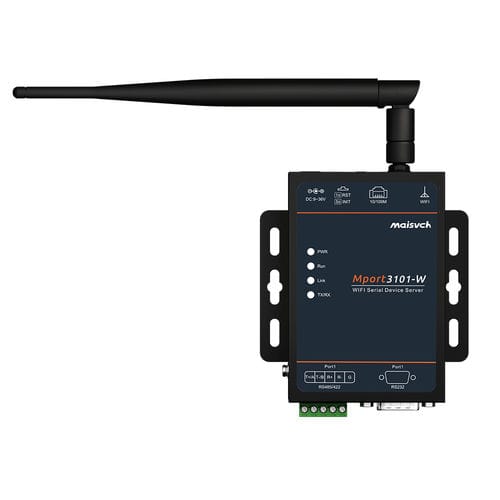
Converting Modbus traffic close to the machine limits the distance and complexity of serial wiring. It also creates one repeatable connection pattern that can be applied across equipment from different automation vendors. The compact industrial device combines the edge functions needed for protocol conversion, wireless access, and machine-side mounting.
Deployment and Verification
Deployment placed wireless communication nodes near production machinery and linked the AP layer back to the industrial Ethernet network. Commissioning acceptance was defined around Modbus interoperability, continuous machine-data exchange, the 50 ms command-transmission target, and signal stability in the factory environment.
The project brief confirms successful equipment integration with Mitsubishi, FANUC, and Siemens machine platforms. It also reports a broader field deployment record approaching 20,000 units for this device family. The brief does not publish a latency trace, packet-loss result, or coverage survey, so this case does not present those metrics as measured project outcomes.
Results
The value of the design is not simply that machines gained Wi-Fi. The architecture reduced the number of custom interfaces between production equipment and the plant network, localized protocol conversion at the asset, and limited dependence on new fixed serial cable runs.
1. Lower integration risk when machines use different serial or Modbus interfaces.
2. Less installation disruption than extending dedicated communication cabling to every machine.
3. Faster replication through a consistent machine-edge connection pattern.
4. Simpler fault isolation because the wireless and protocol-conversion boundary is located at the machine.
Planning wireless connectivity for PLCs or serial machines? Send your controller interfaces, protocol requirements, latency target, production layout and RF constraints to [email protected]. Explore the Mport3101-W product page or read the full case study.