#Product Trends
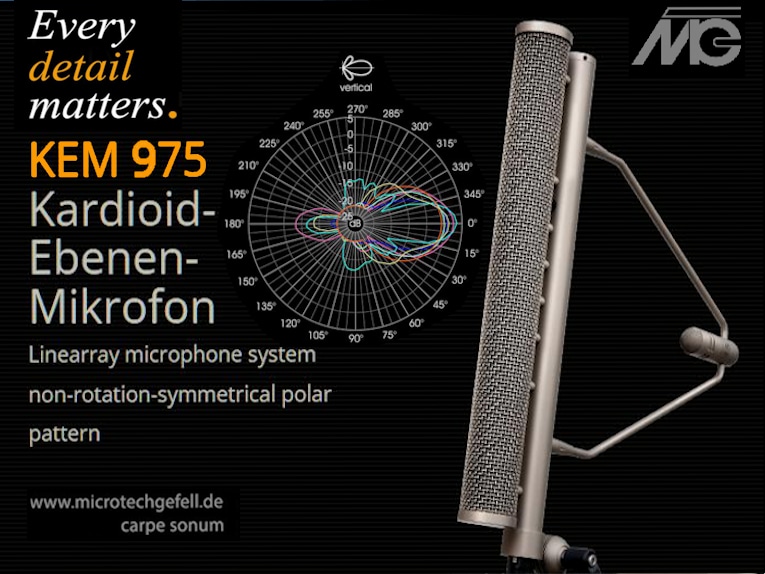
Growing global demand thanks to technical excellence – The Microtech Gefell KEM 975 Linearray microphone system
A Highlight of 2026 – The KEM 975 cardioid plane microphone for Professional Audio Recordings and Demanding Installations
With the KEM 975, Microtech Gefell presents one of the world’s most precise and versatile microphone systems for professional audio recordings and demanding installations. This cardioid plane microphone sets new standards in directionality, sound fidelity, and range. The KEM enjoys an outstanding reputation in the international audio and event technology sectors. This is also reflected in a gratifying number of global inquiries in 2026.
The microphone is considered the benchmark for demanding applications where the highest sound quality, precise directionality, and reliability are required. Its international range of applications currently extends from opera houses and theaters to studios, parliaments, and conference halls.
Developed in collaboration with the Institute for Radio Technology (IRT)
The KEM 975 was created in close cooperation with the IRT Munich, which developed and patented the underlying line-array principle. The combination of research and Microtech-Gefell manufacturing guarantees the highest precision, reliability, and long-term stability.
KEM 975 – Ideal for professional environments
The KEM 975 is used internationally in demanding scenarios, including:
• Broadcasting & TV – announcer positions, studios, outdoor broadcasts
• Music production – choirs, orchestras, churches, concert recordings
• Orchestras, theater & stage – stage movement, large stage spaces
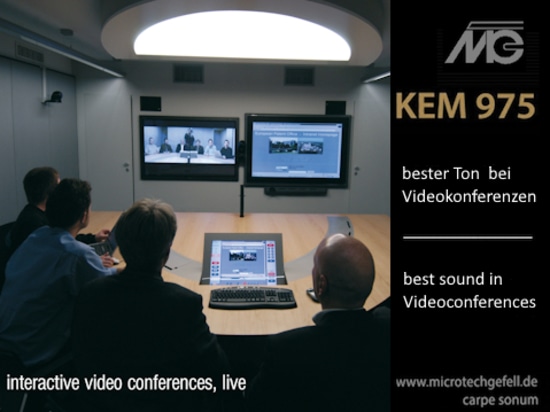
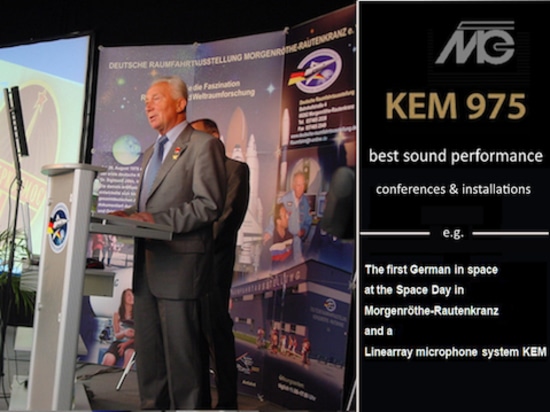
• Conferences & installations – lecterns, video conferences, auditoriums
Its threefold acoustic range compared to other products enables high-quality recordings even from greater distances—without any loss of sound quality.
Unique directional characteristics for maximum control
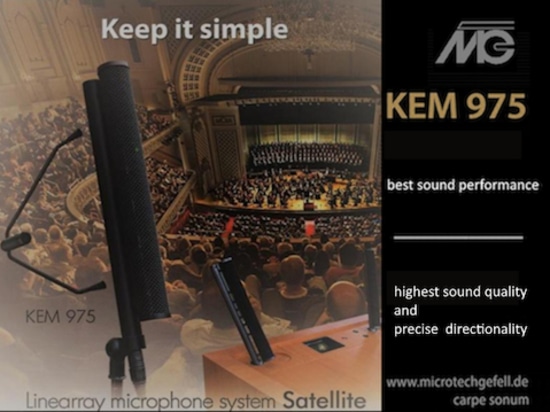
The KEM 975 is a vertical line array consisting of eight small-diaphragm condenser capsules arranged in series. This design produces a non-rotationally symmetric polar pattern:
• Horizontal: classic cardioid
• Vertical: features of a directional microphone with an opening angle of 30 degreesangle of coverage
This makes the system ideal for widely dispersed or moving sound sources, such as choirs, ensembles, speakers, and stage performances. At the same time, background noise, room reflections, and crosstalk are effectively minimized.
Advantages - Analog Signal Processing Without Latency
All signal processing is performed entirely in analog—a decisive advantage for broadcast, live sound reinforcement, and music production.
The result:
• no latency,
• maximum authenticity,
• precise transient response,
• extreme SPL handling up to 152 dB SPL
For extended low-frequency focusing with a delta capsule for applications requiring constant directivity down to low frequencies, the optional delta capsule is available—developed by the Institute for Radio Technology (IRT).
Together with the outer capsules, it forms an equilateral triangle and ensures:
• increased directivity below 800 Hz,
• frequency-constant directivity down to below 100 Hz,
• better spatial separation of low-frequency sources,
• more homogeneous spatial imaging, especially in music recordings.
Technical Highlights of the KEM 975
• Polar pattern: horizontal cardioid / vertical clubbed directivity
• Pickup angle: 120° horizontal / 30° vertical
• Frequency response: 40–18,000 Hz
• Sensitivity: 775 mV/Pa
• Maximum sound pressure level: up to 152 dB SPL
• Nominal impedance: 40 ohms
• Latency-free analog signal processing
• Optional: Delta capsule for enhanced low-frequency focusing
Selected examples of venues, typical applications, and advantages of the KEM 975:
Opera houses – Main microphone for choir, orchestra, soloists – Wide coverage, low reflections, high presence – e.g., Leipzig Gewandhaus, Berlin State Opera, Cologne Opera
Theaters – Stage, speech transmission – Freedom of movement, targeted directivity – e.g., Theater Bonn
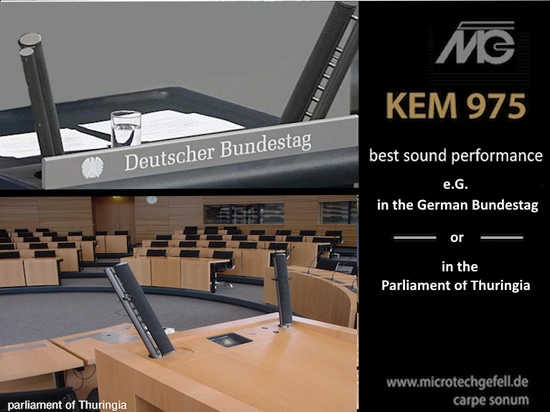
Parliaments – Speaker’s podium in the plenary hall – Freedom of movement, background noise suppression, targeted directionality – e.g., German Bundestag and several state parliaments, European Council, Polish Parliament (Sejm), Turkish Parliament (TBMM)
Broadcast Studios – e.g., ARD and ZDF productions, music and voice recordings, used in talk shows, panel discussions, and music recordings; Austrian Broadcasting Corporation (ORF) → used in control and recording rooms; Deutschlandfunk / MDR / RBB → latency-free, neutral sound, high dynamic range – used in live debates and concert recordings where freedom from reflections is crucial
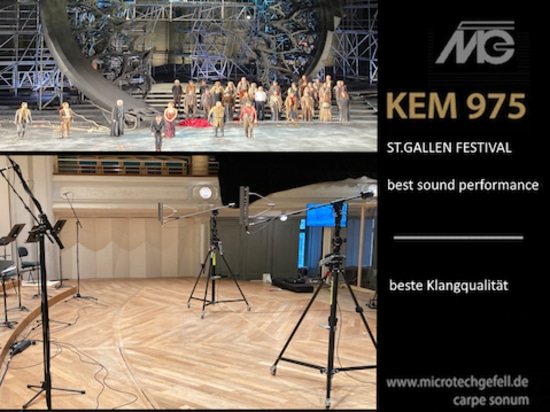
Choirs/orchestras + open-air/live – large stages, festivals, open-air operas – range, robustness, low wind sensitivity – main microphone and support microphone – low-frequency focus, transparency, depth gradation – e.g., St. Gallen Festival (Switzerland) / Used with a large choir without additional support microphones / Result:
Open-air settings – homogeneous sound imaging, minimal crosstalk, excellent transparency,
e.g., opera “Notre-Dame” (Franz Schmidt) / Transmission of orchestra and choir via fiber optics in an open-air setting / clear separation between choir and orchestra despite great distance,
Gewandhaus Leipzig / Staatsoper Berlin / Konzerthaus Berlin / Regular use in orchestra and choir productions.
Advantages: Wide stage coverage, reduced reflections, natural depth gradation.
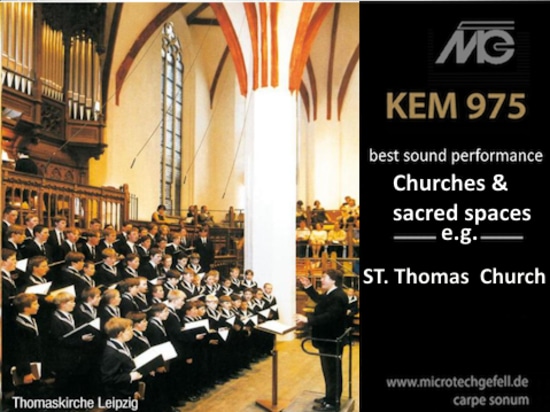
Churches/sacred spaces – Speech and ensemble recording – Minimization of reverberation and targeted pickup