
#Industry News
Adif Stations Neuronal Centre (CNE), Madrid
OPTIMAX3 at ADIF's CNE: one architecture, limitless configurations
The best designs are those where form follows function without compromise. In a technical landscape that is often over-engineered, OPTIMAX3 stands out as an exercise in coherence: an architecture purpose-built to integrate seamlessly into complex, heterogeneous networks.This philosophy is best demonstrated in environments where complexity is a tool rather than an obstacle—most notably in the Adif macro-project and its new Valdebebas Stations Neuronal Center (CNE).
Adif manages an incredibly diverse station estate, ranging from major hubs with massive passenger footfall to remote, unstaffed halts. Each site has its own specific requirements, yet all must operate within a strict hierarchical structure. The challenge is clear: providing local autonomy while maintaining centralised management from the Stations Neuronal Centre (CNE) in Valdebebas (Madrid).
[Modular architecture for rail infrastructure]
Managing communications across hundreds of points in a national rail network requires an architecture where each node can function independently while remaining under remote supervision. The OPTIMAX3 architecture scales across three tiers: global control at Valdebebas, six territorial sub-centres, and individual stations. This cascading structure ensures consistent data flow while guaranteeing local operability—even if global connectivity is lost. It is a robust IP-based solution where reliability, redundancy, and seamless IT integration are paramount.
[UMX-03: The system’s central hub]
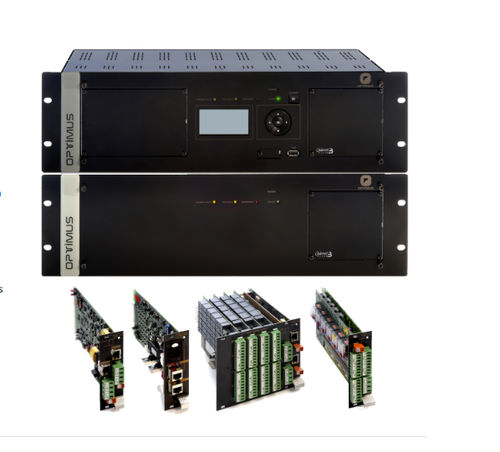
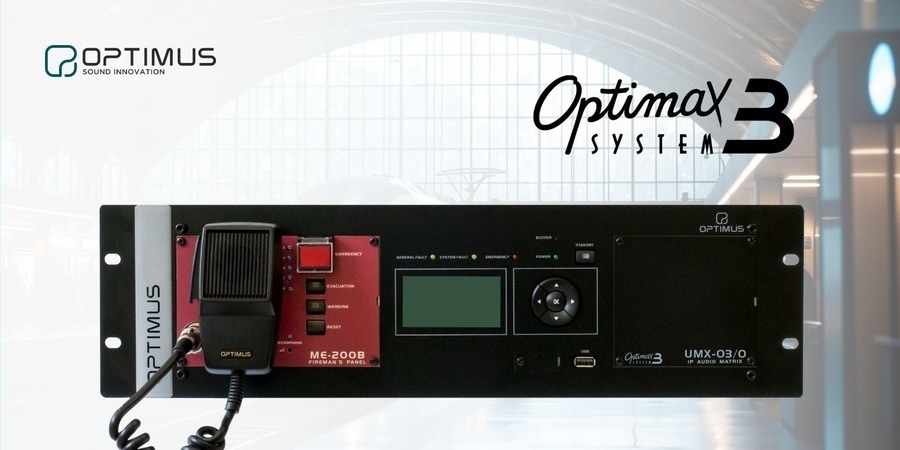
At the core of OPTIMAX3 is the UMX-03 digital audio matrix. Featuring a redundant IP backbone, this central unit simultaneously manages four incoming and outgoing IP audio channels while maintaining a 16-channel internal bus for local processing. Its design allows for direct integration with fire alarm systems via three supervised input contacts, three voltage-free outputs, and a failsafe relay output. The 32 GB internal memory stores messages in MP3, WAV, or Ogg-Vorbis, ensuring immediate broadcast capability regardless of network status. The matrix also provides continuous supervision of lines and power amplifiers, with support for secondary units, microphone consoles, and noise sensors via its CAN bus.
[IF-822ETH / IF-804ETH: Flexible distribution]
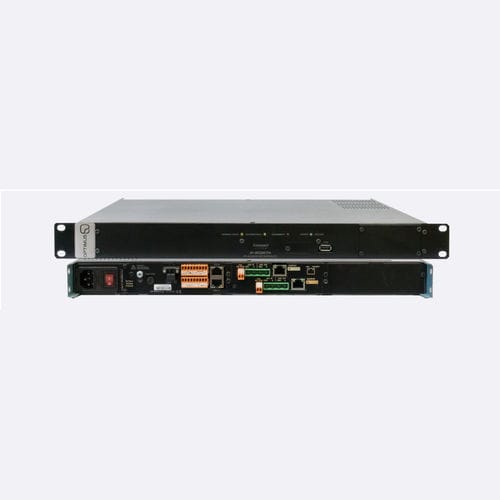
For sites requiring connection to legacy analogue amplifiers or audio distribution at remote points, the IF-822ETH and IF-804ETH interfaces provide the ideal bridge. These units convert conventional PA setups into IP-ready nodes, receiving inputs from IP consoles, SIP telephony, and background music channels. IF-822ETH provides two audio inputs and two outputs, perfect for locations requiring local microphones. IF-804ETH features four audio outputs, optimised for maximum distribution. Both units include a front USB port and 16 GB of internal storage. This allows operators to leverage existing equipment, effectively transforming legacy hardware into OPTIMAX3 nodes
[IF-8P4ETH: Integrated power on demand]
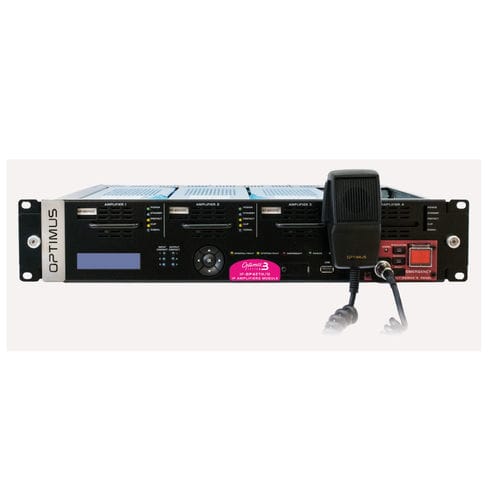
Where a project requires distributed power with IP control, the IF-8P4ETH integrates both into a single chassis. Housing up to four high-efficiency Class D amplifiers, it supports configurations from 60 W to 460 W per channel, including backup amplification options. The system performs continuous supervision of A/B loudspeaker lines for every amplifier. Furthermore, its hot-swapping capability ensures maintenance can be carried out without service interruption. For greater capacity, IF-8P4/0E expansion units add four additional slots each, increasing zone count without complicating the architecture.
[Valdebebas (Madrid): The neural ecosystem]
The Adif Stations Neuronal Centre in Valdebebas is this architecture realised at scale. From this hub, communications across the entire Spanish rail network are coordinated, with each station utilising a bespoke OPTIMAX3 configuration tailored to its needs. Major terminals rely on UMX-03 matrices with extensive I/O and control consoles. Mid-sized stations use IF-8P4ETH interfaces to minimise the equipment footprint, while small halts use IF-804ETH units to drive existing analogue hardware. Despite this diversity, every single node is integrated into the same centralised management ecosystem.This capacity for local adaptation with global integration is what sets the OPTIMAX3 platform apart. It is not just hardware; it is a communications architecture designed for railway workflows that stands out in the market for its level of customization.
[Beyond Rail]
While the Adif project is our most emblematic case study, the OPTIMAX3 architecture excels far beyond the railway. From multi-plant industrial complexes and split-terminal port infrastructures to sprawling corporate campuses, any environment requiring coordinated communication across dispersed sites can benefit from this scalable solution. The platform does not dictate a single deployment model. It supports fully centralised setups, distributed processing at each node, or hybrid architectures that combine central oversight with local resilience. The flexibility is built into the design, not restricted by it.
[Built for longevity, ready for the future]
At OPTIMUS, we design for long lifecycles. The modularity of OPTIMAX3 allows for technological evolution—new amplifiers, emerging protocols, and hardware updates—without the need for a total system overhaul. This forward-thinking approach is rooted in safety. The platform was designed from the ground up to align with EN 54 standards, incorporating the necessary supervision and emergency management functions as standard. We have paved the way for certification as the next logical step for a system that is already the benchmark in rail safety.