#Product Trends
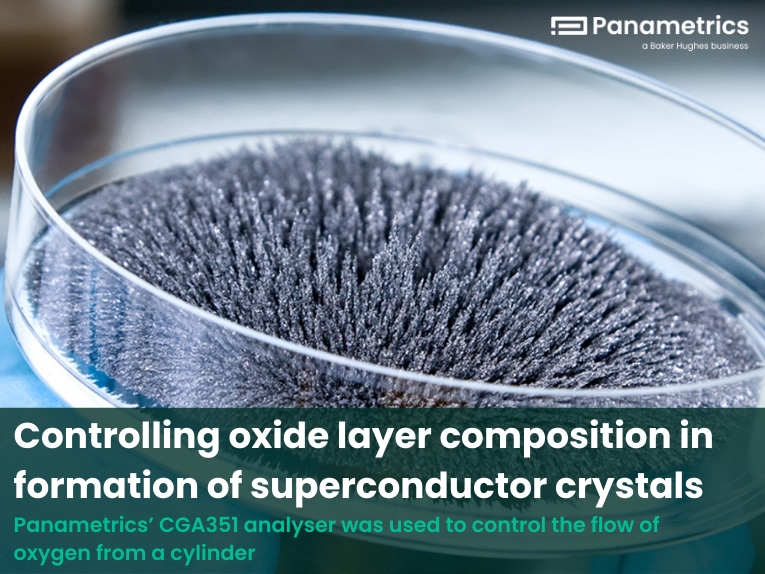
Controlling oxide layer composition in formation of superconductor crystals
Panametrics’ CGA351 analyser was used to control the flow of oxygen from a cylinder
Application
Control of the oxide layer is critical to the manufacturing of superconductor materials. Research has proven that precise control of the oxygen content is necessary to achieve the desired properties in the materials.
Background
An enclosure with a clear cover contains materials that are to be crystallized and made into superconductors. The development rate and purity of the crystals are dependent upon the temperature and amount of oxygen in the system. At start-up, the system is purged with argon. When the temperature nears the set point, oxygen is added so that the atmosphere contains a 2% concentration of oxygen in argon.
A university helped develop superconductors for the power industry. The amount of oxygen needed to be controlled for proper development of the crystals. An oxygen monitor was needed to precisely control the oxygen concentration. Oxidation was previously controlled by visual monitoring of the crystals.
Installation
The CGA351 analyzer was installed and the 4 – 20 mA output was then used to control the flow of oxygen from a cylinder in order to keep the level at 2% by volume.
Advantages
After a demonstration, a zirconium oxide based oxygen analyzer was selected because of its fast response, low sample volume, attractive pricing, and easy installation. The fast response of this analyzer was very important because of the nature of the reaction. The low sample volume is critical because of the small volume within the reaction chamber.
Equipment
A Panametrics CGA 351 Zirconia Oxygen Analyzer was used.
Specifications:
• Application: 0% – 21% oxygen in argon (typically 2% oxygen)
• Pressure: atmospheric at sample point in the purged enclosure
• Temperature: ambient at sample point in the purged enclosure