#Industry News
Punching Copper Busbar: How to Calculate Tonnage and Set Die Clearance
The force formula with worked examples, shear strength by temper, clearance per side and the practical limits that keep holes clean and punches intact.
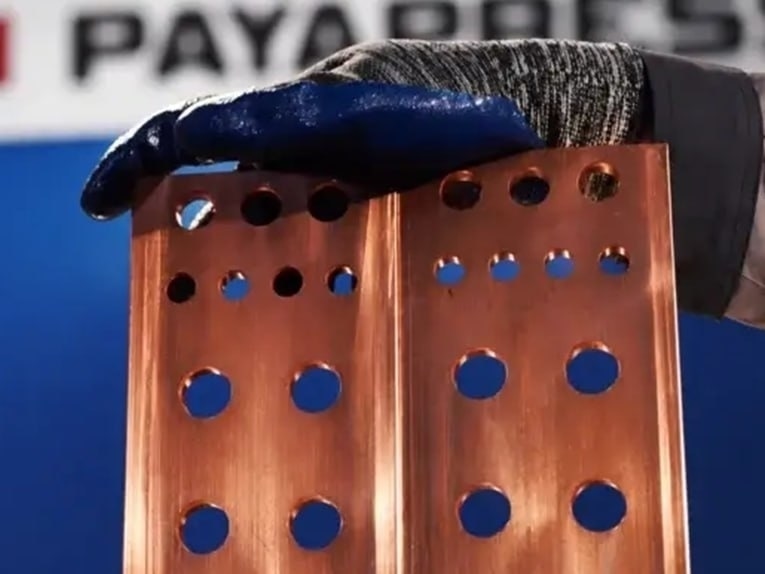
Copper busbar punching is often set up by trial and error, yet the required force and die clearance can be calculated before the first hole is made. A new technical guide from PAYAPRESS shows panel builders how to size punch tonnage, choose clearance and keep hole quality consistent.
The formula
Punching force equals the perimeter of the hole multiplied by bar thickness and the shear strength of the material. With millimeters and MPa, the result is in newtons. For a 14 mm round hole in 10 mm copper with a shear strength of 200 MPa, the perimeter is about 44 mm and the force about 88 kN, or 9.0 metric tons and 9.9 US tons (1 metric ton-force equals 9.807 kN, 1 US ton-force 8.896 kN). A 13 × 20 mm slot in the same bar needs about 110 kN, roughly a third more than a round hole of the same width.
Shear strength by material
Typical shear strength is about 152 MPa for soft C11000 copper in O60 temper and 179 MPa in hard H04 temper; aluminum 6101-T6 sits near 140 MPa. Temper alone therefore changes the required force by around a fifth, which is why a margin for worn tooling makes more sense than sizing a press to the exact figure.
Die clearance
Clearance is set as a percentage of thickness per side: about 6 to 8 % for soft copper and 8 to 10 % for hard copper, with the lower value for precision work. For 10 mm bar at 8 %, that gives 0.8 mm per side, so a 14 mm punch needs a 15.6 mm die. Too little clearance raises force and tool wear; too much produces a heavy burr and rollover at the hole edge.
Practical limits
As rules of thumb, the punch diameter should not be smaller than the bar thickness, and the hole should sit at least one bar thickness from the edge of the copper. Punch strength is checked separately by dividing the force by the punch face area and comparing the resulting tip pressure with the allowable stress of the punch steel.
Matching tonnage to the machine
The guide closes with a sizing check: a 22 mm hole in 15 mm copper requires about 207 kN, well within the 400 kN rating of the HBC-CP.CNC200 CNC punching machine, which handles bars up to 200 × 15 mm.
The full guide, with an online punch tonnage calculator, shear strength and clearance tables and an FAQ, is available on payapress.com.