#Product Trends
From Resolvers to Inductive Sensors
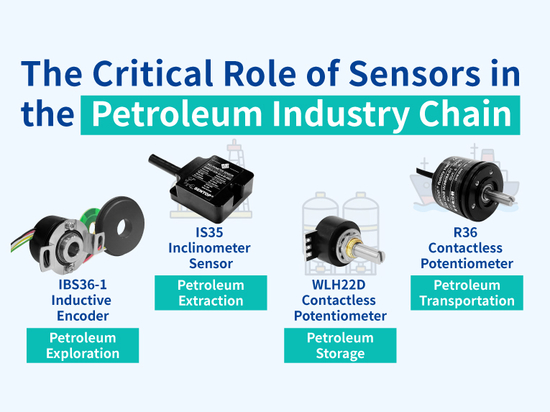
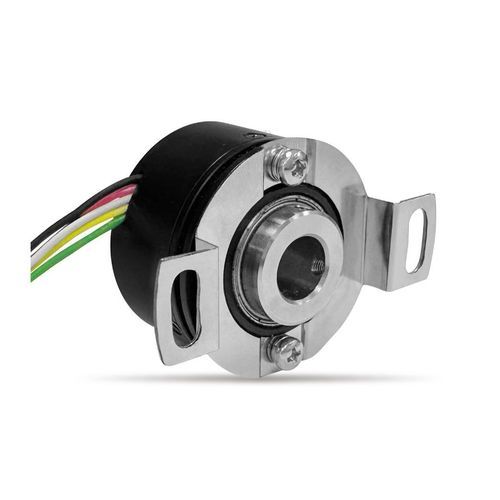
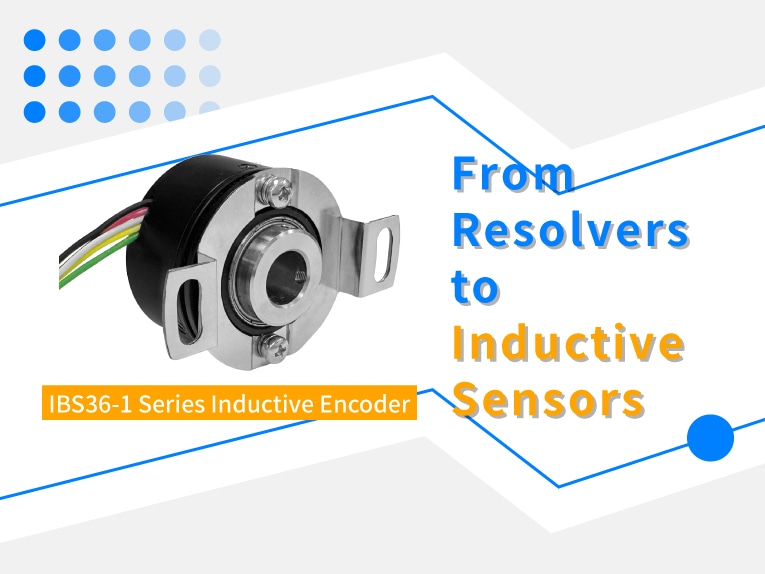
Sibol has now launched the IBS36-1 series of compact hollow-shaft inductive encoders.
01. Resolver
A resolver, literally defined as a rotary transformer, is a sensor used to measure the angular displacement and angular velocity of rotating objects. Based on the AC electromagnetic induction principle discovered by Michael Faraday in 1831, it consists of one excitation coil for signal generation and two sine and cosine induction coils arranged at a 90° angle to each other. When a high-frequency AC excitation voltage is applied to the excitation coil, corresponding induced voltages will be generated in the two induction coils. The amplitude ratio between the induced voltage and the excitation voltage depends on the relative positional relationship between the induction coils and the excitation coil. The angular position can be accurately calculated by demodulating the induced voltage signals.
In terms of structure, resolvers are similar to AC motors, composed of stator coils and rotor coils. In a broad sense, a resolver is a special motor designed exclusively for precision measurement.
Early resolver models adopt a structure with excitation coils fixed on the stator and induction coils mounted on the rotor. To export electrical signals from the rotating rotor, slip rings and brushes are required. This type is defined as a brushed or contact resolver. However, friction between brushes and slip rings inevitably causes mechanical wear, resulting in lower operational reliability and shorter service life.
To improve reliability and service life, brushless resolvers were developed on the basis of brushed structures. By adding primary and secondary auxiliary coils, secondary electromagnetic induction replaces the traditional brush and slip ring structure, eliminating mechanical wear. Nevertheless, this design leads to larger size, heavier weight and higher overall costs.
Reluctance resolvers were later developed to further save costs and optimize space layout. This structure integrates excitation and induction coils within the same stator slots, while the rotor is made of high-permeability magnetic materials with specially optimized profiles. The air-gap magnetic field formed between the rotor and sine/cosine coils presents an approximate sine-cosine distribution. The only drawback is its relatively lower precision compared with brushed and brushless resolvers.
Originally developed for military applications, resolvers feature a robust structure, strong anti-interference capability, and excellent adaptability to harsh working environments, including dust, oil mist, humidity, vibration, magnetic field interference, extreme high and low temperatures. At present, they are widely adopted in various industrial fields such as servo control systems, automotive equipment, power engineering, metallurgy and robotic systems.
However, the high cost derived from military-grade design limits the widespread popularization of resolvers. Precision winding coils and high-permeability magnetic materials bring high material and processing costs. In addition, dedicated decoders are essential for processing and parsing angular data from induction coil signals, further increasing application costs and technical thresholds. Mainstream brands such as Tamagawa (Japan), LTN (Germany) and Hengstler (Germany) are priced at thousands of dollars, restricting their large-scale industrial application.
Furthermore, the robust structure of resolvers is a double-edged sword. Their large size and heavy weight make them unsuitable for compact and space-sensitive industrial scenarios.
02. Inductive Sensors
In recent years, breakthroughs in printed circuit board (PCB) technology have enabled traditional bulky wound coils to be miniaturized and printed on ultra-thin circuit boards, drastically reducing the hardware cost of traditional resolvers. This revolutionary technology has been widely recognized and adopted by the market in the form of inductive sensors.
Inductive sensors inherit the working principle of traditional resolvers, equipped with excitation coils and induction coils. The excitation coil generates a high-frequency alternating magnetic field, while two structurally identical induction coils are symmetrically arranged in a differential connection structure. Under normal conditions, the differential output voltage of the two symmetrical coils is zero. When a ferromagnetic or conductive object enters the magnetic field, it disturbs the magnetic field distribution, causing a measurable change in the output voltage. The voltage variation corresponds precisely to the position of the moving object.
Inductive sensors retain all the core advantages of traditional resolvers. Benefiting from advanced digital circuit technology, PCB manufacturing, integrated chip innovation and optimized software algorithms, inductive sensors feature a smaller, thinner and lighter structure. They eliminate the need for dedicated decoders, enabling simpler installation, lower costs and wider applicability. Moreover, they support flexible measurement modes that traditional resolvers cannot achieve, including curved geometry measurement, flexible detection and linear position measurement.
03. IBS36-1 Series Inductive Encoder
Adhering to independent R&D and strict quality control, SENTOP continuously delivers high-performance products and customized industrial solutions. The newly launched IBS36-1 series miniature hollow-shaft inductive encoders are available in two specifications: bearing-integrated one-piece type and bearingless split type, fully adapting to diverse customer application requirements.
Features
High Precision: 14-bit resolution with precision up to 0.3%;
Superior Environmental Adaptability: Resistant to dust, oil mist and humidity;
Superior Environmental Adaptability: Resistant to dust, oil mist and humidity;
Cost-Effective: Optimized structure with competitive pricing.
Cost-Effective
Performance Parameters
Power Supply: 5V±10% or 9~30V optional
Output Signals: Analog (0~5V, 0~10V, 4~20mA, PWM), Digital (SSI, RS485, CANopen), Incremental ABZ optional;
Current Consumption: <80mA;
Operating Temperature: -40℃~125℃;
Storage Temperature: -55℃~125℃;
Maximum Rotational Speed: 6,000rpm.
Applications
Widely applied in motors, robotics, industrial automation, automotive electronics, construction machinery, mining, metallurgy, hydraulic power, electric power and other industries. We also provide flexible customized solutions to meet the special needs of diverse application scenarios. Feel free to contact us for professional technical support.