#Industry News
Shanghai Dongmeng: What Equipment Is Commonly Used for the Disposal of Solid Waste and Construction Waste?
Turning Construction Waste into Urban Treasures: Common Equipment for Efficient Resource Utilization
Construction waste is a vital component of urban solid waste, mainly consisting of waste concrete, bricks and tiles, mortar, wood, metals, plastics, etc. Through resource utilization for its conversion, it can not only reduce environmental pollution and save land resources, but also "turn waste into treasure" to produce recycled building materials. This is fully in line with the development concept of circular economy. An efficient construction waste resource treatment line is essentially a sophisticated "dismantling-sorting-recycling" production line, whose core lies in the targeted configuration of a series of special-purpose equipment.
Typical Process Flow & Equipment Configuration (Stationary Plant Solution)
A stationary C&D waste recycling plant adheres to the principle of "stage-wise processing, layered purification, and value maximization." Each link in the process is closely connected, with specialized equipment tailored to different processing objectives, ensuring the final products meet strict quality standards. The standard process flow is as follows:
1. Feeding & Pre-screening
Raw construction waste, which often contains a mix of large chunks, soil, and fine particles, is first fed into the system via a Vibrating Feeder. This equipment not only ensures a uniform and continuous feed to subsequent processes (avoiding overloads) but also separates out a significant portion of soil and fine particles upfront. This pre-screening step lays the foundation for improving the purity of subsequent recycled materials and reducing the workload of follow-up equipment.
2. Manual Pre-sorting
After pre-screening, the waste enters the manual pre-sorting zone. Workers remove large non-processable items such as bulk plastics, timber, and non-recyclable debris. These items, if not removed in time, may damage crushing equipment or contaminate the final products. Manual pre-sorting is a cost-effective "first line of defense" to ensure the smooth operation of the entire production line.
3. Primary Crushing
The pre-sorted waste (mainly concrete, bricks, and other hard materials) is then sent to a Jaw Crusher for coarse crushing. Jaw crushers are favored in primary crushing due to their strong crushing capacity, simple structure, and ability to handle large, hard materials. They reduce large chunks of waste (often over 1 meter in diameter) to manageable sizes (usually 30-50mm), preparing the material for subsequent fine processing.
4. Initial Ferrous Metal Separation
Crushed materials often contain ferrous metals such as rebar, wire mesh, and steel fragments—valuable recyclables in their own right. An Overband or Drum Magnetic Separator is installed after the primary crusher to extract these ferrous metals. The magnetic separator uses a strong magnetic field to attract ferrous materials from the moving material stream, achieving automatic separation. This step not only recovers valuable metals but also prevents metal impurities from damaging subsequent crushing and screening equipment.
5. Primary Screening
The material after metal separation is conveyed to a Vibrating Screen for primary screening. The vibrating screen classifies the material into preliminary size fractions according to preset standards. Oversized particles that do not meet the requirements are recirculated back to the jaw crusher for re-crushing, forming a closed-loop system that ensures no material is wasted. Meanwhile, the appropriately sized material moves on to the next processing stage.
6. Secondary Crushing
To meet the particle size requirements of high-quality recycled aggregates and optimize particle shape (reducing needle-like and flaky particles), the material undergoes medium-to-fine crushing using an Impact Crusher or Cone Crusher. Impact crushers are suitable for processing brittle materials like concrete and bricks, producing aggregates with good particle shapes. Cone crushers, on the other hand, excel at crushing hard materials and are used in projects requiring higher crushing efficiency and finer particle sizes. The choice of equipment depends on the type of raw waste and the quality requirements of the final products.
7. Deep Cleaning & Sorting
After secondary crushing, the material enters the deep cleaning and sorting stage to remove residual impurities. A secondary Magnetic Separator is used to extract any remaining ferrous metals that may have been missed in the initial separation. Simultaneously, an Air Separator (Wind Sifter) separates light contaminants such as paper scraps, plastic fragments, and wood chips by utilizing the difference in specific gravity between the contaminants and the hard materials. This dual separation process ensures the purity of the recycled material, laying the groundwork for producing high-grade aggregates.
8. Precision Final Screening
The cleaned material is then sent to a Multi-layer High-frequency Composite Screen for precision classification. This equipment features multiple screen layers and high-frequency vibration, which can efficiently separate the material into well-defined grades of high-purity recycled aggregates (e.g., 0-5mm fine aggregate, 5-10mm medium aggregate, 10-20mm coarse aggregate). The high-frequency vibration design effectively solves industry pain points such as screen clogging caused by damp or sticky materials, ensuring stable screening efficiency and accurate particle size classification—directly determining the quality and market value of the final products.
9. Stockpiling & Value-added Processing
The finished recycled aggregates of different grades are conveyed to dedicated stockpiles via belt conveyors for subsequent use or sale. A portion of these high-quality aggregates can be directly used in road sub-bases, backfill materials, or concrete mixing. Another portion enters a "value-added processing line," where it is mixed with admixtures, molded, and cured into higher-value products such as recycled permeable pavers, curbstones, and precast concrete components. This value-added processing significantly enhances the economic benefits of C&D waste recycling, realizing the leap from "waste" to "treasure."
Industry Trends & Advanced Technological Solutions
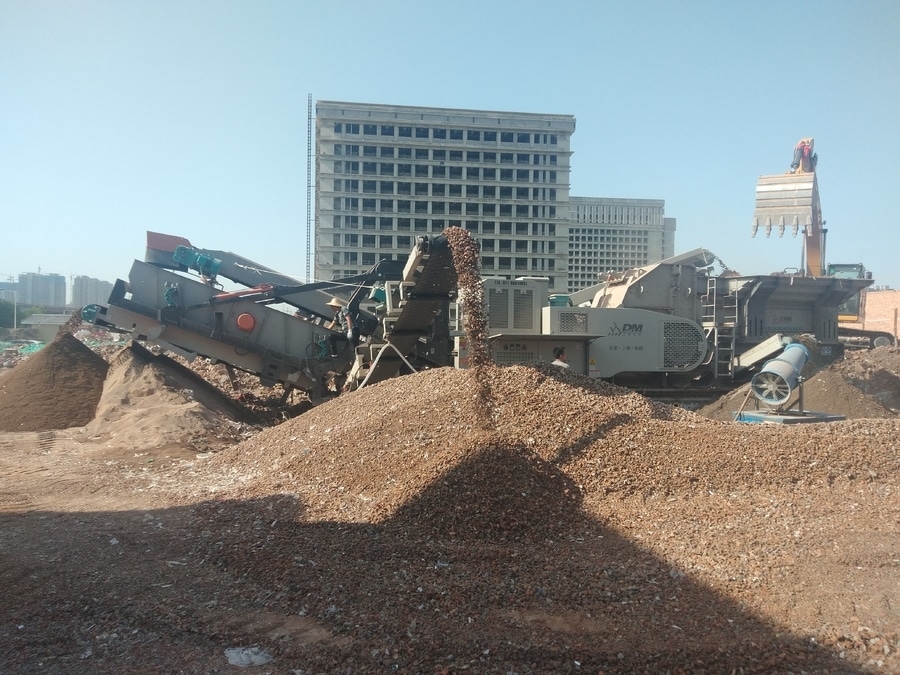
The construction waste resource disposal industry is moving towards intensification, intelligence, and high-value utilization, often adopting a collaborative layout model of "fixed plants + mobile stations." As a key link, screening efficiency and accuracy directly affect the final aggregate quality and the overall efficiency of the plant. Addressing common industry pain points such as screen clogging caused by wet and sticky materials and insufficient classification accuracy is crucial.
To tackle these challenges, Shanghai Dongmeng's high-frequency composite screening equipment offers an efficient solution. Its design enhances screening efficiency and precision, delivering excellent performance even when processing hard-to-screen materials. This helps truly transform construction waste into "urban minerals," promoting a win-win situation for economic and environmental benefits.
Explore advanced solutions tailored to your construction waste resource utilization projects.
Learn more about our equipment and technologies: https://dongmeng-global.com/