#Product Trends
Material-Handling Automation Solutions That Scale with Your Production Growth
Discover scalable material-handling automation solutions designed to grow with your production needs.
Rapid demand spikes are good, until the plant hits its ceiling. When extra shifts and bag‑dump operators no longer keep up, it’s time to look at material handling automation solutions that free capacity without knocking down walls.
Why manual handling becomes a growth bottleneck.
How key features of scalable material handling solutions protect uptime.
When to choose central, decentralised or hybrid systems.
How TSM’s modular hardware and Insight™ analytics add tonnes of head‑room in weeks.
What numbers finance wants in the payback model.
When Growing Output Breaks the Old Playbook
Running extra shifts or hiring more bag dump operators can work until it does not. Our field audits and decades of experience show three pain points that appear once the throughput rises above a certain lb./kg per hour per line:
Pain point - Why it harms profit
Labor shortages - Extra pallets of resin mean extra lifts, but skilled operators are scarce and costly.
Floor space squeeze - New lines force silos, loaders, and blenders into aisles, slowing forklifts and creating safety risks.
Hidden downtime - Manual weigh-ups and recipe errors snowball into unplanned stops that kill OEE targets.
Deploying automated material handling solutions tackles all three at once, no extra headcount, no building extension.
Key Features of Scalable Material Handling Systems
A future-proof system needs flexibility to manage new SKUs, efficiency to keep output high, and cost-effectiveness so savings outrun cap-ex. The following three blocks form the backbone of any robust material management strategy.
Modular hardware → Flexibility at floor level
Bolt-on vacuum receivers, in-plant conveying systems for bulk material loading, and loss-in-weight frames let you add or move stations a line at a time—no full rebuild.
TSM’s Offering:
Conveying Systems (in-plant loading)
Vacuum Receiver networks (in-plant)
Loss-in-weight frames
Each unit ships “plug-and-play” so tomorrow’s upgrade is a weekend job, not a six-month project.
Smart blending & dosing → Efficiency through accuracy:
Opti-Mix gravimetric blenders dose to ± 0.1 % and can accept extra ingredient hoppers (reservoirs) to run more colors or additives. Need higher throughput? You step up to the next Opti-Mix model (e.g., 650 → 1000 kg or lb./h); ingredient add-ons expand variety, not kilograms per hour.
Data & analytics → Cost-effectiveness you can prove:
A single gateway streams run data to cloud dashboards, no “per-tag” license fees. Live scrap, downtime, and energy numbers show where to act next and give financing hard evidence.
TSM’s Offering: Line View on the shop floor; Insight™ in the cloud. Both ship “Insight Ready” so IT work stays light.
Central or Decentralized Systems? Pick the Backbone Your Plant Needs
If this sounds like you … - Start here - Why?
Green-field build, mostly one resin - Central system - Lowest cost per kilogram.
Older building, lots of specialty colors - Decentralized Systems - Installs line-by-line over weekends, isolates contamination.
Mix of commodities & specialty runs - Hybrid - Central trunk for natural resin, pods for color-critical lines.
Quick rule: Central saves cost per kg/lb.; Decentralized Systems saves minutes per changeover. A lot of plants end up with both.
TSM’s Modular & Scalable Systems Explained
Vacuum Receivers – plug and play units feed any line and scale
Opti Mix™ Gravimetric Blenders – ± 1 % accuracy plus add on hoppers for extra colors or additives.
OptiFeed™ Micro Add Feeders – clip on side feeders for < 1 % dosing—no new blender required.
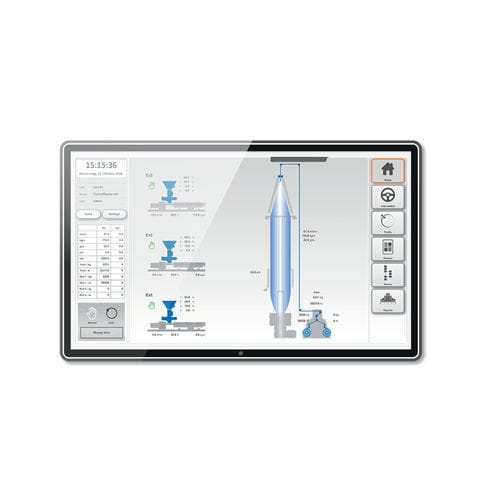
Line View + Insight™ – browser dashboards turn weight data into plant wide material management KPIs.
Because TSM gear ships “Insight Ready,” expanding an automated cell is usually a software licence flip, not a rip and replace project.
Insight™ Dashboards-Turn Raw Data into Extra Capacity
Cloud dashboards convert live machine data into plant-wide performance screens.
Real-time and historic materials & energy data support waste-reduction programs.
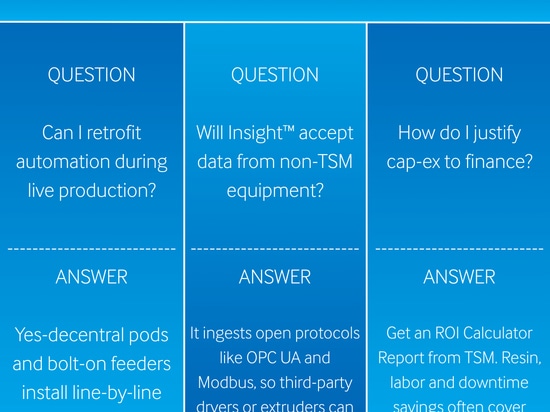
Built on ThingWorx with Kepware, Insight talks to “almost 300” industrial protocols, so third-party dryers or extruders share the same dashboard.
Roll-out follows a three-step “Engage → Execute → Empower” method to help teams visualize, analyze, optimize.
Total-Cost Thinking: Get Finance on Your Side
Equipment is one row; yearly savings fill five more:
Resin saved by ± 0.1 % dosing.
Labor hours removed, no bag tipping, quicker changeovers.
Downtime avoided, auto-purge receivers, fewer forklift jams.
Lower energy, efficient blowers beat compressed-air wands.
Predictable maintenance, Insight™ flags issues before failure.
Add them up and you have a compelling case for material handling solutions that finance can’t ignore.
Real-world example
A 0.5 % masterbatch reduction on a 680 kg/h (1499lb./h) line saves €4,161/$4,719 per month; a 2 % scrap drop adds €19,584/$22,198 per month; together with a 1 % yield increase, total savings reach €33, 538/$38,015 per month.
Plan for capacity first, upgrade the blender model, not just the ingredient count.
If output will move from about 600 kg/h (1323 lbs./h) to 1,500 kg/h (3307 lbs./h) step up to the next Opti-Mix™ size so every component is designed for the higher load.
Want your own numbers?
Book a 20-minute discovery call. We will plug your throughput, resin cost and shifts into TSM’s ROI Calculator and email the PDF report-ready for the finance meeting.
Key Takeaways
Manual bag tipping and forklift runs cap growth before the machines do.
Material handling automation solutions with modular hardware, accurate blending and live analytics scale output without expanding the building.
Central vs Decentralized Systems – depending on the resin mix, building limits and contamination risk – many plants blend the two.
Insight™ dashboards uncover hidden scrap and idle time; those savings often fund the next upgrade.
A data-backed ROI report turns “wish-list” automation into an approved budget line.