#Product Trends
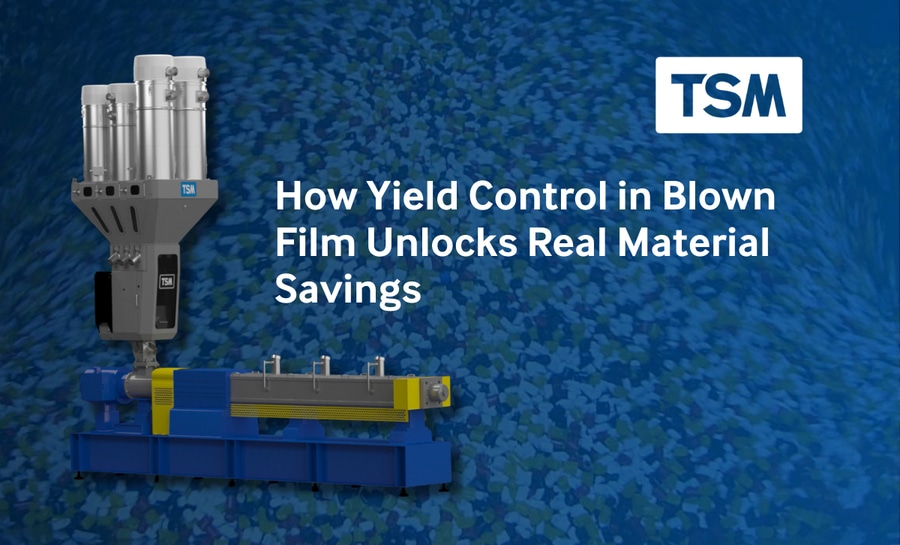
How Yield Control in Blown Film Unlocks Real Material Savings
Yield control is not just a process upgrade. It is a competitive advantage.
In extrusion, control is ultimately about delivering consistent product weight or thickness. When that stability is achieved, material cost becomes predictable.” Peter Sloan, TSM North America Sales Manager
Consistency is everything. In blown film extrusion in particular, small variations in mass flow quickly translate into gauge variation and material giveaway.
Yet many producers still accept wide process variation as unavoidable, compensating by running heavy to stay within customer tolerances. The result is predictable but costly: excess material usage, unnecessary scrap, and reduced yield.
Automatic Extruder Yield Control changes that. By continuously regulating output based on real-time process data, it allows manufacturers to tighten tolerances, reduce waste, and produce more saleable product from the same amount of material.
What Is Automatic Extruder Yield Control?:
At its core, extrusion yield control is about delivering a consistent product weight or thickness over time, regardless of process disturbances.
In a typical extrusion line, material is fed into the extruder at a known rate. Because mass in equals mass out, if you can accurately measure the weight of material entering the extruder, you also know the output. Automatic yield control builds on this principle by continuously adjusting extruder speed to maintain a defined target, whether that target is kilograms per hour or grams per meter.
The goal is simple: remove medium to long-term variation, In blown film applications, this stabilises machine-direction thickness and supports more consistent bubble behaviour over extended production runs.
From Throughput Control to Thickness Control:
Basic extrusion control starts with throughput. A gravimetric system measures the weight of material feeding the extruder, allowing the system to regulate output to a fixed rate. Over time, factors like blockage or pressure buildup would normally cause output to drift. With automatic control, the system compensates by gradually adjusting screw speed to hold output steady.
By adding a line speed encoder, typically at the winder or haul-off, the system now knows not just how much material is being produced, but how fast it is being converted into product length. This allows the calculation of weight per unit length, such as grams per meter or pounds per thousand feet.
Once that value is known, the system can control extruder speed to maintain a constant average thickness in the machine direction. By stabilising mass flow at the source, yield control reduces the need for reactive adjustments downstream and improves the overall stability of the extrusion process.
If the operator increases line speed, the extruder automatically speeds up to match. If line speed is reduced, extruder output follows.
The result is a stable thickness profile over time, without relying on constant operator intervention.
Why Tighter Control Means Better Yield:
Without automatic control, thickness naturally varies over time. To avoid falling below customer specifications, operators often run material heavier than necessary. This creates a wide distribution around the target thickness and leads directly to material wastage.
With automatic extruder yield control, that distribution tightens significantly. When natural process variation is reduced, the average setpoint can be moved closer to minimum tolerance with confidence, reducing material overuse without increasing risk.
This enables down-gauging while still meeting customer requirements.
The impact is measurable. Tighter tolerances mean less waste, fewer rejects, and more saleable product per roll or per order. In many cases, this translates into a 2% to 3% yield improvement through precision control and reduced overuse of resin.
Common Problems Yield Control Solves on the Factory Floor:
Yield control is most valuable when it addresses everyday production challenges that quietly reduce profitability.
One common issue is screen pack blockage. As filters gradually restrict flow, extruder output naturally drops. Without automatic correction, thickness can drift below tolerance, often unnoticed until scrap is produced. Yield control systems compensate for this automatically by adjusting screw speed to maintain output.
Another frequent challenge is frequent product changeovers. Different widths, thicknesses, or materials require fast stabilization to minimize startup scrap. Automatic yield control helps lines reach target conditions faster and stay there.
Perhaps most importantly, yield control removes the burden from operators to manually manage thickness. Instead of relying on experience and constant monitoring, the system maintains consistent output automatically, reducing variability between shifts and operators.
Applications Across Extrusion Processes:
Automatic extruder yield control is well suited to any continuous extrusion process where weight per length matters.
This includes blown film, cast film, sheet extrusion, extrusion coating, and similar applications. In blown film lines, maintaining stable grams-per-meter control is particularly critical, as fluctuations in output affect both gauge consistency and layer balance in multi-layer structures.
In co-extrusion, yield control becomes even more critical. Maintaining precise layer ratios across multiple extruders is extremely difficult to do manually, especially on complex five, seven, or nine-layer structures. Even small deviations can result in overuse of high-cost barrier or seal layers, increasing material costs without improving performance.
By integrating with multiple gravimetric systems, yield control can maintain consistent layer thicknesses and stable overall product structure across the entire line.
Built for Integration and Retrofit:
Modern yield control systems are designed to integrate seamlessly with existing equipment. They typically connect to extruder drives using standard analog signals or digital communication protocols and can be paired with supervisory systems for full-line coordination and monitoring.
Crucially, these systems are retrofittable. Existing extrusion lines can be upgraded without replacing core equipment, allowing producers to unlock material savings and quality improvements without major capital disruption.
Consistency That Pays for Itself:
Automatic extruder yield control does not need to be complex to be effective. By focusing on accurate measurement, continuous adjustment, and stable output, it delivers exactly what extrusion producers need most: consistency.
For manufacturers looking to produce more with less, yield control is not just a process upgrade. It is a competitive advantage.