#Product Trends
Cast Film vs Blown Film
Why The Control Strategy Must Change
Cast film and blown film extrusion both convert molten polymer into flexible film, but they do not create or control that film in the same way.
-
In blown film, manufacturers must manage a dynamic, air-cooled bubble. In cast film, the process places greater emphasis on stable material flow across a flat die, accurate coordination between multiple extruders and consistent layer ratios at high production speeds.
-
These differences matter because the same control strategy cannot simply be transferred from one process to the other. The critical question is not only how the film is formed, but where variation enters the process and how the control system responds.
-
For cast film manufacturers, this is particularly important on multilayer lines. Total film gauge may remain within specification while an individual barrier, sealant or tie layer moves away from its target. The finished film may look acceptable, but material cost or product performance can already be affected.
-
Cast Film and Blown Film at a Glance
In cast extrusion, molten polymer passes through a flat die to form a continuous web. The film is cooled rapidly against temperature-controlled chill rolls before being stretched, trimmed and wound.
-
In blown film extrusion, the polymer passes through a circular die to form a tube. Air inflates the tube into a bubble, which is cooled as it travels upward before being collapsed and wound.
-
This difference in film formation and cooling creates distinct control priorities.
-
Control consideration / Cast film /Blown film
Die design / Flat die / Circular die
Film formation / Flat web / Inflated bubble
Primary cooling method / Direct contact with chill rolls / Air cooling
Main process-stability challenge / Stable output and flow uniformity / Bubble and airflow stability
Main gauge influences / Extruder output, line speed and die profile / Extruder output, haul-off, bubble behaviour and cooling
Multilayer priority / Extruder coordination and layer-ratio accuracy / Extruder, layer-ratio and bubble coordination
-
Both processes depend on accurate material dosing, repeatable recipes and stable extrusion output. The difference lies in how those principles must be applied to the behaviour of the line.
-
Why Cast Film Requires a Different Control Strategy
Rapid chill-roll cooling supports high line speeds, dimensional stability and good optical properties. It also means that changes in material flow or line speed can quickly be reflected in the finished web.
-
On a multilayer cast line, several extruders contribute to one film structure. Each layer may perform a different function, including:
-
Strength or surface appearance
Sealability
Oxygen or moisture barrier
Bonding between otherwise incompatible materials
Puncture resistance
Recycled-content incorporation
-
The control system must therefore do more than maintain total line output. It must help keep every extruder at the correct rate relative to the others while coordinating overall output with line speed.
-
Four areas are especially important: mass-throughput stability, layer-ratio control, recipe accuracy and production visibility.
-
1. Stabilising Extruder Throughput
Extruder screw speed is often used as an indication of output, but screw speed alone does not confirm how much material is being processed.
-
Actual throughput can change because of variations in:
-
Material bulk density
Feeding behaviour
Melt temperature and pressure
Screen-pack condition
Screw condition
Changes in the material formulation
-
A gravimetric extrusion-control system measures the mass of material entering the extruder. Under stable operating conditions, mass entering the process provides a reliable measurement of extruder output.
-
The control system can compare measured throughput with the production target and gradually adjust extruder speed to compensate for longer-term process disturbances. When line-speed data is also available, the system can coordinate output with product speed to maintain the required weight per unit length.
-
This supports more consistent average gauge in the machine direction. It should be distinguished from cross-direction gauge-profile control, which is influenced by die flow, die-lip adjustment and other line-specific systems.
-
For cast film, stable mass throughput provides the foundation for consistent production. If output from one extruder drifts, the effect may appear not only in total gauge but also in the distribution of material between layers.
-
2. Protecting Multilayer Ratios
Layer-ratio accuracy is one of the strongest commercial reasons to use gravimetric control on a multilayer cast-film line.
-
Different polymers and additives can have significantly different costs. Barrier resins, tie layers and specialist additives may represent a relatively small percentage of the overall structure but a disproportionate share of its material value.
-
Consider an illustrative example. If a barrier layer has a target contribution of 5.0% but drifts to 5.3%, the total film gauge may remain correct. However, the barrier polymer is being used at 6% above its intended rate relative to its original target.
-
The reverse situation presents a quality risk. If the layer falls below target, the film may not achieve its required barrier, sealing or mechanical performance even though the finished product remains within its overall gauge tolerance.
-
This is why total line output alone is not enough. Manufacturers need visibility and control over the contribution of each extruder to the final structure.
-
Coordinated gravimetric control can help maintain the required relationship between extruders as production rate changes. This protects the intended film design while reducing unnecessary use of high-value material.
-
3. Maintaining Recipe and Dosing Accuracy
Cast film formulations can contain virgin polymer, recycled material, colour masterbatch, slip and antiblock additives, processing aids and specialist functional materials.
-
Several of these components are used at low inclusion rates. A relatively small dosing error can therefore affect film appearance, handling, sealing or downstream conversion.
-
Accurate gravimetric blending helps maintain the specified formulation by measuring each component by weight. It can also support consistency when production rates change or materials with different bulk densities are introduced.
-
Reliable material delivery is equally important on a high-output line. A shortage, conveying interruption or unstable feed condition can affect extruder throughput and change the final layer structure. Blending, conveying and extrusion control should therefore be considered as connected parts of the material-management process rather than isolated pieces of equipment.
-
4. Creating Production Visibility
Modern cast-film lines generate a significant amount of process data, but that information is often spread across separate controllers and operator interfaces.
-
The production team may need to monitor:
-
Total line output
Individual extruder throughput
Layer percentages
Recipe settings
Material consumption
Line speed
Alarms and process deviations
Production history and batch information
-
On a multilayer line, a change in one extruder may alter layer distribution without creating an obvious change in total output. If operators cannot see the relationship between the individual extruders, material consumption and line speed, the issue may remain hidden until a quality test fails or excessive material has already been used.
-
Bringing this information into a supervisory interface makes process variation easier to identify. It can also support centralised recipe management, material reporting, production traceability and comparison between lines, products or shifts.
-
The objective is not simply to collect more data. It is to give operators and production teams the information required to recognise drift and act before it becomes off-specification film or unnecessary scrap.
-
Where Blown Film Control Differs
Blown film manufacturers face many of the same material-control requirements, including accurate blending, stable throughput and repeatable layer ratios. They must also manage variables created by the bubble itself.
-
These include:
-
Bubble stability and diameter
Air-ring and cooling performance
Frost-line height
Internal bubble cooling, where fitted
Width control
Circumferential thickness variation
Film movement during cooling
-
In cast film, the web is more mechanically constrained after it contacts the chill roll. The process does not have the same bubble-control requirements, but this does not make control less important. The emphasis shifts towards stable high-throughput extrusion, accurate coordination between extruders and uniform delivery of material to the flat die.
-
The two processes therefore share a common control foundation but require different priorities around that foundation.
-
When Should a Cast Film Manufacturer Review Its Control Strategy?
-
A control review may be valuable when a line is experiencing:
-
Unexplained changes in material consumption
Frequent manual adjustment of extruder speed
Layer-ratio movement during rate changes
Excessive use of barrier polymers or additives
Variation between recipes, shifts or operators
Long stabilisation periods following a product change
Limited visibility across separate line controllers
Difficulty tracing actual material consumption to a production run
Acceptable total gauge but inconsistent film performance
-
These symptoms do not always point to a single cause. However, they indicate that material feeding, extrusion output, line coordination and production data should be examined as one connected system.
-
Supporting Better Cast Extrusion Control
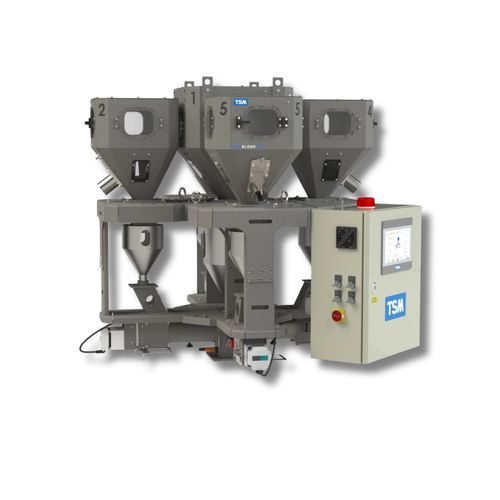
TSM provides integrated technologies for cast-film extrusion, including gravimetric blending and dosing, material handling, extrusion yield control, layer-ratio coordination and supervisory production systems.
-
Depending on the line and application, TSM technologies such as OptiMix, OptiX, OptiBlend, OptiYield and INSIGHT can be configured to support different stages of the material and extrusion-control process.
-
Together, these capabilities can help cast-film manufacturers:
-
Maintain accurate formulations and layer structures
Stabilise throughput across multiple extruders
Coordinate material output with line speed
Reduce avoidable material variation and giveaway
Improve process visibility and production traceability
Support upgrades to existing lines without replacing the complete extrusion system
-
The right approach depends on the film structure, material mix, line configuration and existing control architecture. By matching the control strategy to the specific demands of cast extrusion, manufacturers can improve consistency, protect product performance and gain greater control over every production run.
-