

#Product Trends
How PouchChek Closes the Gap in Heat-Seal Inspection
Combining thermal and visible imaging gives flexible-packaging converters information that visual inspection and periodic sampling alone cannot provide.
As flexible packaging production becomes faster and pouch structures more complex, verifying heat-seal quality becomes increasingly challenging. A package can appear correctly sealed while still containing areas that received insufficient or uneven heat, contamination within the seal, or other conditions that may affect seal integrity. Poorly sealed pouches can result in product leakage, failure of the consumer closure and misshapen pouches.
Traditional quality-control methods remain essential, but each has limitations. Because heat-seal quality depends on factors such as temperature, pressure and dwell time, process changes can occur between samples without producing an immediately visible defect. A deteriorating heating element, contamination in the seal area or a line restart before tooling has fully stabilized can all affect the seal.
Sample-based peel, burst and leak tests provide direct information about seal performance, but only for selected packages. Visual inspection can provide continuous coverage, yet it is limited to what can be seen on the package surface. A seal may appear acceptable while still containing localized areas of insufficient or uneven heat. Sampling provides depth without continuity, while visible inspection provides continuity without direct information about heat distribution. Combined thermal and visible imaging helps close that gap by showing both the physical condition of the package and the thermal signature created during sealing.
Adding the thermal signature
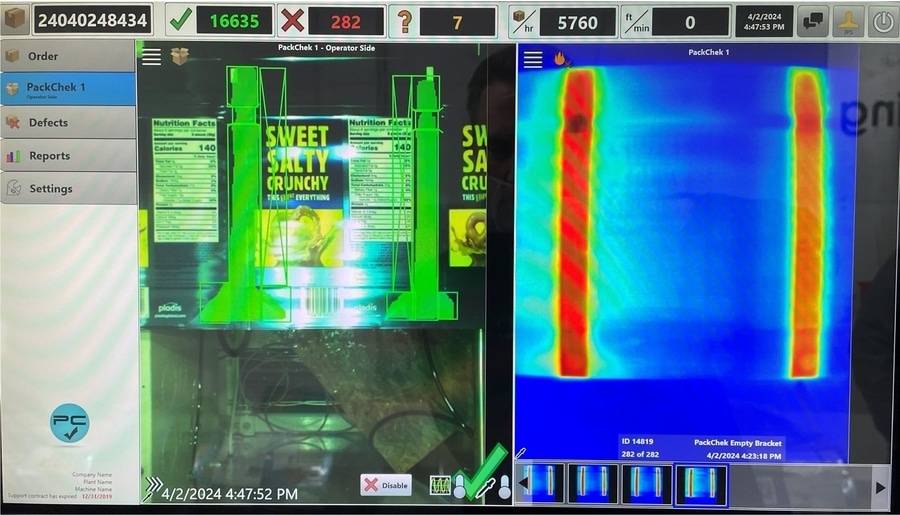
Immediately after sealing, a package retains a thermal signature that reflects how heat was distributed across the seal. PouchChek captures this thermal image together with a visible image of every package, combining information about the sealing process with the physical context of the pouch.
The thermal image can reveal cold areas, insufficient or excessive heat, cold-start conditions and irregular patterns caused by contamination, while the visible image helps relate those anomalies to the package geometry, seal position, zipper or other physical features. This is particularly useful in complex areas such as K-seals and zipper profiles, where different material structures can require different expected thermal patterns.
At production speed, PouchChek compares defined inspection zones against programmed tolerances to identify conditions such as improper heat zones, debris, zipper damage, missing seals and misalignment. By combining both images, operators can see not only what the seal looks like, but what happened thermally when it was produced.
Beyond defect detection
Continuous inspection also changes what happens after a defect is detected.
Instead of identifying a problem only when the next sample is tested, an inline system can recognize an out-of-tolerance condition as production is running. PouchChek can trigger alerts, marking or rejection, while storing inspection images and job information for later review.
Because PouchChek is built on Valco Melton's ClearVision inspection platform, the system captures and stores actual production images and inspection data, providing the visual evidence operators need to understand what happened, investigate recurring issues and react more effectively.
This stored information also creates a traceable quality record that can support customer claims, audits and internal quality documentation. MeasurementChek extends that capability by recording and organizing package-level measurement data for analysis, while SupportChek provides remote access to expert technical support when needed.
The result is a shift from simply detecting defective packages to understanding why the problem occurred, using visual evidence to support faster corrective action, traceability and quality investigation.
A more complete approach to seal quality
No single inspection method replaces the others. Destructive tests remain valuable for verifying seal strength and performance. Visible inspection identifies physical and positional defects. Thermal imaging adds information about the sealing process itself.
PouchChek brings visible and thermal inspection together for every package produced, while ClearVision's data and support infrastructure extends that information into traceability, analysis and troubleshooting. For flexible-packaging converters, the result is a more complete view of seal quality: not only identifying when a package falls outside tolerance, but providing the visual and thermal evidence needed to understand why.


