#Product Trends
Exhaust Fan Balancing On Site: Diagnose the 1× Peak Before Adding Weight
Cleaning, bolt checks, phase repeatability and the right number of correction planes decide whether an on-site exhaust fan balance holds.
When an exhaust fan shakes, the usual request is: balance it. Balancing removes one fault only, mass imbalance. If the impeller is dirty, the base is loose or the fan runs near resonance, correction weights will not hold. Our exhaust fan field guide sets out the order of work for an on-site balance.
Why speed matters
Imbalance force grows with the square of speed (F = m × ω² × r). Double the speed and the force rises four times. A fan that is quiet at low speed can shake hard at full speed, for example after a frequency converter raises its rpm.
Step 1: clean and tighten
- Lock out and tag out the drive.
- Clean the impeller of dust, product or paint build-up. In many cases cleaning alone removes or greatly reduces the imbalance.
- Inspect blades and welds. Tighten impeller-to-hub, hub-to-shaft, bearing housing and anchor bolts.
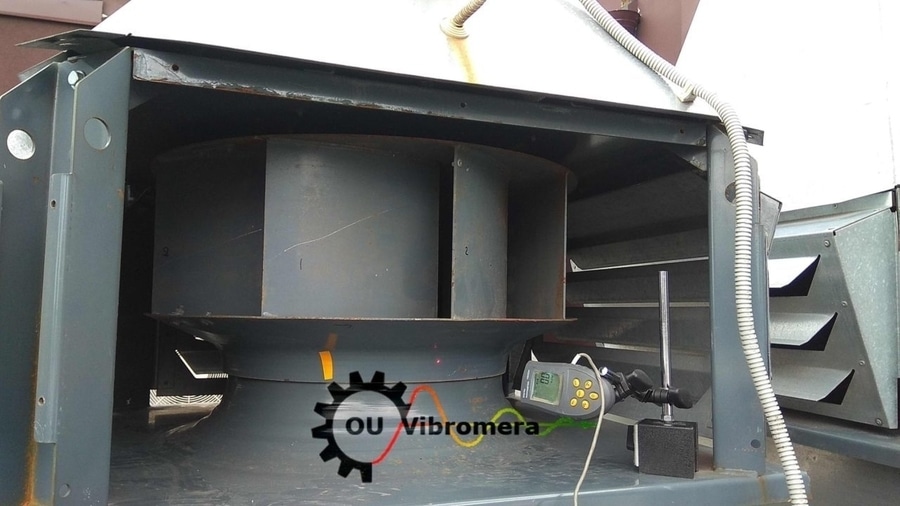
- Check shaft and impeller runout with a dial indicator.
Step 2: confirm it is imbalance
- Read the FFT spectrum. Start balancing only when the 1× (running speed) peak dominates.
- Make 2–3 control starts. Amplitude and phase must repeat; phase should not drift more than 10–15°.
- Compare phase at the two bearings: near 0° points to static imbalance, near 180° to couple or dynamic imbalance.
Step 3: one plane or two
Narrow impellers (L/D below 0.5) running under 1,000 rpm can usually be corrected in one plane. Wider or faster rotors need two. If a single-plane correction lowers vibration at one bearing but raises it at the other, switch to two planes. Size the trial weight to change amplitude by 20–30% or phase by 20–30°.
Two cases from the guide
- A supply fan ran at 29 Hz with an impeller natural frequency of 28 Hz. Phase was unstable and the standard method failed. A four-run, amplitude-only method (trial weight at 0°, 120° and 240°) brought vibration to an acceptable level as a temporary fix until the fan could be replaced.
- At a sugar factory, one exhaust fan showed misalignment (high 1× and 2× axial) and another looseness (1×, 2×, 3× harmonics). Alignment and tightening came first.
Tolerances
Most industrial exhaust fans are balanced to G6.3 per ISO 21940-11, high-speed or critical fans to G2.5. ISO 14694 sets fan vibration limits by category.
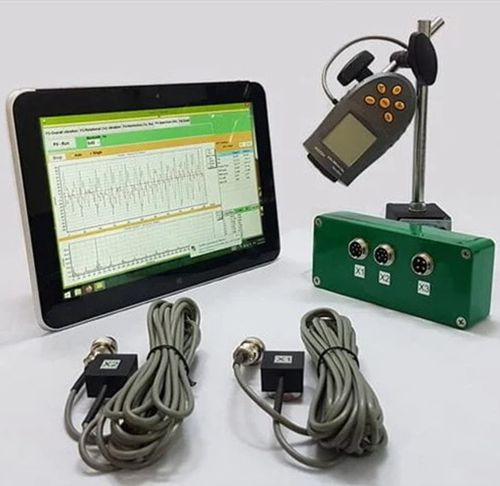
Balanset-1A combines a vibrometer with FFT spectrum (1×, phase, overall vibration) and one- or two-plane balancing with the fan in its own bearings. Windows laptop not included.
Equipment: Balanset-1A by VIBROMERA — vibromera.eu