#Product Trends
Laser distance sensors in the paper industry
The paper industry is an important economic sector with a centuries-old tradition. From its simple, manual beginnings, it has developed into a highly technical production process.
The paper industry is characterised by continuous processes in which flexible webs run at speeds of several hundred metres per minute. To ensure consistent product quality, from printing paper to cardboard and special films, parameters such as web guidance, width, thickness and roll diameter must be continuously monitored and controlled. Non-contact sensor systems are essential here to avoid mechanical stress and wear while achieving millimetre or even micrometre accuracy.
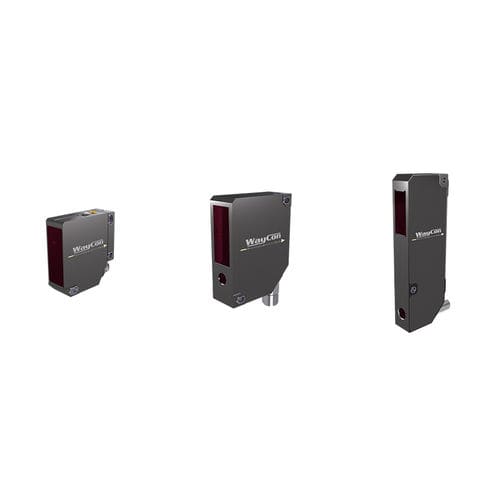
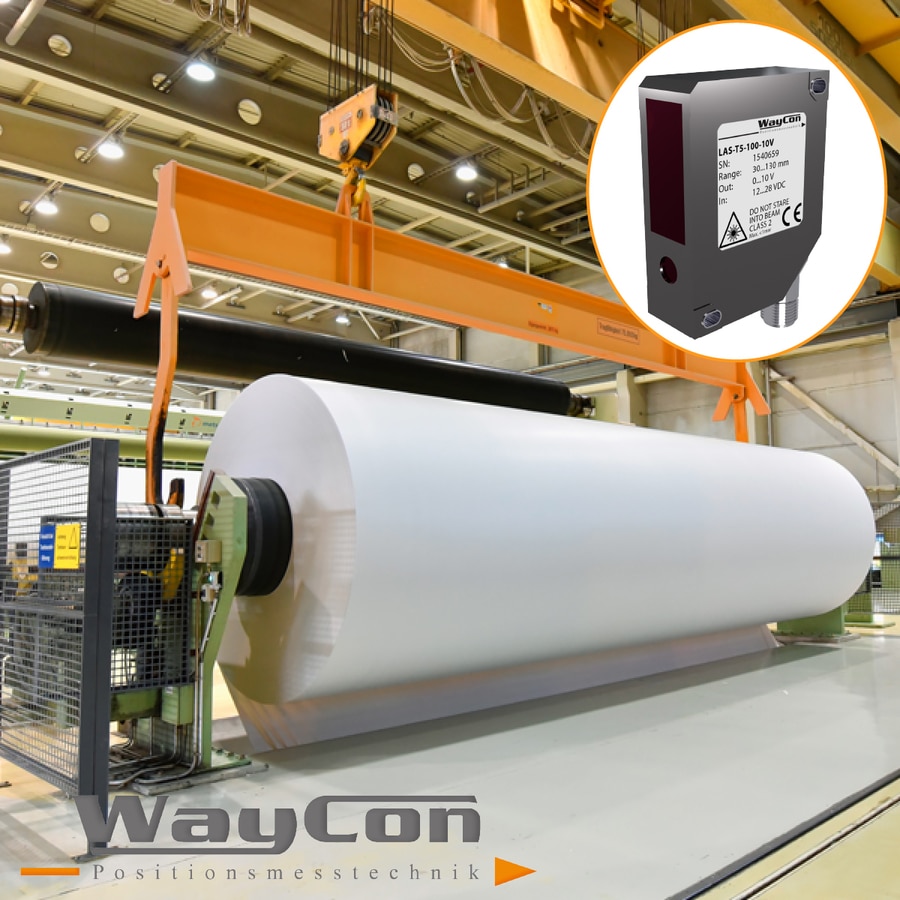
Laser distance sensors from the LAS-T series are a proven sensor series for monitoring in the paper industry. The LAS-T series measures distances up to 800 mm without contact. The compact laser sensors are used, for example, in sag measurement. When winding thin paper webs, unwanted sagging between the rolls can occur. If the sag becomes too great, this leads to tearing of the paper. With a LAS-T sensor above the web, the distance to the paper surface can be measured with millimetre precision, allowing sagging to be detected at an early stage and the roll speed to be adjusted accordingly.
Another typical application is thickness measurement. For this purpose, two laser sensors are mounted on opposite sides of a paper web. By comparing the two measured values, the web thickness can be determined. Line lasers have proven to be particularly suitable for this application. Unlike point lasers, which only measure a single point, line lasers allow for surface averaging over a wider area. Thanks to the high measuring accuracy of the sensors, even the thickness of the thinnest speciality papers can be measured precisely.
The diameter of the wound or unwound paper roll can also be easily measured using laser distance sensors. This enables real-time monitoring of the winding status and is essential for process automation.
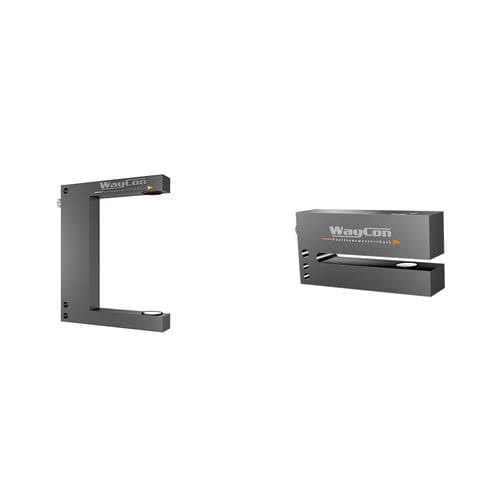
In addition to the application examples mentioned above, web edge monitoring also plays an important role in ensuring correct winding. If the web becomes misaligned, this leads to unclean winding, which can result in creases, for example. To prevent this, laser sensors are mounted on the side of the paper web. If the web slips and leaves the sensor's measuring range, the sensor detects the change in height. As an alternative, ultrasonic sensors from the UBA series can also be used. These sensors, which have been specially developed for web edge monitoring, are used in a similar measuring setup and measure the movement of the paper web within their fork.
Overall, the combination of high-precision LAS‑T laser distance sensors and robust UBA ultrasonic web edge sensors offers the paper industry a comprehensive measurement system for monitoring and controlling process parameters. Whether for sag monitoring during winding, roll diameter control or web edge protection: non-contact measurement ensures greater process stability, less waste and lower maintenance costs.