#Product Trends
Automotive Assembly Line Integrators Purchasing Smart Industrial Electric Screwdrivers: What Are the Key Considerations?
Automotive Assembly Line Integrators Purchasing Smart Industrial Electric Screwdrivers: What Are the Key Considerations?
As automotive manufacturing rapidly evolves towards mixed-model production, digital quality management, and flexible automated lines, smart industrial electric screwdrivers are no longer just simple fastening tools. They have become core process units in vehicle assembly and new energy vehicle (NEV) battery, electric motor, and electronic control assembly lines. For automotive assembly line integrators, the selection of smart electric screwdrivers during project bidding and line solution implementation directly impacts the stability of the entire line, project acceptance timelines, end-customer (OEM) satisfaction, and long-term operational and maintenance costs.
Many integrators, when selecting equipment, only compare torque parameters, neglecting crucial factors like system integration capability, process adaptability, data interfacing capability, and delivery and full-cycle service capacity. This oversight can lead to a series of risks, including difficult on-site debugging, frequent line alarms, inability to interface data with the MES system, and troublesome maintenance down the line.
I. Core Focus Points for Automotive Assembly Line Integrators When Purchasing Smart Industrial Electric Screwdrivers
1. Tightening Process Performance: Precision, Strategy, and Application Adaptability to Meet OEM's Stringent Process Standards
Working conditions vary greatly across automotive assembly stations, including general assembly, chassis, seats, doors, power batteries, and electric motors/controls. These stations involve everything from small screws to high-torque safety bolts, demanding a high level of comprehensive process capability from the tightening tools.
Key considerations for integrators:
Torque and angle control precision, and repeatability/consistency: Must comply with the ISO 5393 industrial tightening standard. The tools must be capable of handling different bolt joint conditions (soft and hard joints) to avoid torque scatter and torque decay, meeting the quality control requirements of the automotive industry.
Multi-step tightening strategies: Support for combined torque-angle control, multi-program storage, and multi-spindle synchronous tightening is required. This allows adaptation to mixed-model production with quick changeovers of tightening parameters for different vehicle models, solving the needs of multi-variant co-production.
Adaptability to working conditions: The tools must be suitable for various scenarios, including environments with oil and vibration, confined installation spaces, robotic end-of-arm tooling, and handheld stations. A compact structure and adequate protection rating are essential for compatibility with robotic mounting and stations with confined spaces/interference.
2. Automation System Integration Capability: Interfacing with PLC/MES to Reduce On-Site Debugging Workload
The core work of an integrator is to connect the entire line; the tightening tool is just one sub-unit. The ease of integrating the tool directly determines the project debugging timeline.
Key evaluation points:
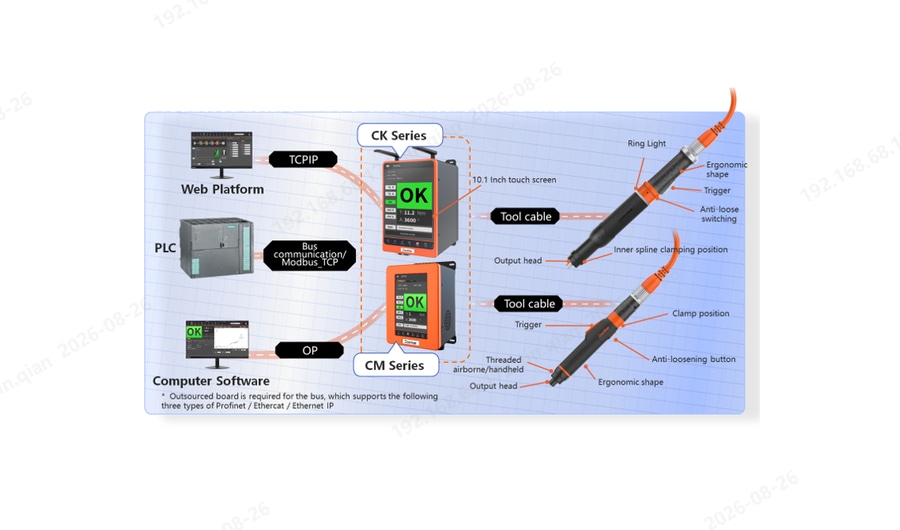
Support for mainstream industrial Ethernet protocols: (e.g., Profinet, EtherCAT, Modbus) for easy connection to the line's PLC.
Comprehensive I/O interaction logic: Clear output of alarm signals and pass/NG signals to simplify the integrator's work in programming interlock logic.
Availability of complete communication protocol documentation and sample programs: To reduce the integrator's secondary development workload.
Capability for real-time MES upload: The ability to upload full tightening process data and tightening curves to the OEM's MES system to meet full-process quality traceability requirements, along with support for large-capacity local data storage and export functions.
3. Error-Proofing Capability and Stability: Reducing Line Downtime and Ensuring Project Delivery Yield
Automotive production lines operate on tight cycle times. Frequent alarms, missed fastenings, floating fastenings, or over-torquing at a tightening station can directly halt the entire line, putting immense pressure on the integrator during project acceptance.
Key selection criteria include the tool's built-in error-proofing mechanisms:
Real-time identification and alarming for issues like floating screws, stripped threads, over-torque, and abnormal angles.
When combined with an automatic screw feeding solution, the system should enable synchronization between feeding and tightening to identify missing or incorrect screws, preventing assembly defects at the source and reducing on-site rework rates.
Evaluation of the equipment's reliability during continuous, long-term operation and verification of its precision under sustained high-frequency operation.
4. Supplier Engineering Capability, Delivery Lead Time, and Full-Cycle Technical Services
Given the tight schedules and numerous non-standard modifications in automotive integration projects, integrators place high value on the supplier's comprehensive engineering strength:
Pre-sales selection support: The supplier should demonstrate a deep understanding of automotive assembly processes, providing assistance with workstation tool selection, process recommendations, and testing plans—not just selling hardware.
Delivery capability: Assurance of stock for standard models and controllable lead times for non-standard customizations to meet project milestones.
On-site technical support: Support for debugging and issue resolution during project implementation on-site.
After-sales support: Availability of spare parts, firmware updates, and continuously updated technical documentation, ensuring stable support even after the warranty period.
Proven industry experience: A track record of successful implementations with automotive parts suppliers and OEMs, demonstrating practical project experience to reduce the risk of unforeseen problems.
II. Danikor: A Domestic Intelligent Tightening Solution Tailored for Automotive Assembly Integration Projects
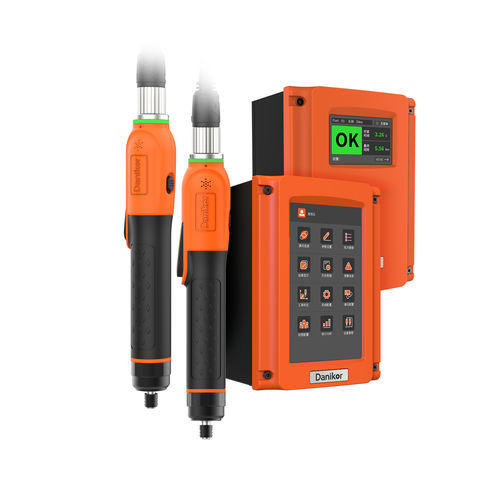
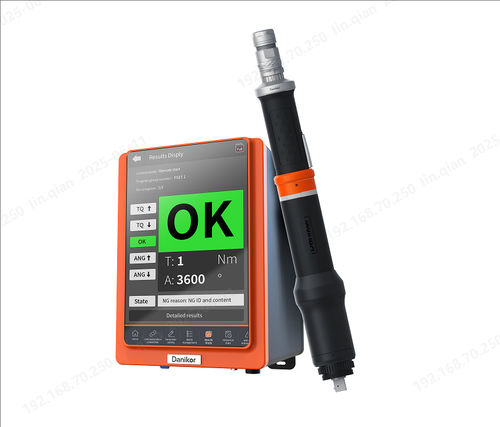
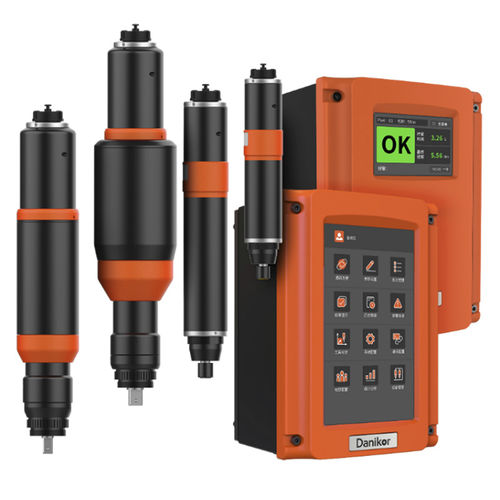
Danikor has over a decade of experience in the automotive and NEV assembly sectors. Its product portfolio includes wired and cordless, sensor and current-controlled, inline and handheld tools, and flexible feeding systems, comprehensively addressing the diverse project requirements of automotive assembly line integrators.
1. Robust Tightening Process Performance, Adapting to Diverse Automotive Application Needs
The Danikor smart tightening tool series complies with the ISO 5393 standard, covering a wide torque range from 0.02 to 600 Nm. This encompasses the majority of assembly stations, from small interior screws to large chassis and battery/electrical drive unit bolts.
2. User-Friendly and Open Integration Capabilities, Significantly Reducing Debugging Burden for Integrators
Addressing the pain points of system integrators, Danikor has factored line interfacing needs into product design from the outset:
Controllers support mainstream industrial buses like Profinet, EtherCAT, and Modbus, with clearly defined I/O signals.
Complete communication manuals and protocol documents are provided to integrators for seamless PLC interfacing.
Real-time output of tightening torque, angle, time, and full tightening curves allows for direct interfacing with OEM MES systems. This enables complete, end-to-end traceability of assembly data, meeting IATF 16949 quality traceability requirements.
3. Full-Process Service Capability System for Integrators
Danikor has established a full-process service capability system specifically designed for automated integration projects:
Pre-sales Stage: A standardized solution library, drawing from mature application cases across multiple industries, enables rapid matching of customer needs, faster responses, and assured implementation. This assists integrators in refining their bidding technical proposals.
Mid-Sales (Order) Stage: A regular email feedback mechanism for periodic progress reports, milestone synchronization, and proactive risk alerts, alongside a project issue management system for parallel, collaborative problem-solving and accelerated closure.
Project On-Site Stage: Collaboration with integrators to complete on-site debugging support, assisting in troubleshooting tightening process and signal interaction issues.
After-Sales Stage: A response commitment of 4-hour initial response, 24-hour solution provision, and 48-hour on-site service. This combines online/offline coordinated response with a tiered problem-handling mechanism.
Currently, Danikor products are widely deployed in OEM vehicle plants and production lines for NEV battery, electric motor, and electronic control components. This extensive experience in implementing automotive assembly projects means Danikor understands the practical issues integrators face during bidding, on-site implementation, and acceptance phases. The company offers not just hardware, but comprehensive tightening process solutions adapted for automotive production lines.
Leveraging its proprietary core tightening technology, a complete product matrix, open and user-friendly integration interfaces, and proven experience in the automotive industry, Danikor provides a cost-effective, full suite of intelligent tightening solutions for automotive assembly integrators. This helps drive the upgrade of automotive and NEV production lines towards high-precision, digital, and flexible assembly.