#White Papers
HV‑Driven Heterojunction Reservoir
The application of high-voltage amplifiers in the calculation of the physical reservoir pool of ferromagnetic-electrostatic heterojunction systems
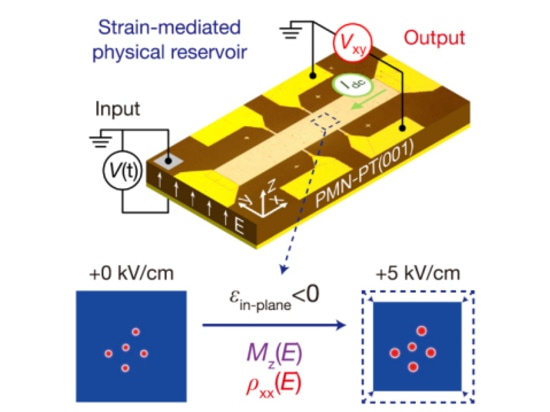
Reservoir computing (RC) is an efficient recurrent neural network framework with fixed internal connections and only output-layer training, significantly reducing computational cost. Physical reservoirs exploit intrinsic nonlinearity, high dimensionality, and short-term memory for temporal processing, among which spintronic reservoirs are attractive for their non-volatility, low power, multifunctionality, and CMOS compatibility. Magnetic skyrmions offer small size, topological stability, and energy efficiency, but existing skyrmion-based reservoirs mainly rely on current or magnetic-field inputs with relatively high energy consumption. This work experimentally demonstrates a strain-mediated voltage-controlled skyrmion reservoir using a multiferroic Pt/Co/Gd/PMN-PT heterostructure, where electric fields tune both magnetization and resistivity, with anomalous Hall effect as output. The system successfully performs waveform classification and Mackey–Glass time-series prediction, paving a new path for low-power neuromorphic computing.
Research Direction:
Magnetic-electrical coupling devices with adaptive control, Neuro-inspired computing and reservoir computing, Study on Phase Transition and Physical Properties Controlled by Piezoelectricity,High-frequency/rapid dynamic regulation experiment.
Experimental objective:
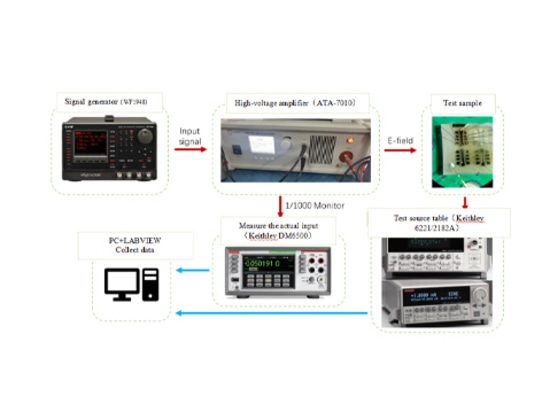
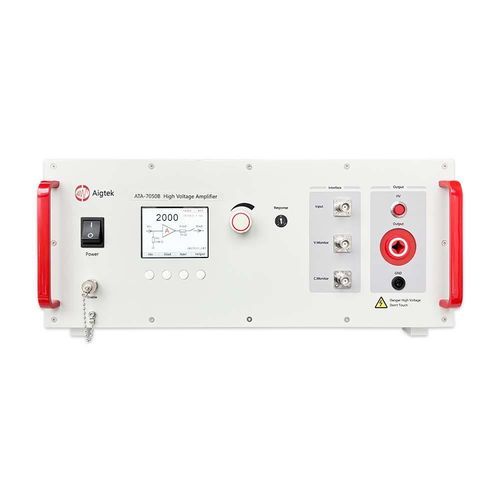
The arbitrary waveform generated by the signal generator is amplified by the high-voltage amplifier and then input into the system. The real-time output of the detection system is detected, and the model training and testing for the reserve pool calculation of this system are carried out.
Testing equipment:
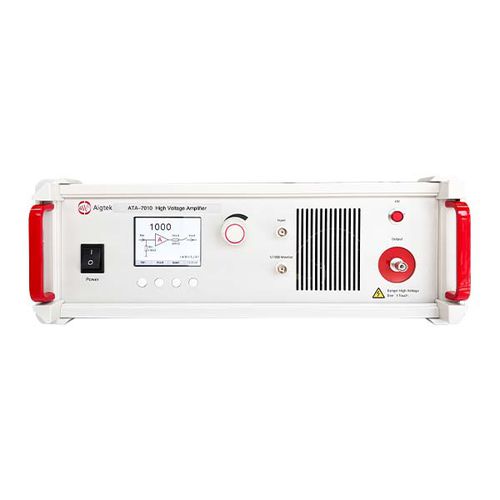
Signal generator, ATA-7010 high-voltage amplifier, current source, nanovoltmeter, digital multimeter, etc.
Experimental process:
This experiment first utilized micro-nano processing to fabricate Hall bar devices with magnetic multilayer films on a piezoelectric substrate. Subsequently, through a transfer circuit board, the timing signals were input into the system via a signal generator and a high-voltage amplifier, and the Hall voltage of the device was read as the signal output. Synchronous input and output signals were collected using an instrument, and through model training, the timing signals could be predicted.
The specific experimental platform setup is shown in the following figure. The signals generated by the signal generator were input into the high-voltage amplifier, which produced the required high electric field for the experiment and applied it to the sample. A series of test source meters were used to collect the output signals and the synchronous actual input signals. Using Labview software programming, the measurement results of the instrument were synchronously read on the computer for the subsequent analysis of the experimental data.
Experimental results:
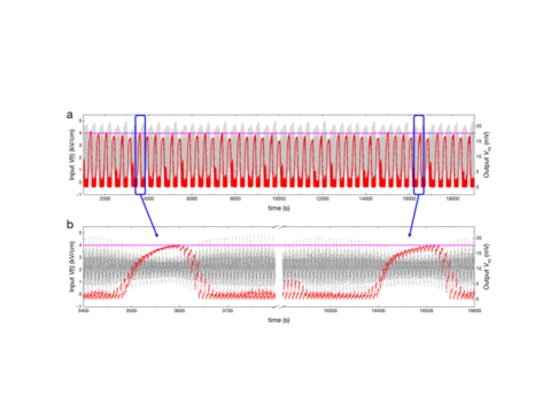
In the Mackey-Glass chaotic time series prediction task, an arbitrary waveform (≤ ± 4 V) was generated using a signal generator and then amplified by a high-voltage amplifier by a factor of 100 to 200 before being input into the test system. A total of 2500×50×2 = 250,000 data points were continuously collected. After testing, the signal amplification factor and signal accuracy met the experimental requirements. As shown in Figure a, after a long-term test, both the input signal (gray) and the output signal (red) were in a relatively stable state. Figure b shows the data details of the part in the blue box of Figure a.