#Product Trends
High-Temperature h-BN Chambers Drive Efficiency Upgrade of Hall Effect Thrusters
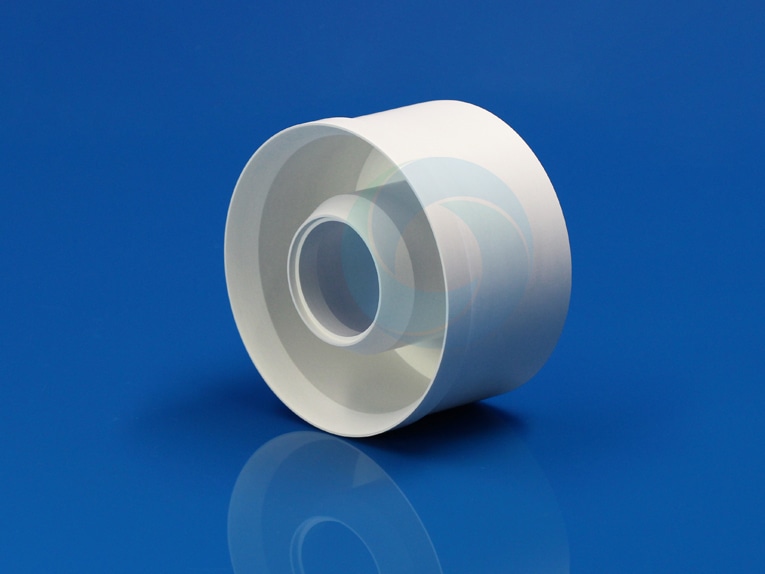
hexagonal boron nitride plasma chamber
In today’s era of rapid development in deep space exploration and satellite technology, efficient and reliable propulsion systems are the key to extending the lifespan of spacecraft and expanding the boundaries of missions. The Hall Effect Thruster (HET), as an advanced electric propulsion technology, has become the mainstay of modern satellite orbit maintenance and deep space missions due to its advantages of high specific impulse and long service life. However, its core component – the plasma chamber – has long been subjected to severe challenges such as high temperatures, high-energy ion sputtering, and strong electric fields, which directly limit the performance and reliability of the propulsion system.
In this context, Innovacera has officially launched a hexagonal boron nitride (h-BN) plasma chamber component specifically designed for high-performance Hall effect thrusters. This component is made of advanced ceramic materials and employs precise manufacturing techniques, aiming to significantly enhance the operational efficiency, stability and service life of the thruster in extreme environments.
Breaking Through Material Limits: Why Choose Hexagonal Boron Nitride (h-BN)
The plasma chamber is the “heart” of the Hall thruster. It not only needs to confine and stabilize the plasma discharge and guide the ion flow to be ejected efficiently, but also must directly withstand the high-temperature heat load and high-speed ion bombardment from the plasma. Traditional materials can affect mission safety during long-term operation due to erosion, thermal stress, or degradation of electrical performance.
Hexagonal boron nitride (h-BN), a high-performance ceramic with a layered structure similar to that of graphite, possesses extremely high thermal stability, electrical insulation properties, and chemical corrosion resistance. It can bring revolutionary material advantages to Hall thrusters:
•High Temperature Resistance: Capable of enduring working conditions exceeding 1000℃ for an extended period, preventing structural failure due to uneven thermal expansion.
•Electrical insulation: Effectively prevents high-voltage breakdown and abnormal discharge, ensuring the stability of the acceleration electric field and the accuracy of thrust control.
•Resistance to ion erosion: Its surface is smooth and highly chemically inert, which can significantly delay the wear of the chamber wall and thus becomes a key factor in extending the lifespan of the propeller.
•Low secondary electron emission: This helps to reduce plasma disturbances and ensures stable and reliable thrust output.