#Product Trends
PTC vs MCH Ceramic Heating: How to Choose the Right Industrial Igniter
PTC Heater or MCH Ceramic Heater—which is the better choice for your industrial igniter?
In industrial high-temperature heating and biomass combustion ignition systems, ceramic igniters are gradually replacing traditional nickel-chromium resistance wire heating solutions. Ceramic heating technology outperforms traditional heating solutions in heating rate, energy efficiency and working lifespan.
PTC heaters and MCH metal ceramic heaters represent the two mainstream heating technologies on the market. They feature distinct material structures, temperature control mechanisms, maximum temperature ratings and applicable fields. Such core differences greatly influence equipment ignition performance, system stability and long-term maintenance expenses.
I. Working Principle of PTC Heaters
PTC (Positive Temperature Coefficient) heating elements use barium titanate (BaTiO3) semiconductor ceramic as the core material, characterized by a significant increase in resistance with rising temperature.
Its working process is as follows:
• Cold start phase: Low resistance, high current, rapid heating
• Heating process: As temperature rises, resistance increases rapidly, causing power to drop automatically
• Thermal equilibrium phase: The system operates stably within a certain temperature range
PTC materials achieve self-limiting temperature functionality through their inherent physical properties, thus typically requiring no complex external temperature control systems, offering high safety and ease of use.
However, its temperature performance has a clear upper limit. Conventional barium titanate PTC elements typically operate stably within a temperature range of 250–300℃; when the temperature exceeds approximately 350℃, resistance drift or even material failure may occur. Therefore, they are more suitable for medium- to low-temperature constant-temperature heating applications and are difficult to meet high-temperature ignition requirements.
II. Working Principle of MCH Metal Ceramic Heater
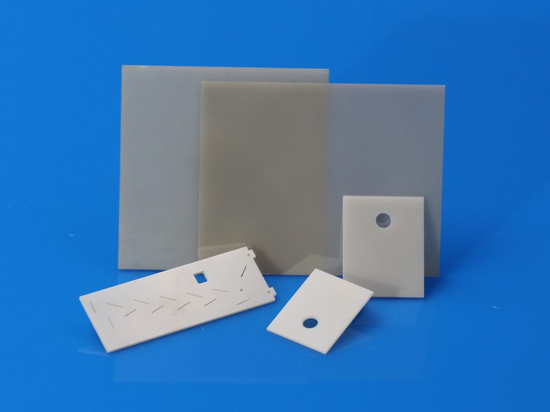
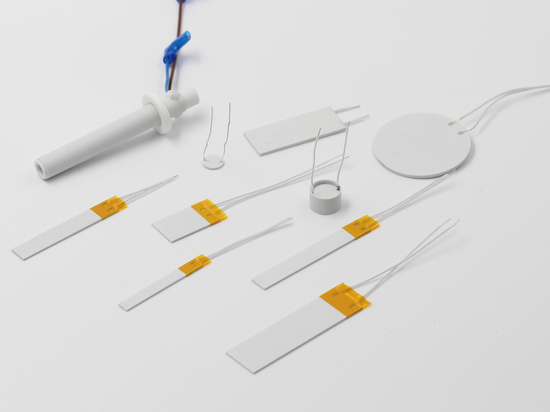
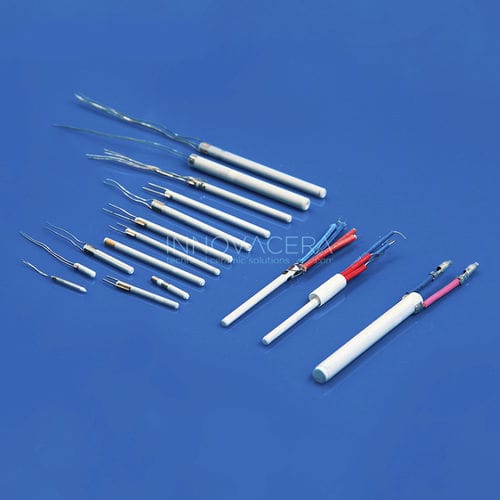
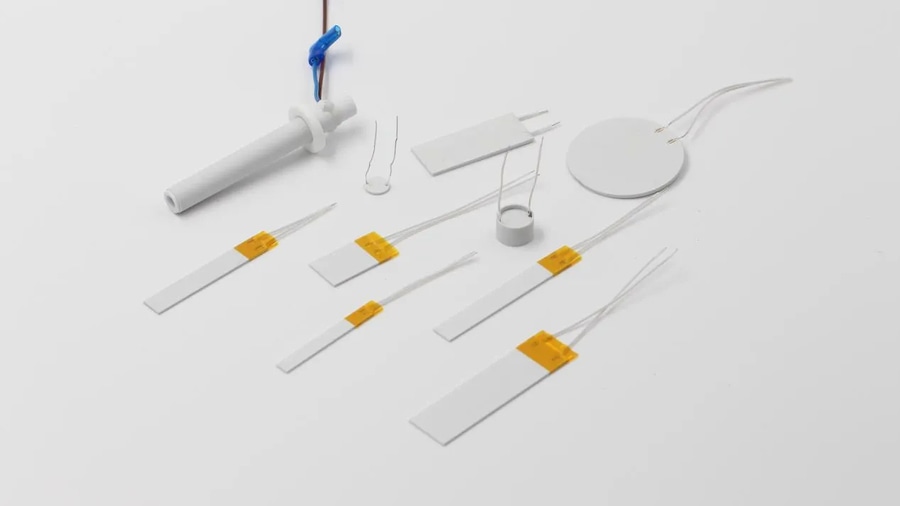
MCH (Metal Ceramic Heater) is an integrated ceramic heating element manufactured through a high-temperature co-firing process.
Its typical structure is:
High-purity alumina (Al2O3) or silicon nitride (Si3N4) ceramic substrate + metal resistive heating circuit
The manufacturing process typically includes:
Circuit patterns are formed by screen printing high-melting-point metal resistive pastes such as tungsten, molybdenum, and manganese, which are then laminated with ceramic green sheets in multiple layers. After high-temperature co-firing, a dense, integrated structure is achieved, enabling an electric-heating monolithic packaging solution.
In high-end industrial ignition applications, silicon nitride substrates can also be selected to further enhance thermal shock resistance and high-temperature stability.
MCH Key Features:
• High power density: approximately 30–50 W/cm²
• Fast heating speed: capable of reaching over 700°C in a short time
• Wide temperature range: industrial-grade products operate stably between 700–1000℃
• High thermal efficiency: uniform heat distribution and low energy loss
• Long service life: heating circuit encapsulated within ceramic, offering strong oxidation resistance
It should be noted that MCH itself does not possess the self-limiting temperature characteristics of PTC materials and typically requires an external temperature control or protection circuit to achieve precise temperature regulation and system safety.