#Product Trends
Large Alumina Ceramic Insulation Components: How Are Kovar, Stainless Steel, and Ceramic Reliably Brazed?
Ceramic to Metal Brazing
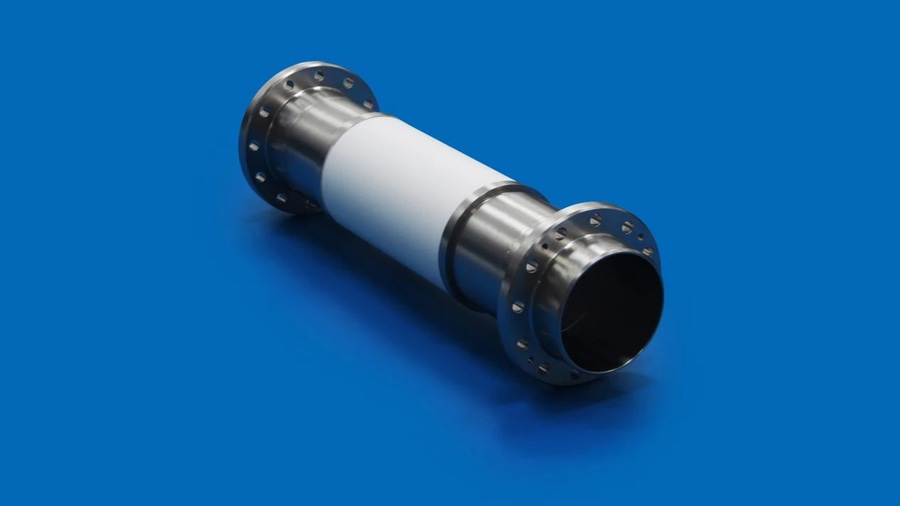
In high‑voltage electrical systems, vacuum equipment, semiconductor devices and scientific instruments, large‑size insulating structures typically use ceramics to deliver reliable electrical insulation, while metal parts undertake mechanical connection, flange mounting and sealing duties under given operating conditions. Joining alumina ceramics with metals including Kovar and stainless steel is a core technical solution to realize these composite assemblies.
Unlike standard small ceramic insulators and vacuum feedthroughs, large cylindrical ceramic – to – metal brazed assemblies come with bigger overall dimensions, longer body lengths and substantially larger bonding interfaces between ceramic and metal. Certain large parts can have a total length of several hundred millimeters, which places stricter requirements on material compatibility, machining tolerance, assembly concentricity and brazing processes.
For this reason, large – scale ceramic – to – metal brazing cannot be treated as a simple dimensional scaling – up of small hermetic seals. It demands comprehensive optimization covering material grade selection, structural design, thermal‑stress mitigation, precision machining and brazing process parameters.
I. Why do large insulating components require a combination of ceramics and metals?
Single materials often struggle to simultaneously meet the requirements for electrical insulation, mechanical connection, and structural integration in large high-voltage or vacuum equipment. Alumina ceramic offers excellent electrical insulation, high-temperature resistance, chemical stability, and compatibility with vacuum environments, making it widely used in insulating structures for high-voltage and vacuum systems. However, ceramics are inherently brittle, which limits their application in flange connections, mechanical fastening, and assembly with main equipment bodies.
Metals such as stainless steel and Kovar, on the other hand, offer superior mechanical strength and workability, enabling them to be machined into flanges, sleeves, connecting rings, and other mounting structures. By employing ceramic-to-metal sealing technology, the electrical insulation properties of ceramics can be combined with the mechanical joining capabilities of metals, allowing components to achieve both electrical isolation and structural rigidity, along with hermetic sealing required for specific applications.
In vacuum and high-voltage applications, this ceramic-metal combination is particularly critical. The key to success lies not merely in selecting individual materials, but in ensuring reliable bonding between different materials during brazing and long-term operation.