


#Product Trends
Wave Spring Bearing Preload in Compact Motors
How installed height, spring rate and thermal growth affect preload, with an LMS25-M6 design example.
In compact electric motors, the space available for a bearing preload spring is often limited. The engineering challenge is to keep the bearing load within a suitable range as component tolerances and operating temperatures change. A wave spring offers a compact way to introduce axial compliance, provided its working height and load characteristics are matched to the bearing arrangement.
Start with the required preload range
The target is an acceptable preload window over the operating cycle. Insufficient load can compromise rolling contact under some operating conditions, while excessive preload can increase friction and heat. Establish the bearing manufacturer's requirements for the selected bearing, speed, lubrication and external loads before selecting the spring.
In a common spring-preloaded motor arrangement, the spring acts on the side face of the outer ring of an axially movable bearing. That ring needs a suitable fit and sufficient axial freedom in its housing so that the spring can accommodate displacement. The complete bearing arrangement determines the preload load path.
Why consider a wave spring with shim ends?
LISPRING's LMS series combines a multi-turn wave spring with flat support turns at both ends. These shim ends provide a flat interface to adjacent components. The spring must be positioned so that its contact area loads the intended bearing ring without interfering with the rotating components.
For a design that needs to accommodate variation in installed height, spring rate is an important selection parameter. A lower rate produces a smaller force change for a given axial displacement, subject to the spring's available travel, load capacity and stress limits.
A numerical example: LMS25-M6
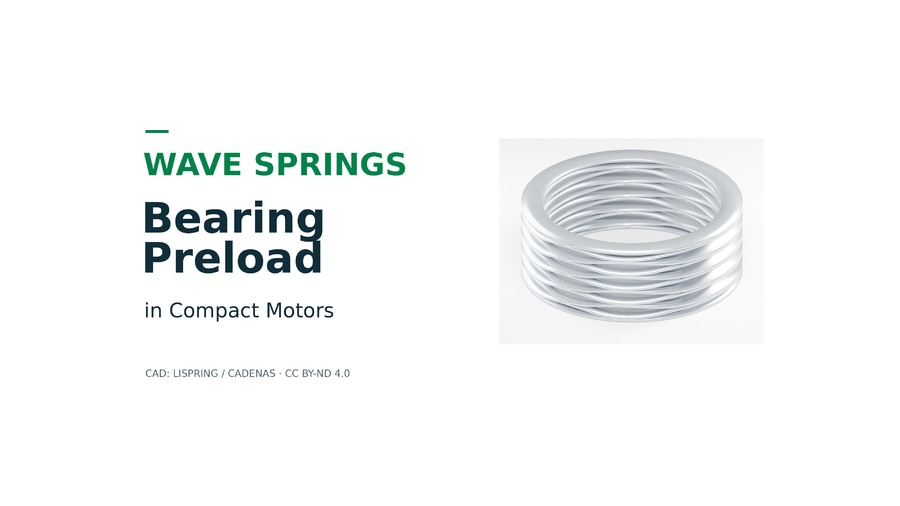
The published LMS25-M6 specification lists a nominal load of 80 N at a working height of 8.84 mm, a free height of 19.89 mm and a spring rate of 7.24 N/mm. The accompanying CAD model represents the spring at the 8.84 mm working height.
For a small displacement around the nominal working point, an approximately linear response gives:
Change in load = spring rate x change in compression
As an illustrative tolerance calculation, assume the installed height varies by +/-0.20 mm. Using the listed spring rate, the estimated load change is approximately +/-1.45 N. A smaller installed height increases compression and load; a larger installed height reduces them.
This calculation illustrates sensitivity to installed height. It excludes spring load tolerance and temperature effects, and the 80 N nominal load is a product specification rather than a preload recommendation for every motor. Confirm the actual load-height response over the intended working range.
Include thermal growth in the tolerance analysis
Shaft, housing and bearing components can expand by different amounts as temperatures rise. Depending on the arrangement, the available spring space can increase or decrease. Evaluate the minimum and maximum installed heights at cold start and at the relevant operating temperatures, then check that the resulting loads remain within the required preload window.
The spring accommodates displacement while its force changes according to its load-height characteristic. Material properties at temperature, stress relaxation and cyclic loading also need consideration where relevant.
Use the space saving as part of a complete design
For suitable designs, wave springs can reduce the axial space required by up to 50% compared with conventional coil compression springs under the same load and deflection requirements. The achievable reduction depends on the selected geometry and application.
Before releasing the design, verify the spring load at the installed-height limits, radial clearances, contact surfaces and available travel. Assembly-level checks should assess bearing temperature, running torque, noise and vibration across the expected operating conditions.
LISPRING provides standard and custom wave springs for industrial assemblies. Share the bearing arrangement, required load range, available axial space and operating temperature to support spring selection.
Explore the LMS series and its CAD resources at:
https://www.wave-spring.com/wave-springs/lms
