


#Industry News
China’s Vibration Shaker Technology: What European Buyers Should Know About the New Performance Frontier
From 0.002 Hz calibration to 100-ton systems: a pragmatic guide for European buyers evaluating Chinese test equipment.
For French and wider European test engineers and procurement teams, China’s shaker sector is no longer only a source of mid-range equipment. Two developments deserve attention: ultra-low-frequency absolute calibration down to 0.002 Hz, and very-high-thrust electrodynamic shaker systems in the 100 t and 140 t class. Neither development makes every Chinese shaker suitable for every European project. But together, they change the competitive benchmark.
1. Calibration down to 0.002 Hz: a capability that used to sit with very few laboratories
A domestic calibration system has recently been built with specifications that directly target one of the hardest areas in vibration metrology:
Ultra-low-frequency module: 0.002 Hz–160 Hz full-range absolute calibration
Maximum peak-to-peak displacement: 50 mm
Relative measurement uncertainty: Urel = 0.5%–1.0% (k = 2)
Low-frequency module: 0.1 Hz–200 Hz
At 0.002 Hz, one complete vibration cycle takes 8 minutes and 20 seconds. This is ground-motion-level micro-vibration — invisible to the eye, but critical for traceability in seismometry, aerospace, precision manufacturing and low-frequency sensor calibration.
The practical significance is structural. Previously, most domestic laboratories could only perform comparison calibration in the 0.1 Hz–20 Hz range, while high-precision absolute calibration at ultra-low frequencies relied on imported systems. The new capability fills a domestic gap in ultra-low-frequency vibration metrology and gives seismic, aerospace and precision-manufacturing sectors a more independent traceability path.
In an earlier international comparison at 0.1 Hz, only a small number of national metrology institutes were able to complete the measurement; several others did not submit data. Pushing absolute calibration down to 0.002 Hz places this capability in a range previously occupied by very few international authorities.
What this means for European buyers: if your application involves seismometers, high-precision inertial devices, MEMS low-frequency sensors or weak-vibration traceability, domestic Chinese calibration capability is now a serious technical reference point — not merely a lower-cost alternative.
2. Very-high-thrust shakers: the records are not new
Ultra-low-frequency calibration is about measuring accurately. Very-high-thrust shakers are about reproducing the environment. The latter directly reflects a country’s equipment ceiling for spacecraft ground vibration testing.
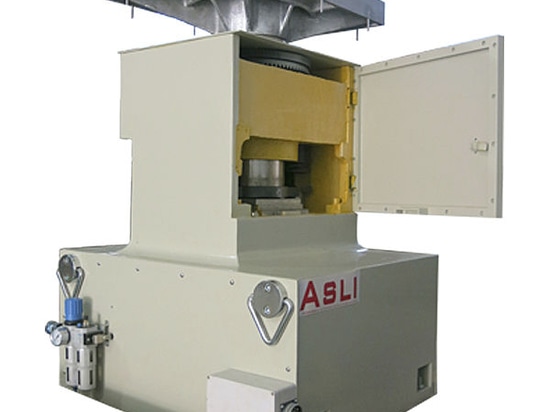
About a decade ago, a 140 t vibration test system was accepted as the world’s largest-thrust electrodynamic vibration test system, with fully independent intellectual property. It uses four shakers in a vertical configuration, with a static load capacity of 40 t and a maximum thrust of 140 t. Key breakthroughs included four-shaker synchronous excitation, large magnesium-alloy table welding, and high-precision, high-load-bearing guidance and support.
More recently, a 100 t single-unit electrodynamic vibration test system was assessed by an industry expert panel as the world’s first single-unit 100 t system, with overall international leading level and fully independent intellectual property. It broke through key areas including ultra-high-thrust high-strength moving-coil design and manufacturing, adaptive high-efficiency moving-coil cooling control, and ultra-large power amplifiers. It can simulate sine, random and shock conditions for complete machines and major components in aviation, aerospace, marine and rail transport.
Taken together, the two lines tell a simple story: China has held the thrust ceiling in electrodynamic shakers for nearly a decade — this is not a one-off breakthrough. The 140 t class serves whole-spacecraft-level testing; the 100 t single-unit class is more flexible for heavy machinery, marine, rail and large-component testing. Together they form a relatively complete extreme-capability spectrum.
What this means for European buyers: distinguish between whole-system-level and component-level requirements. Do not simply ask for the largest thrust number. Match thrust class to specimen size, static load, fixture interface, frequency range and test profile.
3. The international picture: closer, but not identical
The balanced view is this: at the two hard nodes — very-high-thrust electrodynamic shakers and ultra-low-frequency absolute calibration — China has entered the first tier. In sensor ecosystems, calibration-grade modules and long-term field data, international brands still have accumulated advantages. The gap is narrowing, but “full replacement” is not the right description.
In low-frequency vibration calibration, established international metrology and test brands remain benchmarks in calibration-grade systems, with high-end modules offering dynamic range above 160 dB in a single range and meeting stringent international standard requirements. That accumulation cannot be copied overnight.
At the same time, domestic capability is approaching from two directions: the 0.002 Hz absolute calibration system addresses independent ultra-low-frequency traceability, while domestic manufacturers have made public progress at the 0.05 Hz level, with some specifications approaching or exceeding imported equipment.
In the market structure, Chinese manufacturers are already technically competitive with international benchmarks in the medium-thrust segment. Supply is moving from “single reliance on imports” towards “domestic substitution in transition”. In the very-high-thrust segment, the deployment of 100 t and 140 t domestic systems shows that import dependence at the high end has been materially weakened.
4. Export reality: very-high-thrust systems are not automatically available
One important caveat for European buyers: some very-high-thrust vibration systems are subject to Chinese export-control requirements and are not freely exportable at present.
For projects at 100 t class and above, European buyers should include export licensing, end-user review, delivery lead time, spare-parts planning and service support in the feasibility assessment. It is not safe to assume that “a sufficient budget means any thrust class can be sourced from China”.
This also means that, at the extreme-thrust end, international buyers should plan for multi-source strategies or local supply-chain options rather than relying on a single cross-border source.
5. A practical procurement checklist for European teams
Before comparing quotations, clarify the following:
Define the test need by specimen, not by thrust alone. Specimen mass, centre of gravity, envelope, static load, fixture interface, frequency range and test profile matter more than a headline thrust figure.
Ask for calibration traceability and an uncertainty budget. For low-frequency work, absolute calibration capability and uncertainty statements are more important than brochure specifications.
Check standard coverage and fixture compatibility. Confirm that the proposed system covers the applicable test standards and your existing fixture ecosystem.
Check export classification early. For very-high-thrust systems, clarify export-control status before technical selection goes too far.
Plan service, spares and training. Lead time and after-sales support can matter more than a small price difference.
Use reference projects as evidence. A supplier’s involvement in demanding, long-running test programmes is a more reliable indicator than a specification sheet.
6. A pragmatic fit: ASLI
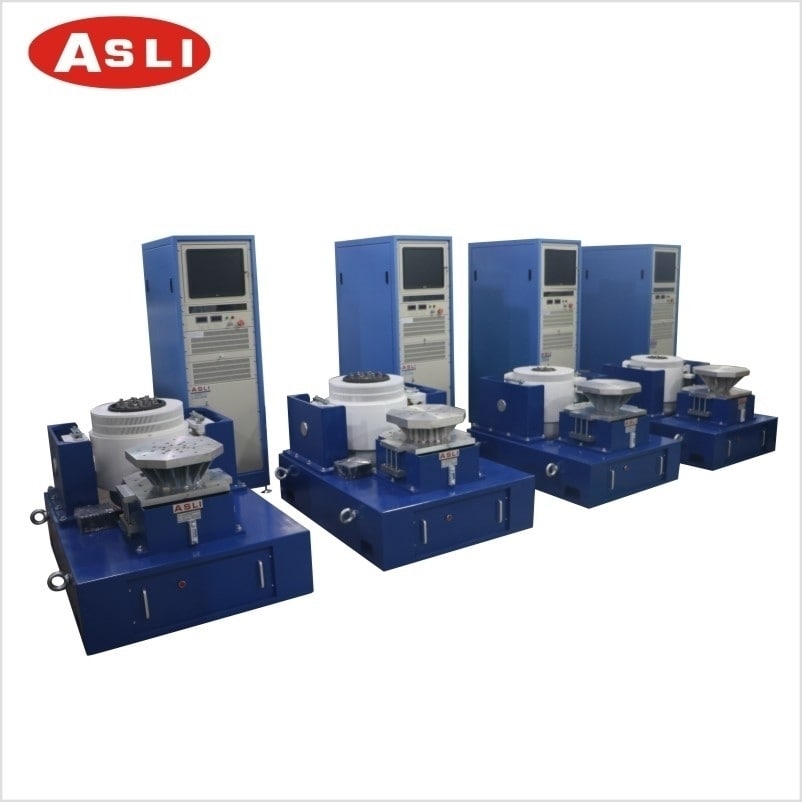
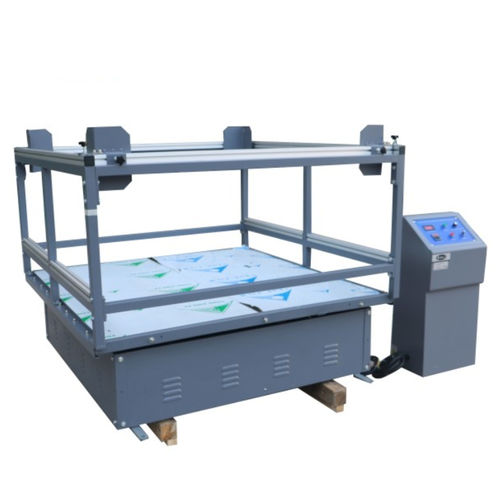
ASLI is one of the vibration shaker manufacturers in this market. We do not claim the extreme-thrust records described above. Our focus is different: covering the majority of test standards and providing custom configurations based on specimen size, fixture interface, frequency range, test profile and site conditions.
For projects that do not require 100 t-class thrust, this can be a more practical route — with advantages in delivery lead time, export-compliance certainty and whole-lifecycle cost. In other words, not every test programme needs the world’s largest shaker. Many need the right shaker, properly configured and reliably supported.
Bottom line
China’s shaker technology is now world-class at two hard nodes: very-high-thrust electrodynamic systems and ultra-low-frequency absolute calibration. At the same time, international brands still lead in parts of the sensor and calibration ecosystem, and some very-high-thrust systems are not freely exportable. For European buyers, the sensible approach is to treat domestic Chinese options as a serious technical benchmark — and to evaluate compliance, fit and support with the same rigour as performance.
Un clin d’œil de France pour terminer : « Ça vibre ? Parfait. Tant que ça tient, c’est notre métier. » À bientôt, et bonne campagne d’essais.
 鄂公网安备42018502009509号