#Product Trends
Why Are There So Many Temperature-Humidity Chamber Manufacturers in China? A Structural Analysis of Supply-Side Fragmentation
A Neutral Assessment of Demand Structure, Entry Barriers, Industrial Clusters, and Standards Evolution
One phenomenon is easy to misread: a large number of manufacturers does not automatically mean intense competition at the same technical level, nor does it mean the industry is low-tech. A more accurate description is that China’s temperature-humidity chamber sector exhibits a layered supply structure. At one end are manufacturers with system integration capability and long-duration reliability validation; at the other is a large group of producers focused on standard chamber integration and regional service. Both share the same product category name, but they serve different precision requirements and different budget constraints. Explaining “why there are so many manufacturers” is therefore essentially explaining why entry and survival costs for the lower layer of supply are low enough to be sustainable.
The analysis below proceeds along four dimensions: demand structure, supply-side entry thresholds, industrial clusters, and institutional variables. Where quantitative estimates are used, they are presented as directional indicators rather than precise measurements, because different sources define product categories and statistical scope differently.
Demand Side: A Large Base That Does Not Need to Be “Created”
Temperature-humidity chambers serve electronics, automotive components, new-energy batteries, semiconductors, pharmaceuticals, and defense-related testing. Demand is not dependent on a single industry cycle. Over the past five years, however, the most significant structural change has come from new-energy vehicles and energy storage.
Publicly available industry estimates suggest that the Chinese market for constant-temperature and constant-humidity test chambers reached roughly RMB 4.5 billion in 2025, accounting for approximately 38% of the global market. Within that total, the application share of new-energy vehicles and energy storage is estimated to have risen from about 18% in 2023 to 29% in 2025. Other estimates place the growth rate of procurement demand from these two sectors at over 20% year on year in 2025.
Different sources use different category boundaries. Some estimate the global “environmental test equipment” market at around RMB 10.6 billion in 2024, while others estimate the narrower “constant-temperature and constant-humidity chamber” segment in China at RMB 4.5 billion. These figures are not directly comparable. What they share is a directional conclusion: new-energy and energy-storage testing has become one of the highest-weight sources of incremental demand. Even if procurement in traditional industrial sectors slows, standard-type equipment still has an expanding base. Manufacturers do not need to create this demand; they only need to capture it.
Supply Side: The Entry Cost Is Not “Whether It Can Be Built,” but “How Much Capability Counts as Enough”
This is the core layer for understanding the large number of manufacturers.
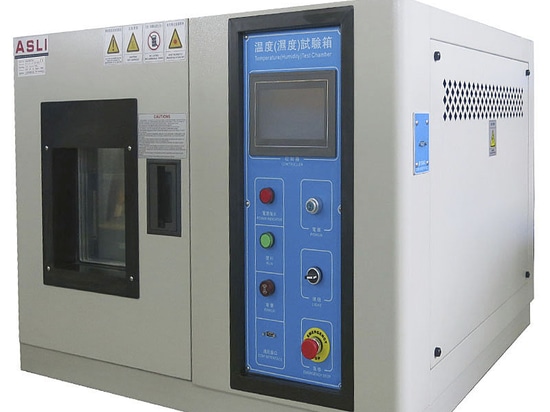
A temperature-humidity chamber consists of functional modules: refrigeration, heating, humidification, dehumidification, air circulation, and control. In a mature industrial environment, sheet-metal enclosures can be fabricated locally, while compressors, controllers, and sensors can be purchased. Public selection guides and supplier information reflect this division of labor: when assessing manufacturer capability, industry analyses often examine in-house sheet-metal processing capability and the brand and source of key components such as compressors, controllers, and sensors. In other words, for standard-type products, the proportion of self-manufactured content in the final assembly can be compressed to a relatively low level.
This does not mean the industry lacks technical barriers. In the mid- and high-end market, barriers concentrate in control algorithms, whole-machine thermal balance design, stability during wide-temperature-range long-duration operation, and compliance with automotive or defense-related standards. The critical point is that these two sets of capabilities do not serve the same market. Industry estimates suggest that the number of reliability test equipment manufacturers in China has remained stable at around 320, while only about 15% possess full-chain independent R&D capability. The original sampling scope of this estimate is not fully disclosed in public summaries, so it is better treated as an order-of-magnitude reference rather than a precise count. Even so, the structural feature it describes is consistent with widely observed industry patterns: the vast majority of manufacturers neither need nor are able to cover high-end barriers; their existence fills the supply gap for standard-type equipment.
Market concentration data support the same judgment from another angle. Industry estimates place the CR10 of the high-low temperature test chamber sector at roughly 42%–45% in 2025, with a large number of small and medium-sized manufacturers active in regional or niche segments. The two ends of this range reflect differences in statistical scope, but both point to one fact: the top ten companies together cover less than half of the market, and the remaining share is dispersed among a large number of smaller manufacturers. This dispersion is itself a direct measure of “many manufacturers.”
Industrial Clusters: Making “Integration” Physically Feasible
The layered supply structure can persist in reality because industrial clusters provide supporting density.
The Yangtze River Delta and the Pearl River Delta together host approximately 73% of enterprises above designated size in the environmental test equipment sector. Within the Suzhou-centered cluster, about 60 enterprises above designated size are estimated to contribute 52% of national production capacity for lithium-battery explosion-proof test chambers. Dongguan offers another perspective: publicly cited local data indicate that the city had 127 registered environmental test equipment enterprises in 2025, of which about 38% explicitly stated the capability to produce automotive humidity-heat test chambers, concentrated in industrial zones such as Wanjiang, Houjie, and Liaobu.
The significance of these figures is not simply “many companies.” It is that supporting density pushes the fixed cost of whole-machine integration down to a level that small teams can bear. When sheet-metal processing, refrigeration component distribution, controller procurement, and regional technical service can all be completed within a short radius, a small or medium-sized manufacturer does not need to build a complete supply chain to produce and deliver a standard chamber. Industrial clusters lower not the “technical threshold” but the organizational and logistics thresholds—and these are precisely the variables that determine whether production can be launched at a small scale.
Standards Evolution: Layering Is Converging Gradually, but Not Yet Complete
The institutional dimension is another variable for understanding why lower-end supply has persisted for a long time.
The standard GB/T 10586-2025, which took effect on December 1, 2025, replaced the 2006 version that had been in use for nearly two decades. The new standard systematically revises technical requirements and test methods, imposing clearer constraints on parameters such as temperature fluctuation, load conditions, and dynamic operating conditions. Industry analyses generally agree that the upgrade raises market entry thresholds and accelerates the elimination of assembly-type manufacturers lacking core technology.
One methodological caution is necessary. The often-cited estimate that the new standard “eliminates about 12% of low-end production capacity” is a commercial consulting estimate, not an official statistic released by the standard-setting body or a regulator. It is more prudent to treat it as a directional signal rather than a precise measure of capacity exit. More importantly, a 12% elimination rate itself implies a premise: before the standard upgrade, low-end capacity did constitute an observable scale in statistical terms. The tightening of standards is a gradual process, not a one-time clearing. Under the old standard cycle, a chamber that could “control temperature, control humidity, and keep parameters roughly within range” could enter the market. This state persisted long enough for a large number of small-scale manufacturers to complete registration, start production, and accumulate channels. The new standard is changing this equilibrium, but the speed of change depends on regulatory enforcement and the simultaneous tightening of customer acceptance criteria.
A Structural Judgment, Not a Value Judgment
Combining the four dimensions above, the reasons for the large number of temperature-humidity chamber manufacturers in China can be summarized as follows:
Broad and growing downstream demand provides an expanding base; the integration threshold for standard-type products in industrial clusters is low enough to make small-scale supply commercially viable; and the standard system’s tolerance of lower-end supply over a long period has made “participating in supply through integration capability rather than full-chain R&D capability” a sustainable business model.
This explanation is not intended to imply that the industry is low-tech. On the contrary, it explains why technical density and the number of suppliers can become decoupled. Leading manufacturers direct resources toward control algorithms, thermal balance design, and long-duration reliability validation, serving customers with rigid requirements for data traceability and long-term stability. A large number of small and medium-sized manufacturers serve price-sensitive regional markets and general industrial customers with relatively relaxed precision requirements. The two layers of supply correspond to two types of demand; they share the same category name, but they do not overlap in capability structure or competitive plane.
For buyers, the practical implication of this structural judgment is that “many manufacturers” lowers the cost of requesting quotations but significantly raises the cost of due diligence. What needs to be distinguished is not whether a factory exists, but where the manufacturer’s capability actually sits—whether it has system integration capability with thermal balance design and long-duration stability validation, or whether it remains at the level of sheet-metal integration and parameter declaration for standard chambers. Standards are tightening and concentration is rising slowly, but the phenomenon of “many manufacturers” is the combined result of demand structure, entry thresholds, and industrial clusters. It will not disappear quickly because of a single round of standard upgrades.