
#Product Trends
High-Performance Anti-Static Bellows for Pharma, Food & OEM Industries
Engineered to prevent static build-up, ensuring contamination-free, safe, and reliable performance in critical industrial applications.
Introduction
In modern industrial environments, where high-precision processes are the norm, static electricity can pose silent yet severe risks. From triggering accidental ignitions in powder-handling systems to damaging sensitive electronic components, static build-up is a hazard that engineers cannot afford to ignore.
Anti-static bellows are one of the most effective solutions to mitigate these risks. Designed to prevent the accumulation and discharge of static electricity, they ensure safer, cleaner, and more efficient material transfer in industries such as pharmaceuticals, food processing, and OEM machinery manufacturing.
Understanding Anti-Static Technology
Anti-static refers to the property of a material to prevent or reduce static electricity build-up. Static is generated when two materials come into contact or rub together, causing electrons to transfer and create an electrical charge.
If uncontrolled, static can lead to:
• Dust attraction – leading to contamination in clean environments.
• Product degradation – moisture or dust attracted by static may compromise quality.
• Ignition hazards – especially in the presence of flammable powders or gases.
• Equipment malfunction – due to electrostatic discharge (ESD) affecting control systems.
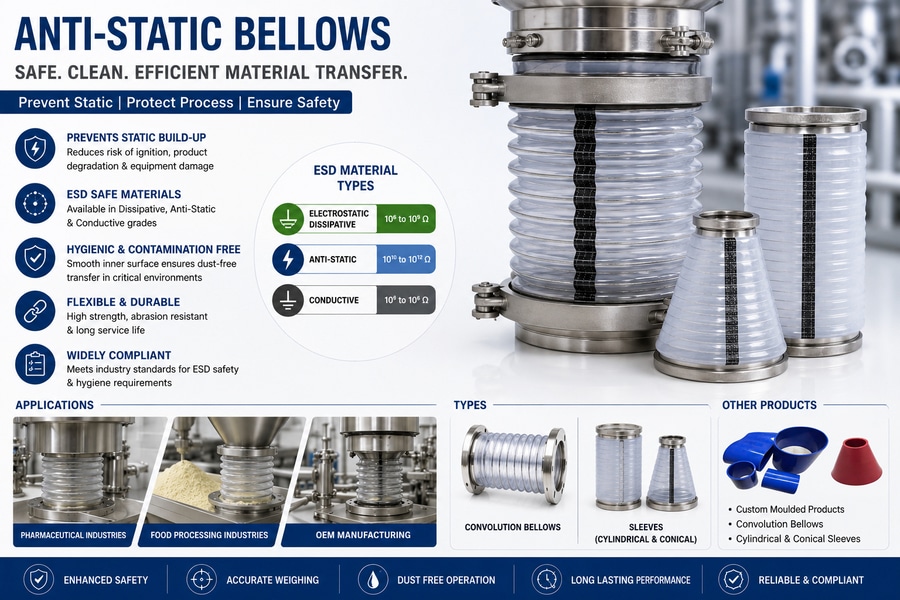
Types of ESD (Electrostatic Discharge) Materials
Anti-static bellows are typically made using materials that fall under one of the three ESD classifications:
1. Electrostatic Dissipative Materials
o Function: Limit static build-up and safely dissipate charges.
o Surface Resistivity: 10⁶ to 10⁹ Ω.
o Use Case: Environments requiring controlled discharge to avoid spark risks.
2. Anti-Static Materials
o Function: Reduce the generation of static charges during operation.
o Surface Resistivity: 10¹⁰ to 10¹² Ω.
o Use Case: Packaging, material transfer, and handling applications where static prevention is key.
3. Conductive Materials
o Function: Allow charges to flow freely, preventing accumulation.
o Surface Resistivity: 10¹ to 10⁶ Ω.
o Use Case: Environments requiring maximum charge dissipation for safety.
Applications of Anti-Static Bellows
Anti-static bellows act as a flexible, stress-free connection between transfer chutes and process equipment, particularly in systems with sensitive weighing requirements.
They are widely used in:
• Pharmaceutical Industries
o Powder transfer in cleanrooms without contamination risks.
o Examples: Divis Laboratories, Aurobindo, Hetero, Mylan.
• Food Processing Industries
o Dust-free transfer of flour, sugar, cocoa, and powdered additives.
o Examples: Ravi Foods, 3F Industries, Mondelez India.
• OEM Manufacturing
o Integrated into equipment for bulk material handling, maintaining safety and accuracy.
Types of Anti-Static Bellows
1. Convolution Bellows
o Highly flexible and durable for systems requiring frequent movement.
o Suitable for applications with vibration or movement between connected equipment.
2. Sleeves
o Available in two designs:
Cylindrical Type – Straight profile for vertical or horizontal transfer.
Conical Type – Tapered design for controlled flow and reduced turbulence.
Targeted Customer Segments
Anti-static bellows are essential for:
• Pharmaceutical bulk handling units.
• Food processing plants.
• OEMs manufacturing powder-handling and weighing systems.
Engineering Benefits & Safety Compliance
• ESD Safety – Prevents accidental electrostatic discharge that could cause fires or equipment failures.
• Hygienic Design – Compatible with cleanroom requirements, preventing contamination.
• Durability – Resistant to wear, tear, and chemicals.
• Operational Accuracy – Maintains weighing precision in sensitive batching systems.
• Compliance – Manufactured to meet industry ESD standards and hygiene certifications.
Conclusion
As industries evolve towards automation, higher throughput, and stricter safety standards, the role of anti-static bellows becomes even more crucial. Their ability to control electrostatic hazards ensures product safety, worker protection, and operational efficiency.
Whether in pharmaceutical powder transfer, food ingredient handling, or OEM machinery design, anti-static bellows are more than just a connecting component—they are a safeguard against invisible risks.