
#Product Trends
Signalling instead of switching off
Preventive maintenance in industry
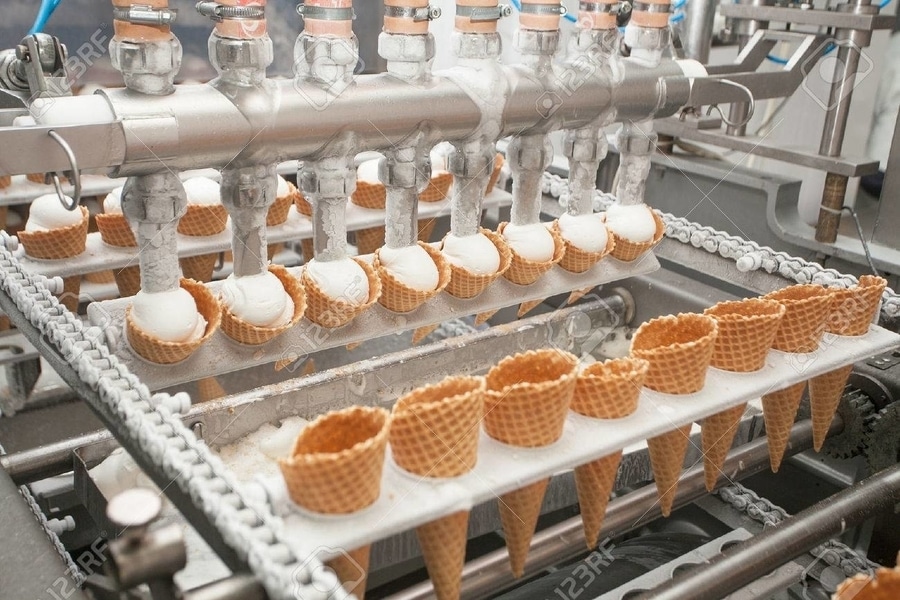
The food and beverage industry needs production facilities that have to work around the clock. A demand that must not be taken for granted.
And it applies to all the components of the plant: From the filling to the capping to the packaging line, all plant components, even smaller ones, must work reliably so as not to disrupt the entire production chain. High plant availability is a must.
Reliable production needs reliable power supply, which in turn should meet a well-maintained plant. All electrical currents should flow exclusively along the paths intended for them. The use of unwanted current paths is both undesirable and problematic, and ultimately dangerous for people and equipment.
Supposed security
Random, occasional measurements of the insulation resistance represent a snapshot and can feign security. But they certainly do not provide information about the availability of an installation. Not until monitoring devices are used that can measure and evaluate insulation conditions during operation and process and signal defined limit values can there be any talk of real system protection.
Insulation faults - only a matter of time
Even a correctly implemented installation is subject to wear and tear - especially in the food and beverage industry. The electrical insulation of the installation is particularly endangered by excessive contact with cleaning agents. The range of liquids alone that are used to remove labels, caps and also contaminants extend from relatively harmless water to aggressive cleaning liquids. This means an extremely high degree of stress for electrical insulation. Resulting insulation faults are only a matter of time.
Maintenance instead of shutting down
Since all common materials for electrical insulation can only withstand the aggressive effects of etching and cleaning fluids at most in the medium term, their destruction is unavoidable in the long run. Spot-on maintenance is becoming extremely important. Through intelligent and continuous monitoring of the entire installation, emerging insulation faults are detected at an early stage. The benefit is obvious: Worn insulation can be replaced during service and maintenance work before serious malfunctions – even production downtimes – occur. Predictive maintenance is thus a result of complex analysis and coordination of power supply, protective measures, continuous monitoring and real-time messages.
Smooth production processes
The main circuit provides the energy for supplying the buildings and their lighting systems and drives (e.g. the conveyor belts). The required energy is transformed, transported, distributed and switched. It is designed either as an unearthed system (IT system) or earthed system (TN or TT system).
Measurements around the clock
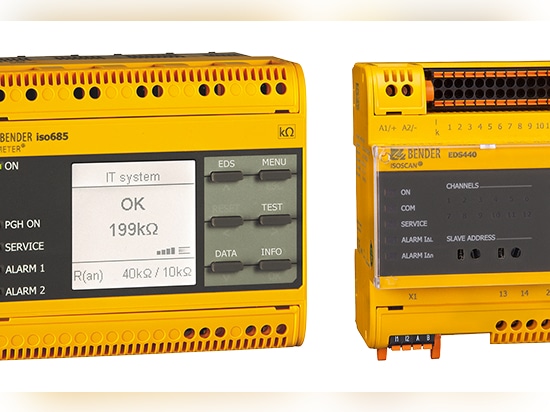
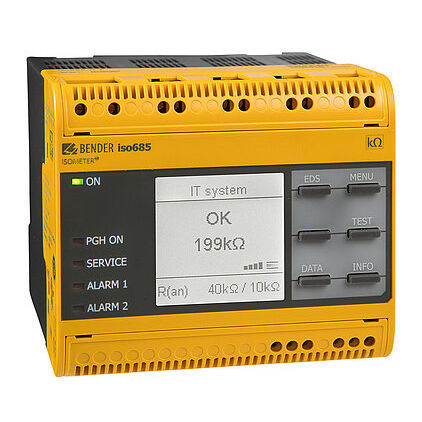
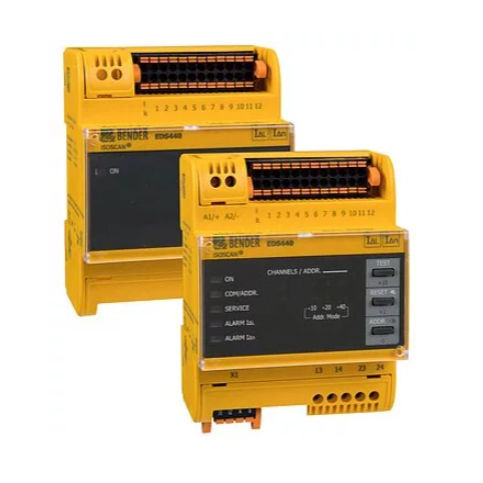
Especially in manufacturing, the IT system proves to be the better power supply to monitor due to its maximum availability. Since no active conductor is directly connected to earth, only a small fault current, essentially caused by the system leakage capacitance, flows in the event of an insulation fault. The upstream fuse does not respond, the power supply and thus continued operation remain guaranteed. Immediate information about a possible hazard is provided by an ISOMETER® insulation monitoring device from Bender. This makes continuous monitoring of the insulation condition during operation the standard – as well as a measurable reduction in maintenance effort (fully automatic instead of manual) and a reduction in costs. Another plus for the reliability of an electrical installation in IT systems is monitoring with additional insulation fault location. The ISOMETER® provides the necessary information advantage. Fast localisation is possible with an insulation fault location system, the EDS system from Bender. The location of the fault is signalled promptly during operation so that faults can be eliminated immediately and shutdowns can be prevented.
The silver bullet - predictive maintenance
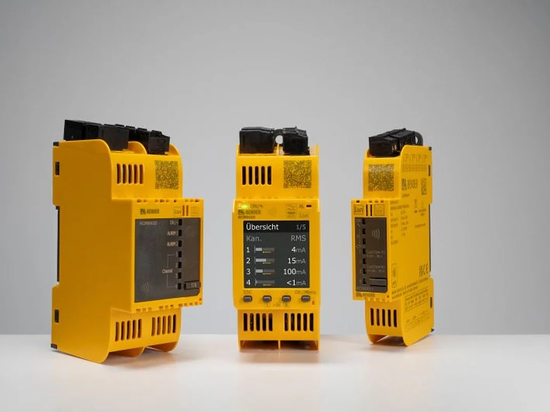
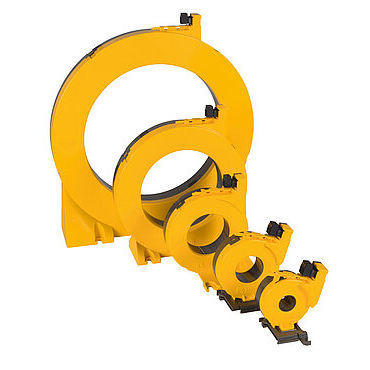
If an earthed power supply system (TN-S system) is installed, the solution is called continuous residual current monitoring – with residual current monitors of the RCM, RCMA or RCMS series from Bender. The total or residual current is continuously measured at particularly important or sensitive points in the system. If the residual or fault current critical for this part of the installation becomes too high, the residual current monitor issues an alarm. Installation technicians are then able to react immediately, so that shutdowns and plant standstills or even fires caused by insulation faults are a thing of the past – the strategy of predictive maintenance is fulfilled.
Low effort - high security
An integration of residual current monitoring is already possible with little effort, if measured data is collected at about 8 to 12 measuring points and the evaluation and information exchange is considered. The technical effort for predictive maintenance and thus enormous cost savings with significantly increased system and personnel safety is conceivably low. The space required for this can usually be found in existing control cabinets and does not require any complex new installations.
Signalling instead of switching off
For control and auxiliary circuits in which, for example, commands are issued or measured, opened, locked, signalled, heated or cooled, the operational safety of the installation is paramount. The production line only runs when specific control voltages are applied.
The following applies to both system types : Insulation monitoring devices provide information in IT systems about the insulation state of the system. In TN-S systems, residual current monitors measure the insulation level and display it. The latest values can be read at any time, and inadmissible deteriorations are reported in good time.