#Product Trends
Advancing Barrier Validation: Precision Testing Methods for Modern Packaging Films
As packaging materials evolve, so too must the precision of the tools used to verify them.
In modern food and beverage packaging, barrier performance defines quality. As the industry shifts towards recyclable, aluminium-free, and bio-based laminates, R&D teams face a consistent challenge: verifying that new materials perform as reliably as their predecessors.
Optical, dye-based, or gas-transmission methods have long been used for inspection - yet they often lack the sensitivity to detect the microscopic faults that can compromise film performance. For today’s advanced coatings and hybrid structures, verification now depends on precision electrical methods capable of demonstrating continuity, repeatability, and compliance under controlled conditions.
Beyond Detection: Establishing Repeatable Proof
In regulated packaging environments, testing is not simply about detecting faults. It’s about proving consistency — ensuring that results can be reproduced, traced, and defended under recognised international frameworks..
Electrical integrity testing has become central to this process. By applying a controlled voltage across the material and monitoring for electrical discharge, laboratories can verify the dielectric uniformity of coatings and laminates with a high degree of precision.
Its value lies in repeatability - enabling comparable outcomes between operators, sites, and test runs. For R&D and Quality teams, this provides the assurance required to validate new materials and maintain global compliance standards.
How Electrical Integrity Testing Works
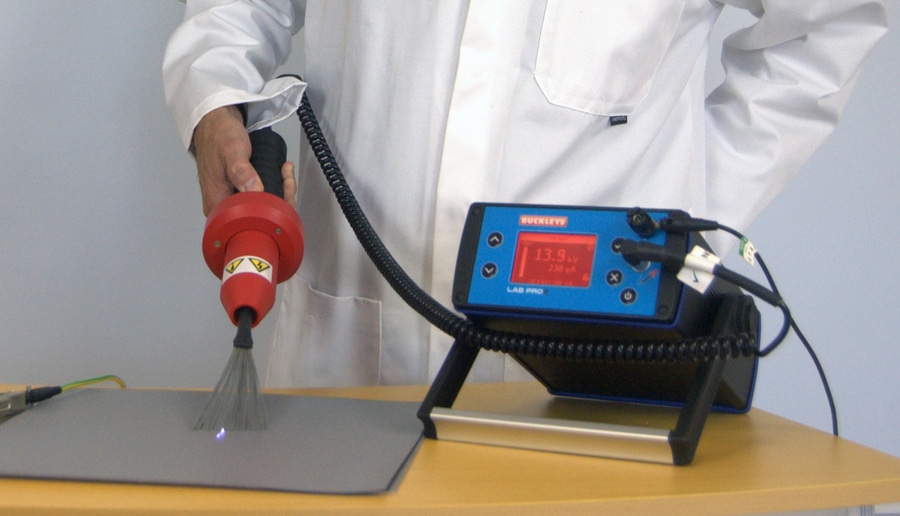
Electrical integrity, or pinhole testing, works by applying a defined voltage between a probe electrode and a grounded conductive backing. If a discontinuity exists within the film, a brief current passes through the defect, triggering a visible and audible indication.
This non-destructive technique offers several key advantages:
Immediate feedback – test results are displayed in real time.
Adjustable parameters – voltage and sensitivity can be tuned to material type and thickness.
Reproducibility – controlled settings ensure consistent outcomes across trials.
Non-destructive testing – samples remain intact for further analysis or reference.
By combining precision voltage control with operator-adjustable sensitivity, laboratories can detect micro-defects below 50 µm and establish repeatable parameters for process validation.
The Lab Pro2: Confidence Through Control
Developed by Buckleys (UVRAL) Ltd, the Lab Pro2 pinhole detector supports laboratories where reliability, documentation, and compliance are essential.
Its stable, mains-powered high-voltage supply ensures consistent output across repeated tests - an essential factor when correlating data between facilities or verifying results during audits. Adjustable sensitivity thresholds (10–450 µA) allow users to tailor testing to each material’s dielectric characteristics, while the intuitive digital interface simplifies operation and configuration.
Each unit is supplied with a traceable calibration certificate to BS EN ISO 9001:2015, supporting internal quality systems and regulatory documentation requirements. With configurable electrode options - including roller and drum configurations - the Lab Pro2 provides the flexibility required for a broad range of coated, laminated, or hybrid materials.
Together, these features establish the Lab Pro2 as a dependable platform for controlled, repeatable, and standard-compliant testing across R&D, production, and compliance verification environments.
From Compliance to Confidence
Electrical integrity testing contributes directly to both quality assurance and innovation efficiency. By incorporating this verification early in development, R&D teams can confirm material uniformity before scale-up, detect micro-defects that other methods might miss, and reduce false positives through precise threshold control.
The ability to establish consistent test parameters allows for faster internal approvals, reduced rework, and improved correlation between laboratory and production data - all while maintaining the documentation trail expected in regulated food and beverage packaging environments.
This level of reproducibility supports confident decision-making and builds traceable evidence for product release, certification, and audit.
Sustainability Built on Verification
As highlighted in the Packaging Europe Sustainable Innovation Report (2025), the future of packaging innovation depends on demonstrating performance with measurable proof. Electrical integrity testing enables that proof - validating the reliability of recyclable and renewable materials before they reach production.
By adopting precision electrical methods, packaging manufacturers can reduce material waste, shorten development cycles, and verify that sustainable structures meet the same integrity benchmarks as traditional laminates.
Verification has become an enabler of sustainability - not a barrier to it.
Precision as Partnership
At Buckleys, we view precision testing as a collaborative process between engineers, scientists, and compliance professionals. The Lab Pro2 represents this partnership - combining engineering accuracy with the practical flexibility required for today’s advanced packaging materials.
Through stable, reproducible, and auditable testing, the Lab Pro2 supports the industry’s shared goal: reliable, compliant, and sustainable packaging verified with confidence.