#Product Trends
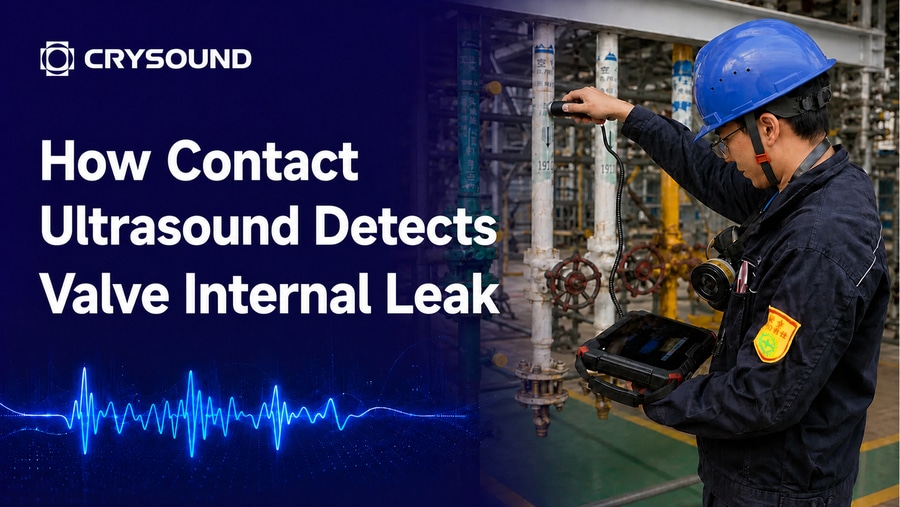
How Contact Ultrasound Detects Valve Internal Leak
From Hidden Leakage to Measurable Evidence for Safer Maintenance Decisions
Valve internal leakage is difficult to detect because the leak path is hidden inside the valve body. Learn how contact ultrasound supports repeatable MP1-MP5 verification, field leakage reference values, and maintenance decisions in chemical, coal chemical, and natural gas applications.
In process plants, a closed valve does not always mean reliable isolation.
Valve internal leakage is difficult to notice because it happens inside the valve body. There may be no visible gas plume, no liquid dripping, no obvious smell, and no external leak point to inspect. From the outside, the valve may look normal and the position indicator may show "closed", while process media can still pass through a damaged seat, disc, plug, ball, or sealing surface.
For chemical plants, natural gas stations, coal chemical facilities, power plants, and utility systems, this is where the risk becomes serious. If a leaking isolation valve is treated as a reliable barrier before hot work, confined space entry, line opening, purging, or maintenance handover, a hidden equipment defect can quickly become a safety, production, quality, and compliance issue.
Recommended Solution and Products
For users who need a complete workflow, see the CRYSOUND Valve Internal Leak Detection Solution. Recommended products for this application include CRY8125, CRY8124, and IA3104.
Why Valve Internal Leaks Are Hard to Detect
1. The leak path is inside the valve
External leaks can often be found with visual inspection, gas detectors, soap solution, or acoustic imaging. Internal leakage is different. The medium passes through the sealing interface inside the valve, so the outside of the valve may show no obvious sign of failure.
Operators may only notice indirect symptoms, such as downstream pressure recovery, incomplete depressurization, unstable upstream pressure, residual gas or liquid after purging, abnormal energy consumption, or process quality fluctuation.
2. "Closed" can create a false sense of isolation
A closing action only confirms that the actuator, stem, disc, ball, or plug has reached the closed position. It does not prove that the sealing pair is still intact. Wear, corrosion, erosion, particles, thermal deformation, or incomplete seating may still allow media to pass through the valve.
This is especially important for maintenance isolation valves, flammable or toxic media valves, high-temperature and high-pressure valves, and critical utility valves. Before work begins, the question should not only be "Is the valve closed?" but also "Is the valve still leaking internally?"
3. Traditional methods depend heavily on experience and site conditions
Manual listening, mechanical stethoscopes, temperature checks, infrared thermography, pressure decay, trend analysis, shutdown inspection, and offline seat tests all have value. But in noisy plants with many valves, insulation, different media, short maintenance windows, and multiple inspection teams, they can be difficult to apply consistently.
Many findings remain subjective, such as "it sounds abnormal" or "the pressure drop seems faster than usual". These descriptions are hard to compare, repeat, hand over, or turn into a traceable maintenance record.
How Contact Ultrasound Helps Verify Internal Leakage
When a valve is closed and a stable pressure difference exists between the upstream and downstream sides, internal leakage through a narrow gap can generate high-frequency ultrasonic signals. These signals are produced by turbulent flow, friction, and impact as the medium passes through the sealing defect.
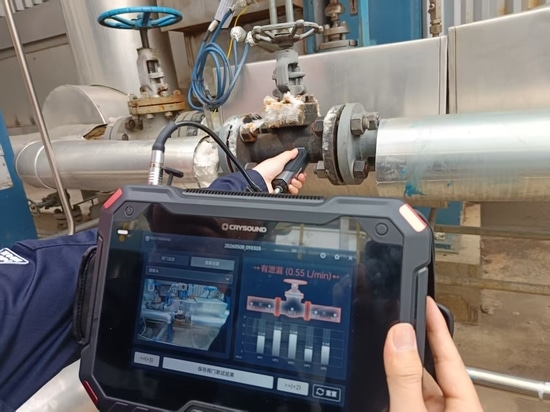
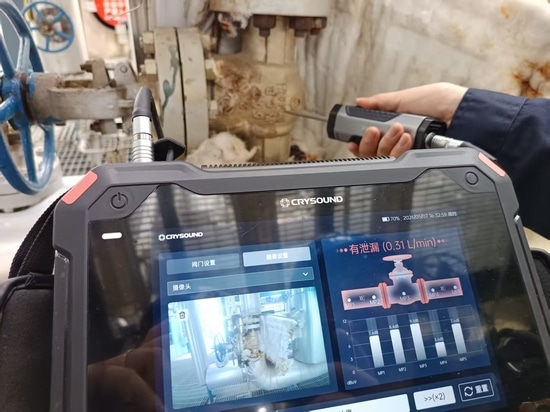
A CRYSOUND contact ultrasound sensor is placed on the valve body or adjacent metal pipeline surface to capture structure-borne ultrasonic signals. The software then analyzes multi-point sound level, spectrum, Final Curve behavior, and repeatability to help determine whether the signal pattern is consistent with internal leakage.
The key value is not simply "hearing" a leak. Contact ultrasound turns valve internal leak inspection into a more repeatable workflow: confirm the operating condition, collect data at defined points, analyze signal features, estimate leakage as a reference, and keep the result for reporting and follow-up comparison.
A Repeatable Field Method: MP1-MP5 Measurement
For valve internal leak inspection, relying on one instantaneous reading is not recommended. A more reliable approach is to confirm the condition first, measure at defined points, and interpret the relationship between those points.
Before measurement: confirm that the valve is closed and that a stable pressure difference is available where possible. Record the medium, valve type, valve size, pressure or pressure difference, valve ID, and test location. Make sure the sensor is in stable contact with the metal surface. If the valve is fully insulated, a local measurement window may be required.
Five-point measurement: MP1 is typically used as the upstream far reference point, MP2 as the upstream near point, MP3 near the valve body or sealing area, MP4 as the downstream near point, and MP5 as the downstream far reference point. Comparing upstream, valve body, and downstream behavior helps reduce false conclusions from a single point.
Repeat and confirm: if one point shows an isolated spike, repeat the measurement and rule out unstable contact, knocking, external noise, bypass lines, and process fluctuation. A more reliable internal leak indication usually appears as a consistent pattern across related points and frequency features.
From "It Sounds Like a Leak" to Data That Can Be Reviewed
In field use, contact ultrasound is not only a signal pickup tool. It helps convert valve inspection into a recordable and repeatable process.
The device can analyze sound level, spectrum, Final Curve, and repeatability, then support conclusions such as normal, suspected leakage, internal leakage, or severe internal leakage. After entering medium, valve type, valve size, pressure, and pressure difference, the system can also provide a leakage reference value for risk grading, maintenance prioritization, and follow-up comparison.
This leakage estimate should be treated as a field reference for screening and decision support. It does not replace statutory inspection, manufacturing acceptance, pressure testing, offline seat leakage testing, or any legally required test method.
Field Application: Which Valves Should Be Checked First?
Based on field experience, the following valves are often the best candidates for internal leak verification:
Maintenance isolation valves: valves used before hot work, confined space entry, line opening, purging, blind plate operation, or equipment handover.
Flammable, explosive, toxic, or hazardous media valves: including natural gas, fuel gas, coal gas, hydrogen, ammonia, hydrogen sulfide, solvent vapor, and similar media.
Steam and utility critical valves: internal leakage can cause continuous energy loss and affect system pressure or downstream equipment condition.
Quality-critical or repeatedly abnormal valves: internal leakage may cause cross-contamination, ratio deviation, failed cleaning isolation, or batch quality issues.
High-risk valves before planned shutdown: in-service screening helps decide which valves should be repaired, replaced, or monitored first.
Case 1: Chemical plant in Yulin, Shaanxi
At a chemical plant in Yulin, Shaanxi, the team inspected 8 suspected leaking water valves with a pipeline pressure of about 0.3 MPa. Contact ultrasound verification identified 4 valves with internal leakage and 4 valves without obvious internal leakage. Follow-up disassembly observations were consistent with the inspection results, helping the customer decide which valves required priority maintenance.
Some recorded valve positions included HX-2114D, 2VX-1158C, 2XV-1155C, and XV-1152D. The system provided leakage reference values ranging from approximately 0.28 L/min to 4.53 L/min, supporting risk-based maintenance prioritization.
Case 2: Coal chemical coking workshop in Inner Mongolia
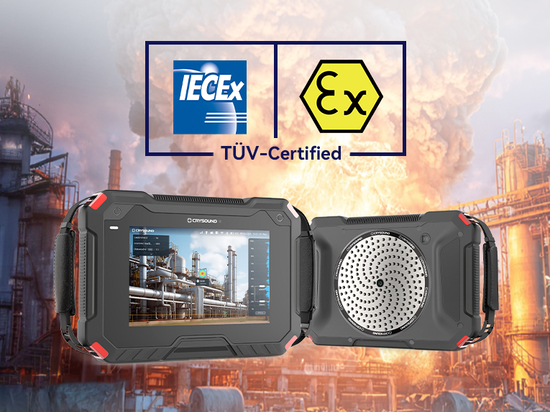
In a coal chemical coking workshop in Inner Mongolia, the site involved coal gas, nitrogen, oxygen, methane, and other media. The environment was complex and required explosion-proof equipment. During maintenance, the customer used an explosion-proof acoustic imaging camera together with an explosion-proof contact ultrasound sensor to verify 10 suspected leaking coal gas valves. The inspection identified 6 valves with internal leakage.
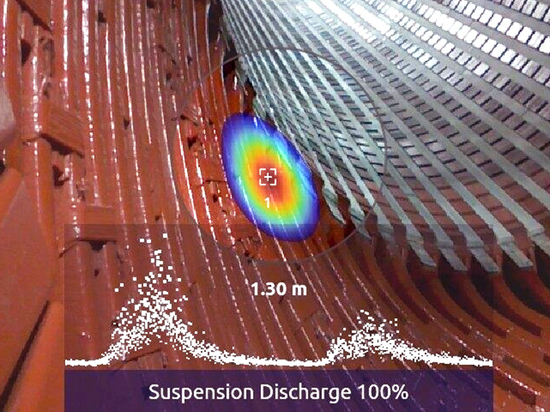
In this type of scenario, acoustic imaging is useful for fast external leak and abnormal sound source screening, while contact ultrasound is used to verify internal leakage at key valve positions. Field images, measurement data, and reports can then support maintenance planning and traceability.
Case 3: Natural gas metering station with series-parallel valve groups
At a natural gas large-flow metering station, four valve groups were arranged in a two-in-series and two-in-parallel structure. Downstream pressure rose abnormally, but the customer could not determine which valve or valve group was leaking internally. By checking the valves point by point with contact ultrasound, the team quickly located 2 valve groups with internal leakage, including abnormal behavior in series valves. The result was consistent with the downstream pressure increase observed on site.
This case shows that contact ultrasound is not only about determining whether leakage exists. It also helps narrow the troubleshooting area in complex piping arrangements and focus maintenance resources on higher-risk valves.
Working Together with Acoustic Imaging
Valve leakage inspection should not depend on a single tool. For gas systems, acoustic imaging is well suited for fast external leak screening at flanges, joints, pipelines, instrument interfaces, and valve bodies. Contact ultrasound is better suited for verifying internal leakage of gas or liquid valves.
Together, they create a more complete workflow: acoustic imaging performs wide-area screening, contact ultrasound performs point verification, and software analysis plus reporting supports follow-up maintenance and management decisions.
Explore the Valve Internal Leak Detection Solution
For a complete workflow covering external leak screening, contact ultrasound verification, leakage reference estimation, and report-based follow-up, visit the CRYSOUND Valve Internal Leak Detection Solution.
Related Products
CRY8125 Acoustic Imaging Camera: handheld acoustic imaging for field leak detection and inspection workflows.
CRY8124 Advanced Acoustic Imaging Camera: acoustic imaging support for industrial leak screening and abnormal sound source localization.
IA3104 Contact Ultrasound Sensor: contact ultrasound measurement for valve internal leak verification and point-based inspection.
Important Application Boundaries
Contact ultrasound is effective for in-service verification of pressurized valve internal leakage, but the following conditions should be considered before interpreting results:
Confidence is higher when the valve is closed and a stable upstream-downstream pressure difference is available.
The sensor needs stable contact with a metal surface. Thick insulation, coatings, corrosion, or limited access can affect signal quality.
A single-point spike should not be used as the only basis for a conclusion. Repeat the test and rule out external interference.
For high-temperature, low-temperature, or special operating conditions, select the probe and accessories according to the product manual.
Leakage reference values are suitable for screening, prioritization, maintenance decisions, and comparison over time. They do not replace required legal or offline test methods.
Conclusion
Valve internal leakage is hard to detect because it is hidden, gradual, and often masked by the simple fact that the valve appears to be closed. Contact ultrasound helps inspection teams move beyond subjective judgment and build a repeatable workflow with defined measurement points, data records, leakage reference values, and follow-up reports.
For process industry users, this means earlier identification of isolation failure risks, fewer unnecessary disassemblies, clearer maintenance priorities, and better evidence for communication between safety, maintenance, production, and management teams.