#Product Trends
Cubic CPET ODM Solution Enables Reliable and Precise Cardiopulmonary Exercise Testing Performance
How Cubic's Sensing Technologies and Development Capabilities Support Customized CPET Solutions for Medical Device Partners
Background: Advancing Standardization and Reliability in CPET Applications
The 2025 European Respiratory Society (ERS) Clinical Exercise Testing Guidelines highlight a growing shift in the role of cardiopulmonary exercise testing (CPET).[1] Beyond individual test results, modern CPET systems are increasingly expected to provide standardized, reliable, and comparable physiological data that support disease management, rehabilitation assessment, treatment evaluation, and long-term patient follow-up.
To achieve this goal, ERS emphasizes standardized testing procedures, rigorous calibration and quality assurance, enabling clinicians to confidently compare results across repeated tests, clinical sites, and different stages of patient care.
Challenge: Ensuring Reliable and Consistent CPET Performance Over Time
For longitudinal CPET applications, consistent measurement performance across repeated assessments is essential. Reliable comparison of patient data over time requires not only accurate measurements, but also long-term stability and repeatability across the entire measurement system. This depends on multiple factors, including stable gas sensing, accurate flow measurement, precise signal synchronization, standardized calibration procedures, and strict manufacturing quality control throughout the product life cycle.
Among these factors, advanced sensing technologies provide the foundation for reliable CPET measurement by ensuring rapid response, high precision, and long-term stability in capturing dynamic changes of oxygen, carbon dioxide, and respiratory flow signals during each breath.
Signal synchronization between respiratory flow and gas concentration measurements represents one of the key technical challenges in achieving accurate Breath-by-Breath analysis. In sidestream gas sampling systems, sampled gas travels through the sampling line and pump before reaching the gas analysis module, where O₂ and CO₂ concentrations are measured. Due to the gas transport path, sampling dynamics, and sensor response characteristics, gas concentration signals inevitably experience delays relative to the respiratory flow signal. Without effective synchronization and dynamic delay compensation, these time differences may affect the accuracy of Breath-by-Breath parameter calculations and reduce data comparability across repeated assessments.
Beyond sensor performance and signal synchronization, standardized calibration and verification procedures are essential to maintaining measurement consistency throughout the product lifecycle. Regular calibration ensures that sensor outputs and system measurements remain traceable and comparable over time, while verification processes help ensure consistent system performance across different devices and testing environments.
As CPET applications continue to expand in clinical evaluation, rehabilitation, and long-term patient management, medical device companies require solutions that can ensure reliable performance throughout the product life cycle. Addressing these challenges requires comprehensive capabilities in gas sensing, flow measurement, signal processing, system integration, calibration, and manufacturing quality control.
Solution: Cubic's CPET ODM System for Standardized and High-Reliability Data
In this context, CPET systems need to simultaneously possess high-precision measurement capabilities, signal synchronization capabilities, and end-to-end quality assurance capabilities. As a leading manufacturer of gas sensors and analyzers, Cubic, relying on its proprietary Self-developed Gas Sensing Technologies, In-house Manufacturing and Prototype Testing & Validation, is committed to providing standardized, highly reliable CPET complete system ODM solutions for global medical customers.
• Precision CPET Measurement Starts with Advanced Sensing Technologies
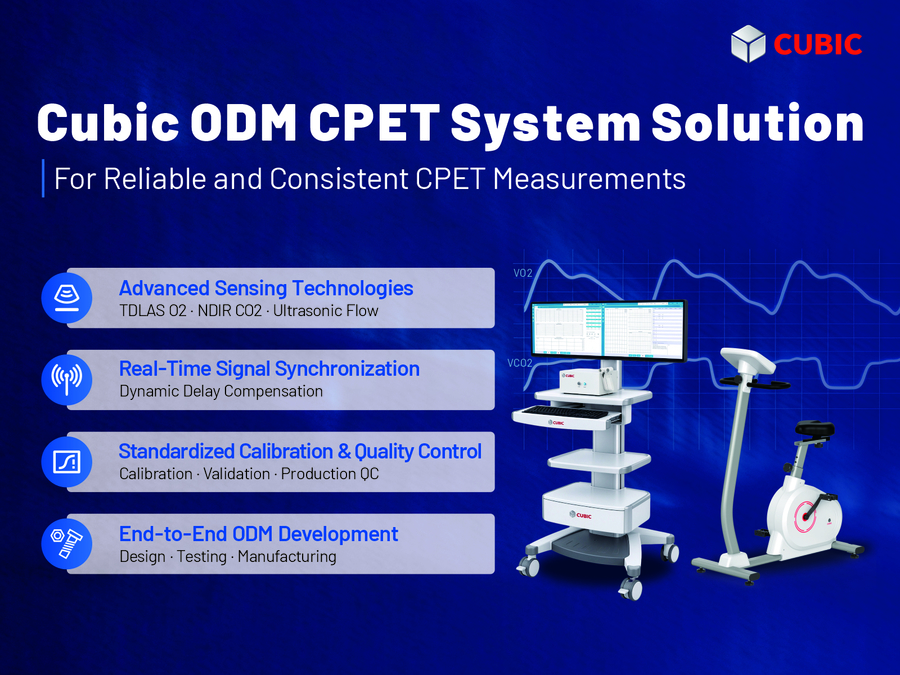
Cubic integrates TDLAS-based oxygen sensing, NDIR-based CO₂ measurement, and ultrasonic flow sensing technologies into CPET core modules. The TDLAS oxygen sensor provides a wide measurement range of 0–100% O₂ and a fast response time of ≤170 ms at a flow rate of 150ml/min., enabling reliable oxygen tracking for VO₂ analysis. The NDIR CO₂ sensor provides rapid and stable carbon dioxide measurement to support VCO₂ and RER calculation. Meanwhile, ultrasonic flow sensing with 0.1 mL/s resolution ensures accurate respiratory flow measurement during Breath-by-Breath analysis.
• Real-Time Control for Accurate Breath-by-Breath Analysis
To overcome the data latency, Cubic has developed a proprietary real-time PCB processing platform integrated with dynamic compensation algorithms. Through high-speed data acquisition and unified timestamp management, the system synchronizes respiratory flow, O₂, and CO₂ signals in real time. It continuously monitors sampling conditions, sensor response, and gas circuit status while dynamically compensating for signal delays based on gas transport time and analyzer response characteristics. This ensures that gas concentration data are accurately aligned with the corresponding respiratory flow of each breathing cycle.
Once signal synchronization is completed, the compensated flow and gas concentration data are used to calculate VO₂, VCO₂, RER, and other metabolic parameters, providing a reliable basis for advanced analyses such as anaerobic threshold (AT). By integrating real-time control with dynamic delay compensation, Cubic minimizes calculation errors caused by sampling delays and variations in sensor response time, improving the accuracy and repeatability of Breath-by-Breath parameter calculation. This provides a more reliable data foundation for longitudinal follow-up, treatment evaluation, and precision cardiopulmonary care.
• Standardized Quality Assurance for Reliable CPET Measurements
At the measurement level, Cubic maintains the accuracy of core sensing modules through automated O₂ zero and span calibration, CO₂ calibration, and flow volume calibration. These procedures ensure that each sensing component operates within defined performance specifications and minimizes measurement deviations caused by sensor drift or environmental variations.
At the system level, Cubic verifies the integrity of the complete measurement pathway through ambient condition compensation, gas circuit leak detection, and signal synchronization verification. By continuously monitoring the interaction between sensing modules, gas pathways, and signal processing, the system ensures reliable measurement performance under different operating conditions.
Through the integration of automated calibration routines and real-time system verification, Cubic improves measurement repeatability and consistency across repeated tests and different clinical environments. This standardized quality assurance approach provides a reliable foundation for longitudinal patient follow-up, treatment evaluation, and precision cardiopulmonary care.
Why Cubic
Backed by more than two decades of expertise in gas sensing technologies, Cubic has developed proprietary sensing platforms covering NDIR, TDLAS, and ultrasonic measurement technologies. Based on these self-developed technologies, products including the Gasboard-2510 laser oxygen sensor, MED-CD1001 CO₂ sensor, and ultrasonic flow sensor have been widely applied in medical and healthcare applications, delivering high measurement accuracy, long-term stability, and reliable performance.
With vertically integrated R&D and manufacturing capabilities, Cubic independently develops and manufactures core sensors and key components, supported by strict quality management throughout optical assembly, sensor calibration, electronic integration, and production verification. This ensures consistent product quality, full traceability, and reliable supply from development to mass production.
Beyond sensing technologies, Cubic provides comprehensive OEM and ODM solutions throughout the entire CPET product development lifecycle. From hardware architecture and structural design to software development and system integration, Cubic supports customers in transforming product concepts into complete CPET solutions tailored to specific application requirements.
Cubic also provides prototype development, verification testing, and mold development capabilities to support smooth transition from initial design to mass production. Combined with integrated supply chain management and scalable manufacturing capacity, Cubic helps partners shorten development cycles, ensure reliable product quality, and build sustainable CPET product platforms.
References:
1.ERS technical standard on reference values for cardiopulmonary exercise testing: summary report and a call for action https://publications.ersnet.org/content/erj/67/6/2502463