#Product Trends
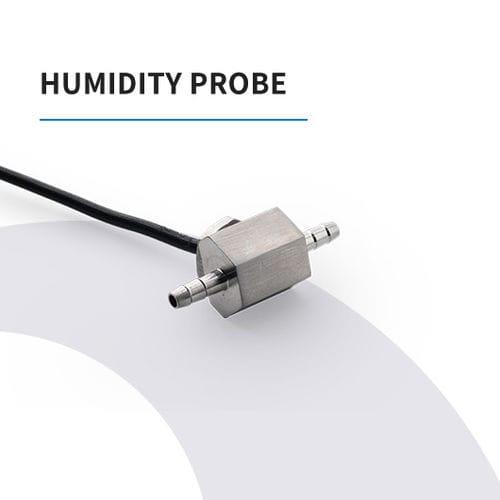
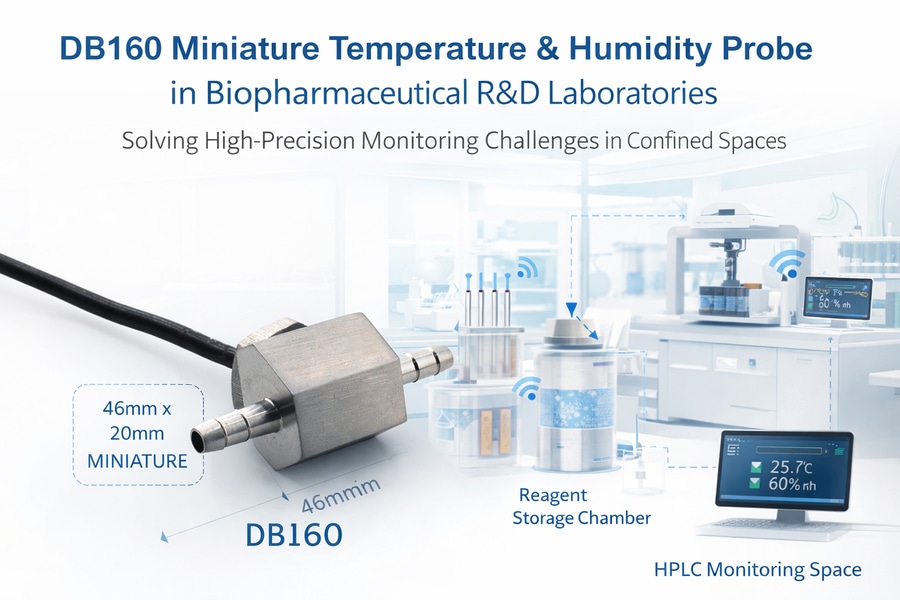
DB160 Miniature Temperature & Humidity Probe
Applied in Biopharmaceutical R&D Laboratories
A biopharmaceutical R&D center faced critical environmental monitoring issues in ultra-compact laboratory spaces.
Key Challenges
Severe space limitation
Enzymatic racks had only 8 cm gaps and reagent chambers 15 cm in diameter. Conventional probes could not be installed internally, and external measurement caused deviations of up to ±1°C and ±8% RH, affecting experimental accuracy.
Slow response to thermal changes
HPLC systems generated rapid temperature spikes (+2°C within 30 seconds), but existing sensors reacted too slowly, leading to chromatography column damage and batch losses up to RMB 30,000.
System integration issues
Analog sensors required external converters for digital systems. In 2023, converter failures caused 12 hours of monitoring downtime.
Solution: DB160 Miniature Temperature & Humidity Probe
The DB160 was deployed to enable high-precision, real-time environmental monitoring in confined laboratory environments.
Key advantages include:
Ultra-compact size (46 mm × 20 mm), enabling installation in extremely narrow spaces
High accuracy of ±0.2°C and ±2% RH, ensuring stable control of sensitive enzymatic reactions
Fast response within 10 seconds, allowing immediate detection of HPLC thermal fluctuations
Native digital I2C interface, enabling direct system integration without converters
304 stainless steel housing with low power consumption, suitable for sterile lab environments
Deployment
The system was deployed across three core areas:
Enzymatic reaction zones: embedded inside rack gaps for direct reaction monitoring
Reagent storage chambers: top-mounted, battery-powered to maintain airtight conditions
HPLC area: real-time thermal monitoring via I2C integration
Performance Results (Dec 2024 – May 2025)
After implementation, the laboratory achieved significant improvements:
Monitoring accuracy improved to ±0.15°C and ±1.8% RH
Zero failures related to temperature/humidity control, preventing estimated RMB 150,000 losses
Maintenance frequency reduced from monthly to once every 6 months, cutting labor costs by 60%
R&D success rate increased from 88% to 98%, accelerating project progress by ~15%
Core Value
The DB160 enables “miniaturization + precision + fast response + direct digital integration” in laboratory environments:
Space breakthrough: fits ultra-confined experimental setups
Risk prevention: 10-second response prevents equipment and sample damage
Cost efficiency: eliminates converter hardware and reduces maintenance workload
Today, the DB160 has become a standard configuration in new gene-editing laboratories and is widely used in cell incubators, microfluidic systems, and other ultra-compact research environments.