#Industry News
Handheld vs Portable vs Fixed Clamp-on Ultrasonic Flow Meter: How to Choose
Handheld vs Portable vs Fixed Clamp-on Ultrasonic Flow Meter: How to Choose
Choose the instrument around the measurement task
A clamp-on ultrasonic flow meter measures from outside the pipe, so it can be installed without cutting the line or placing a sensor in the liquid. That advantage does not make every clamp-on meter interchangeable. A technician checking ten pipes during an energy survey needs a different instrument from a plant that must send continuous flow data to a control system. The correct choice starts with the operating role, then confirms that the pipe, liquid, installation point, outputs, and verification plan support that role.
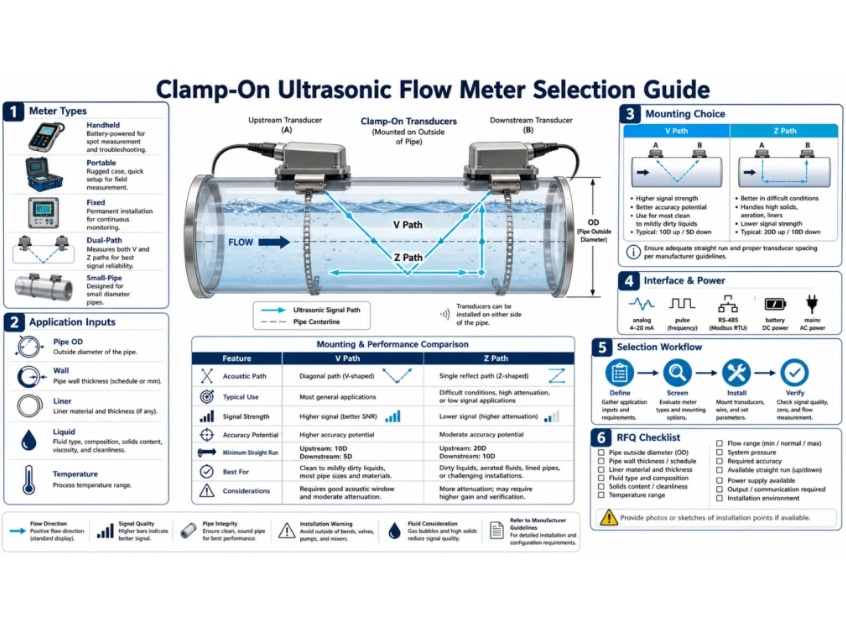
This guide compares handheld, portable, fixed, dual-path, and small-pipe configurations. It does not assign a universal accuracy to clamp-on measurement. Actual performance depends on the complete measurement chain: entered pipe dimensions, wall and liner properties, liquid acoustics, transducer selection and spacing, coupling, flow profile, signal quality, and site verification. ISO 12242:2012 describes ultrasonic transit-time meters for liquid in closed conduits and is a useful reference for the measurement principles and terminology, but a product still has to be evaluated against the requirements of the project.
What a transit-time clamp-on meter measures
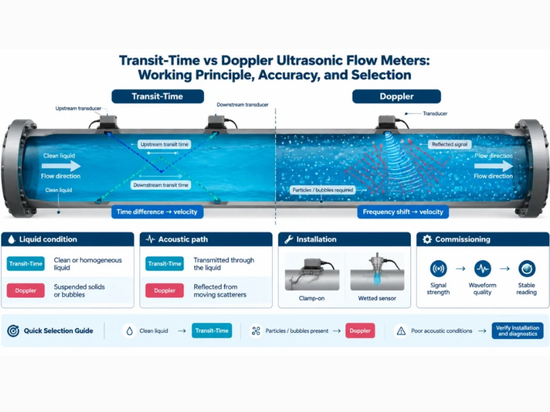
A typical clamp-on transit-time system uses two transducers on the pipe wall. The instrument compares the travel time of acoustic pulses sent with and against the flow. The time difference is related to the axial velocity component along the acoustic path. The meter then combines the calculated velocity with the configured pipe geometry to report volumetric flow.
The instrument therefore needs more than the nominal pipe size. Outside diameter, wall thickness, liner thickness and material, pipe material, liquid type, and transducer arrangement affect the calculated path. A wrong wall thickness can produce a plausible signal while shifting the spacing or flow result. Before selecting a meter, confirm that these inputs are known or can be measured at the site.