#Product Trends
Ultrasonic Sludge Interface Detection: Echoes, Mounting and Field Validation
Ultrasonic Sludge Interface Detection: Echoes, Mounting and Field Validation
Define which sludge boundary the process needs
In a settling tank, “sludge level” may refer to the upper edge of a dense blanket, a transition zone or a suspended-solids cloud that the operator wants to keep away from an outlet. These are not always the same surface. Before choosing an ultrasonic transducer or an echo threshold, define the operational boundary and how it will be checked independently.
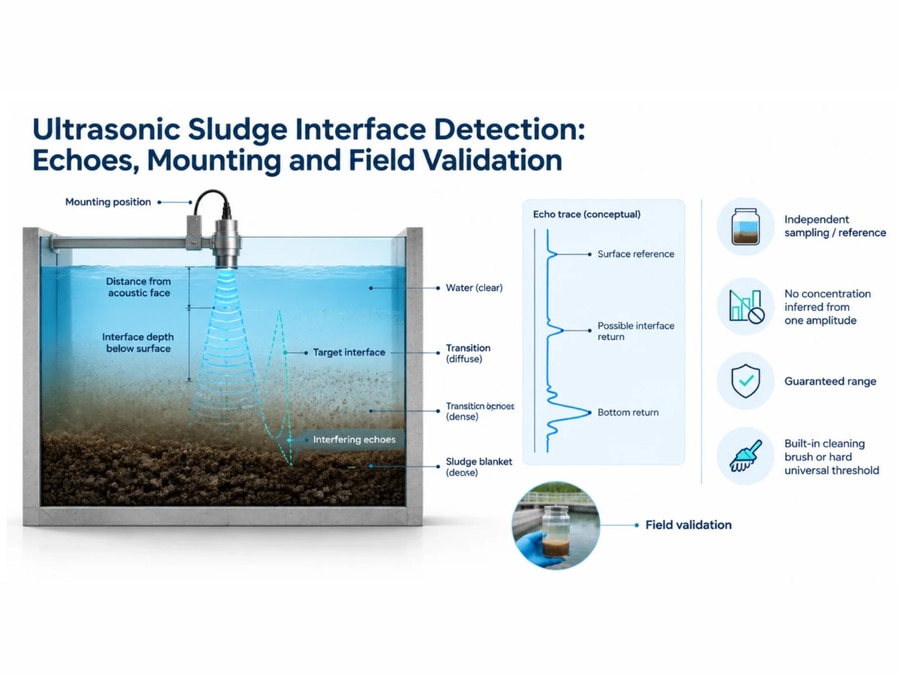
Unlike a rigid plate in a water tank, a sludge–water interface can be diffuse, mobile and uneven. Concentration can change gradually with depth, and several regions can scatter sound. The largest echo is therefore not automatically the desired interface. A useful measurement system must distinguish a process-relevant return from reflections associated with the bottom, structures, bubbles or moving equipment.
Distance, interface depth and blanket thickness are different values
A submerged ultrasonic element sends sound toward the separation zone and receives scattered or reflected energy. For a useful return with corrected round-trip time t and appropriate effective sound speed c, the basic distance model is d ≈ ct / 2. Electronics delay and the acoustic origin need to be accounted for. This equation converts time to distance; it does not decide which echo represents the sludge boundary.
For a vertical measurement, interface depth below the water surface includes the transducer’s immersion depth. As an illustrative example, a face 0.5 m below the surface and an interface 3 m below that face give an interface depth of 3.5 m. If local water depth is 5 m, the corresponding local blanket thickness is 1.5 m. These are explanatory numbers, not BBUA-M specifications. A slant distance cannot be used as vertical depth without the appropriate geometry.
State the reference origin in drawings, displays and validation records. A changing water level can change the relation between immersion, measured distance and depth below the surface. A local thickness is also not the volume or mass of sludge across an entire basin. Those conclusions need additional spatial and process information.