#Product Trends
Ultrasonic Heat Meter Working Principle and Selection: Flow, Delta T, and Energy Calculation
Ultrasonic Heat Meter Working Principle and Selection: Flow, Delta T, and Energy Calculation
A heat meter is three measurements plus a calculation
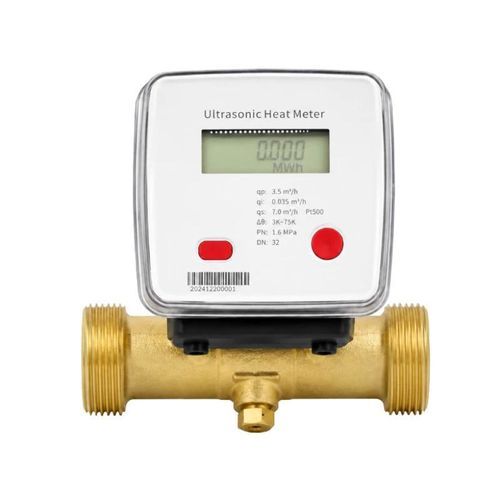
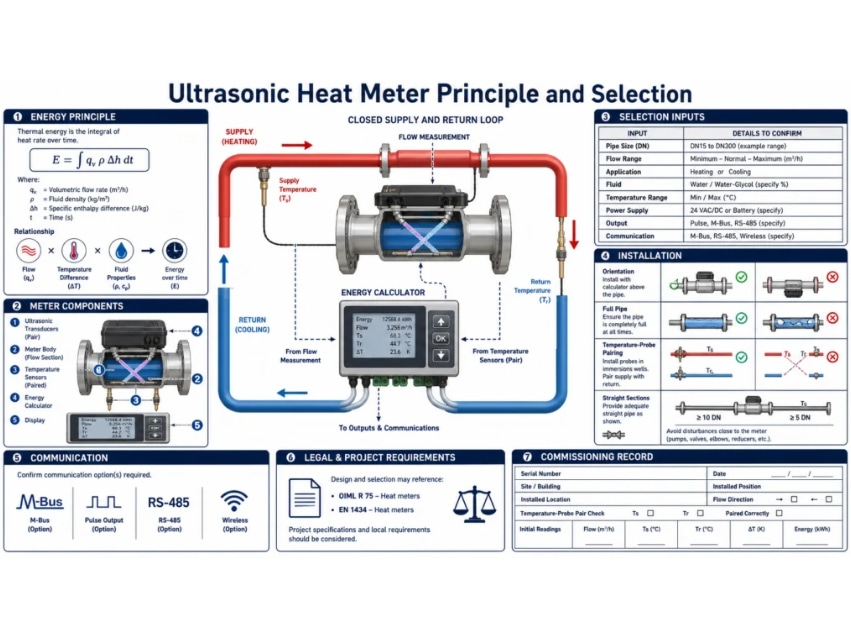
An ultrasonic heating or cooling energy meter does not measure thermal energy with one sensor. It combines fluid flow, supply temperature, return temperature, and the thermophysical properties of the circulating fluid, then integrates the result over time. The flow channel can be accurate while the reported energy is wrong because the temperature sensors are reversed, poorly inserted, not matched, time-misaligned, or configured for the wrong fluid.
Selection must therefore treat the flow sensor, temperature-sensor pair, calculator, installation, communication, and regulatory purpose as one measuring system. A device for operational energy balancing is not automatically suitable for tenant billing or legal metrology. Confirm the applicable national rules, approved meter configuration, installation requirements, sealing, verification period, and data handling before procurement.
How thermal energy is calculated
A simplified instantaneous thermal-power relationship is:
thermal power ≈ volume flow × density × specific heat capacity × temperature difference
The meter integrates power over time to obtain energy. A complete calculator may use an enthalpy-difference formulation or tabulated properties as functions of temperature and fluid composition rather than constant density and heat capacity. The selected algorithm and fluid must match the system. Water, water-glycol mixtures, and other heat-transfer fluids cannot be treated as identical.
For heating, supply temperature is normally above return temperature; for cooling, the sign and channel naming may reverse according to the installation and calculator convention. Define whether energy is accumulated separately for heating and cooling, netted, or assigned by operating mode. A swapped pair can create negative values or put energy into the wrong register.