#Industry News
IEPE Accelerometer Selection: Sensitivity, Axis, Mounting and Frequency Range
IEPE Accelerometer Selection: Sensitivity, Axis, Mounting and Frequency Range
Define the vibration event before choosing sensitivity
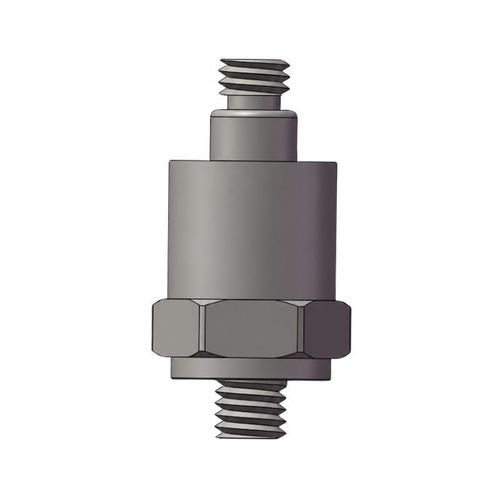
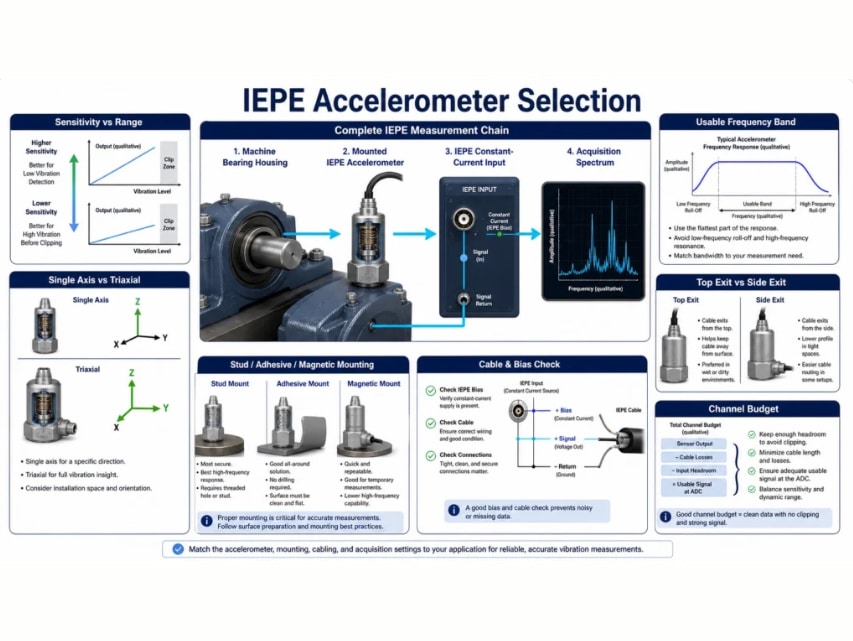
An IEPE accelerometer combines a piezoelectric sensing element with integral electronics and normally operates from a compatible constant-current input. It is well suited to dynamic vibration and shock measurements, but it does not measure true static acceleration. Selection begins with the vibration event: expected amplitude, lowest and highest useful frequency, axis directions, machine surface, temperature, cable route and data-acquisition input.
Sensitivity is only one part of this measurement budget. A high-sensitivity sensor produces more output for weak vibration but usually leaves less headroom for large acceleration. A low-sensitivity sensor can accommodate stronger events but places more demand on the noise performance of the cable and acquisition system. The usable combination must avoid overload at the top end and maintain adequate signal-to-noise at the bottom end.
Understand the complete IEPE measurement chain
The mechanical input passes through the mounting interface and sensor base to the piezoelectric element. Integral electronics convert the high-impedance charge signal into a lower-impedance voltage signal carried on the same two-wire connection as the constant-current supply. The acquisition channel removes the DC bias and digitizes the dynamic component.
Compatibility therefore includes more than connector shape. Confirm constant-current level, compliance voltage, bias range, AC coupling, cable capacitance, input range, sampling rate, anti-alias filtering and grounding. A sensor can be mechanically appropriate yet clip because the channel lacks voltage headroom, or appear noisy because the selected range is far above the useful signal.